
 Newsletter
Starlink gears up for India debut, Global aviation collaboration, and $45B space ambition.
🗓 Morning, folks! ☀️
Markets had a rough Monday as selling pressure picked up and risk appetite vanished.
Both benchmarks closed at the day’s lows, while mid- and small-caps took the bigger hit, marking their steepest single-day fall in four months.
The damage was led by sharp drops in Bharat Dynamics, FACT, Godrej Properties, and HUDCO, all slipping 5-6%. The biggest shock came from InterGlobe Aviation (IndiGo), which tumbled 9%, its worst fall in four years, after operational disruptions spooked investors.
💡 Spotlight: Starlink finally puts a price on India 🚀
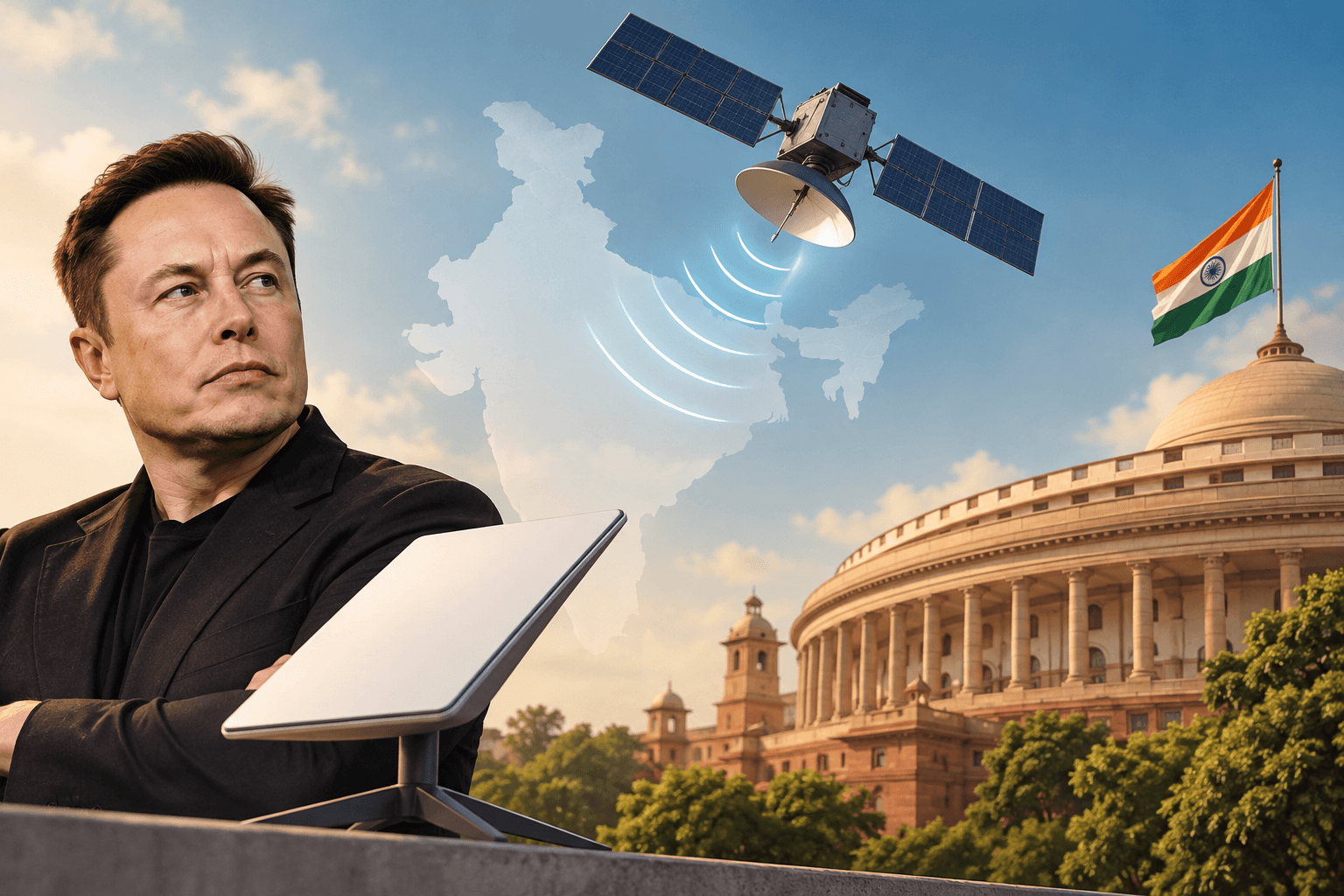
SpaceX’s Starlink is gearing up for its India debut, revealing official subscription prices after securing a five-year regulatory permit.
The residential plan will cost ₹8,600 per month, and the hardware kit which includes dish, router, cables and all comes in at ₹34,000, along with unlimited bandwidth and a 30-day trial.
The pitch is 99.9% uptime, “weather-resilient” connectivity, and plug-and-play internet aimed especially at rural India, where broadband gaps still exist.
The pricing is notably higher than earlier estimates, which pegged the monthly bill at ₹3,000-₹4,200, but Starlink is betting that reliable, anywhere-in-India internet will win users anyway.
Let’s hit it!
1 Big Thing: Cyient & US-based Navitas team up to power India’s chip future ⚡
Cyient Semiconductors and US-based Navitas Semiconductor have signed a long-term partnership to speed up India’s adoption of Gallium Nitride (GaN) power tech.
Gallium Nitride (GaN) power tech is a new kind of chip material that makes electronics faster, smaller, and much more energy-efficient than regular silicon.
What’s going on: Navitas, a Nasdaq-listed leader in GaN and SiC chips, brings cutting-edge tech, while Cyient Semiconductors adds its growing strength in custom power solutions and chip design.
Together, they plan to build an end-to-end GaN design and manufacturing ecosystem in the country.
Why it matters: India currently relies heavily on imported power semiconductors. Localising GaN production means lower costs, faster R&D cycles, and fewer supply-chain bottlenecks for Indian OEMs.
Big theme: right now, India does not make GaN power chips at scale. Most GaN devices like fast chargers or power modules are imported from the US, Europe, or Taiwan.
Only a few Indian players (IIT spin-offs, small fabs, R&D labs) are experimenting with GaN prototypes, but mass production is zero.
It is because GaN manufacturing needs special fabs, super-clean environments, and expensive tools India doesn’t yet have. Also, global GaN players hold most of the patents and expertise.
2. Dynamatic & Dassault deepen jet manufacturing partnership ✈️
Dynamatic Technologies has signed a major new deal with Dassault Aviation for manufacturing of its newest business jet. The stock gained more than 7% reacting to the update.
It’s a civilian & commercial business jet, mainly used for private, corporate, and VIP travel.
What’s going on: Dynamatic will now manufacture one of the jet’s most complex and high-precision sections.
The company will build the entire back section of the jet, which is the part that holds critical systems, supports the tail, and keeps the aircraft stable in flight.
Big theme: for years, India mostly built small parts or assembled aircraft under foreign licences. But that’s changing with companies like HAL, Tata Aerospace, Dynamatic, and Mahindra Aerospace now taking on bigger, more complex sections of global aircraft programs.
India already makes major structures for planes like the Airbus A320, Boeing 787, Sikorsky helicopters, and now high-end business jets like the Falcon 6X.
The push comes from cheaper skilled labour, rising engineering talent, and global players wanting reliable manufacturing outside traditional hubs.
While we are on deals,
Biocon will be on the radar after it announced a plan to make Biocon Biologics a fully owned subsidiary. To do this, it will issue new shares to Biologics’ minority shareholders at ₹405.6 per share, a small premium to Friday’s close.
Right now, Mylan owns 6.09% of Biocon Biologics. With Biocon now deciding to make Biocon Biologics a 100% subsidiary, it must buy out Mylan’s entire stake. The company will need $400 million (₹3,598 crore) for this.
To fund all this, the board has cleared a ₹4,500 crore QIP, which will also push promoter holding below 50%.
3. JSW Infrastructure goes shopping 🛍️
JSW Infrastructure is expanding into rail freight by buying three group companies that run and manage goods trains, for ₹1,212 crore.
What’s happening: its wholly owned arm, JSW Port Logistics, has signed a Share Purchase Agreement to acquire 100% stake in JSW Rail Infra Logistics, JSW Minerals Rail Logistics, and JSW (South) Rail Logistics.
Quick refresher: JSW Port Logistics is the part of the group that helps goods move end to end across India, from ports and coastal shipping to warehouses, freight forwarding, and last-mile delivery.
Once the deal is done, these three firms will sit under JSW Infrastructure as step-down wholly owned subsidiaries, meaning they’ll be owned through another group company, not directly.
The why: this buy gives JSW Infrastructure a faster entry into key Indian Railways freight programmes like Indian Railways’ General Purpose Wagon Investment Scheme (GPWIS) and the Liberalised Special Freight Train Operator (LSFTO) scheme.
4. Stocks that kept us interested 🚀
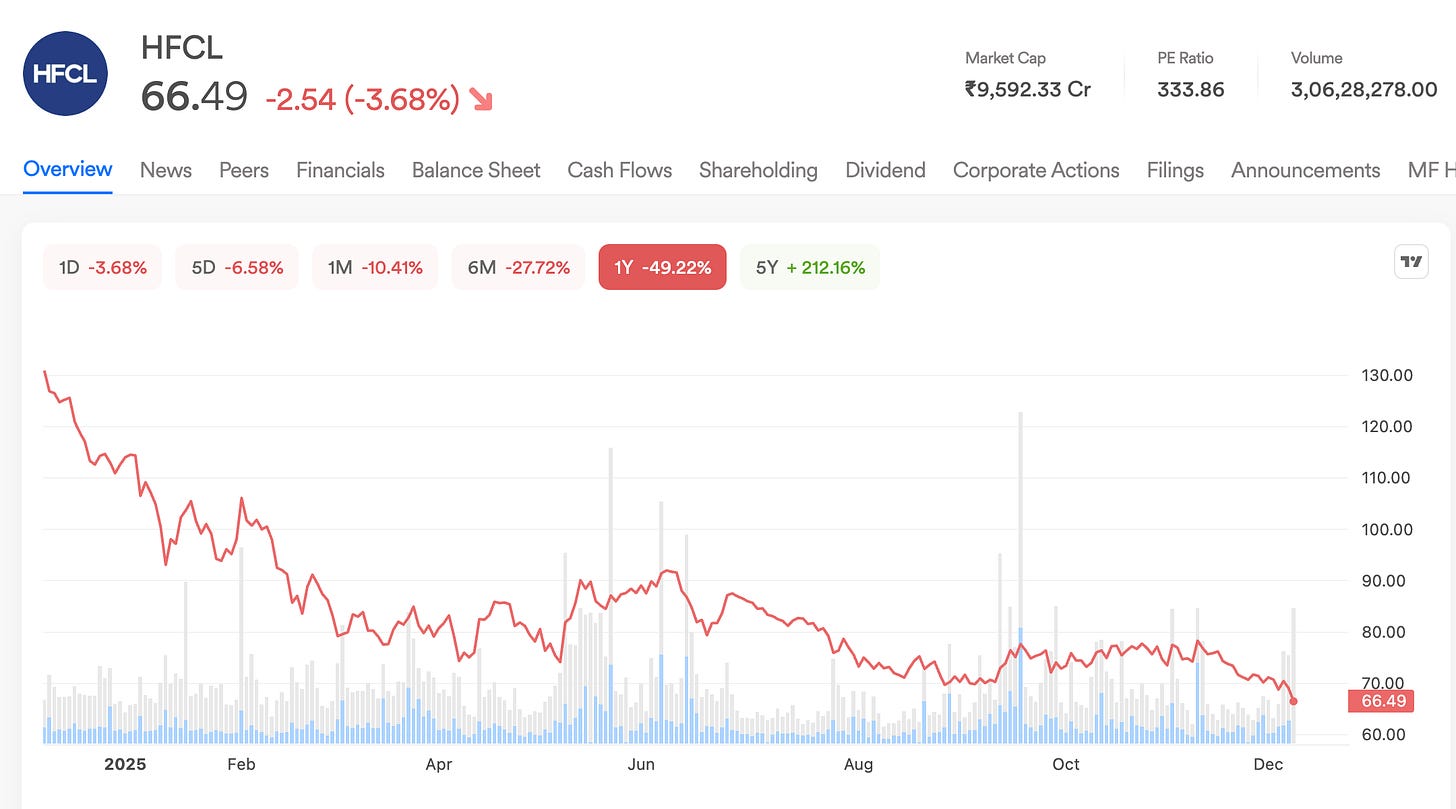
1. HFCL lands ₹656 crore export order 🚢
HFCL secured export orders worth ₹656 crore for the supply of optical fibre cables.
HFCL makes telecom equipment, optical fibre and cables, and also provides digital network solutions for telcos and governments.
What’s the deal: the company will supply the cables through its overseas subsidiary. The order is from an international customer and is expected to be executed by November 2026.
The why: this comes as global demand for fibre keeps rising. More people are getting online, broadband is expanding, and 5G rollouts need high-capacity fibre to carry heavy data traffic with low latency.
A report by Persistent Market Research also estimates that the global fibre optics market could grow from $7.7B in 2025 to $15.8B by 2032, at a 10.7% annual growth rate.
2. SPML shares surge on new Rajasthan water project win 💸
SPML Infra and its joint venture partner Shri Hari Infraprojects have bagged a ₹207 crore project from Rajasthan’s Public Health Engineering Department (PHED) in Jhalawar.
What’s happening: the order includes construction of 3 wells, 3 water treatment plants that together can clean 118 million litres of water a day.
It also includes storage tanks that can hold 16.1 million litres of clean water and about 53 km of large water pipelines to carry the water.
For context, 118 million litres of water can sustain 2 lakh households or a mid-sized city per day.
Big picture: the contract falls under the Nonera Water Supply Project, which is designed to improve water infrastructure across the Kota and Bundi regions of Rajasthan.
The state faces acute water scarcity, with per-capita availability expected to fall to just 450 cubic meters by 2050. Initiatives like this are crucial in reducing that risk and supporting PHED’s goal of ensuring 100% access to safe drinking water by 2047.

What else are we snackin’ 🍿
✈️ More airlines: Aviation Minister Ram Mohan Naidu says India needs five major airlines and the government is actively encouraging more players to enter the skies.
📈 New money habits: Young Indians are pulling their parents into the markets, pushing MF participation toward 20% of households, says Groww.
That’s a wrap! Don’t let the weekday blues get to you.
And if you’d like to place your brand on this newsletter, let us know.
Hit that 💚 if you liked this issue.