
 Newsletter
RIL's Golden Decade, Auto acquisition, and BYD beats Tesla.
🗓 Morning, folks!
💡 Spotlight: Reliance Industries wrapped its 48th AGM with big-bang announcements.
Chairman Mukesh Ambani confirmed Jio’s IPO by H1 2026 and launched Reliance Intelligence, a new AI subsidiary to build green-powered data centres and scale AI services nationwide. He also revealed partnerships with Google to expand AI tools for startups and with Meta in a $100 million joint AI investment (Meta 30%, Reliance 70%).
Reliance Retail Ventures Ltd Executive Director Isha Ambani projected 20%+ CAGR growth for Reliance Retail and global ambitions for Reliance Consumer Products.
Reliance also laid out giga-scale clean energy bets across solar, hydrogen, and bioenergy, reiterating the Net Carbon Zero 2035 goal.
Reliance is stacking bets across every growth theme India cares about. If Ambani’s “Golden Decade” promise holds, the next few years could redefine what the country’s biggest conglomerate looks like.
Let’s hit it!
1 Big Thing: India posts fastest growth in five quarters at 7.8% 📈
India’s economy grew 7.8% in the June quarter (Q1FY26), the fastest in five quarters, beating economists’ estimates and dimming hopes of an RBI rate cut in October.
The deets: GDP growth accelerated to 7.8% from 7.4% in the March quarter and 6.5% a year earlier. Gross Value Added (GVA) also rose 7.6%, helped by stronger-than-expected expansion in manufacturing and services, though agriculture and mining lagged.
Gross Value Added (GVA) is simply the measure of how much value the economy actually creates after subtracting the costs of raw materials and inputs.
Economists say the upside surprise makes it harder for the RBI to justify cutting interest rates at its upcoming policy review.
The growth story: services led the surge, expanding 9.3%, the fastest in two years.
Government services hit a 12-quarter high of 9.8%, while financial services (8.6%) and trade, hotels, transport and communication (9.5%) also posted their best growth in two years. Services now account for 53% of India’s GDP.
Manufacturing stayed strong, growing 7.7%, close to last year’s high base. But construction slowed to 7.6%, down from over 10% in recent quarters. Mining shrank 3.1%, its weakest performance in nearly three years, while electricity output grew just 0.5%, the slowest in 19 quarters as early monsoons hit demand.
Big picture: economists expect India to maintain around 6.5% growth for FY26, even if US tariffs shave 0.2–0.4 percentage points off.
Big picture: economists see India holding near 6.5% growth for FY26, even if US tariffs shave 0.2–0.4 points off. Tax relief, solid farm output, and GST reforms should keep consumption steady, though big-ticket spending may wait for festive discounts.
With S&P upgrading India to BBB and projecting 6.5% growth, the country looks set to keep its crown as one of the fastest-growing major economies.
2. Acquisition spree powers up Samvardhana Motherson 🔥
Samvardhana Motherson acquired an 81% stake in Japan’s Yutaka Giken Co. Riding on the back of this, the stock revved up nearly 1%.
Yutaka Giken is engaged in the production of metal components and assemblies such as rotors and stator assemblies for motors, drive systems, brake systems, and thermal management systems.
What’s happening: company’s board also approved an 11% stake in Shinnichi Kogyo Co. Ltd. through its wholly owned arm, Motherson Global Investments BV. The acquisition is valued at $184 million, representing the cash outflow for the 81% stake.
Yutaka Giken, incorporated in Japan and listed on the Tokyo Stock Exchange, holds a 62% stake in Shinnichi Kogyo. Currently, Honda Motor Co. owns 69.66% of Yutaka Giken, while the remainder is held by public shareholders.
The why: Samvardhana Motherson said the transaction will deepen its partnership with Honda and expand its business with Japanese OEMs. It also opens opportunities for cross-sell Yutaka Giken’s product portfolio to other automakers, particularly in emerging markets.
Not stopping there: on the same day, the board also cleared the acquisition of an additional 20% in Youngshin Motherson Auto Tech Limited from Korea’s Youngshin Components. With this, the JV will become a wholly owned subsidiary, strengthening Motherson’s global footprint.

While we are on deals,
National Aluminium Company (NALCO) is turning up the heat with a ₹30,000 crore plan to build a new aluminium smelter and a coal-based power plant over the next five years.
What’s brewing: of the total planned investment, about ₹17,000-18,000 crore has been earmarked for the proposed smelter in Odisha, while around ₹12,000 crore will be used for the coal-based power project. For this, the company is currently in talks with Coal India and NTPC.
What’s next for the company: as part of its growth strategy, Nalco is also looking to acquire new bauxite and coal mines to strengthen raw material security.
With India’s aluminium consumption projected to touch 7.5-8 million tonnes annually by 2030, NALCO is strategically placed to meet this rising demand and strengthen its leadership in the global aluminium space.
On the domestic front, Odisha, Chhattisgarh, Madhya Pradesh, and Uttar Pradesh lead in aluminium production capacity, and together these states form the backbone of India’s aluminium output.
3. Cube Highways gears up for $600m IPO 🛣️
Cube Highways Trust, one of India’s biggest road operators, is planning an IPO that could raise up to $600 million.
Cube is currently a private trust but plans to convert into a public entity through this. In private trades, the trust is valued at around $2 billion.
Why it matters: the company is backed by Abu Dhabi’s ADIA and Mubadala. It clocked ₹3,307 crore in revenue for FY25, up from ₹2,916 crore a year ago. With only five Infrastructure Investment Trust (InvITs) currently listed, IRB, India Grid, Powergrid, Indus Infra, and Capital Infra, Cube’s debut would add another big player to India’s growing infra investment space.
Zoom out: India has 27 registered InvITs, but public listings are still relatively rare. With infra spending a big government theme and investors hungry for steady-yield assets, Cube’s IPO could open the lane for more private trusts to test the public market waters.
4. Netrasemi bags $12.5 million to boost India’s chips crusade 💻
Netrasemi has raised $12.5 million in a Series A round led by Zoho Corporation and with participation from existing investor Unicorn India ventures.
What they do: the Kerala-based startup develops system-on-chips (SOCs) for smart IoT (Internet of Things) products. These chips are capable of handling complex workloads like video processing and providing real-time analytical data.
The deets: this is the company’s second funding followed by a ₹10 crore pre-series A funding raised in December 2024. This takes Netrasemi’s valuation from ₹95 crore to ₹630 crore - a whopping 6.6x jump.
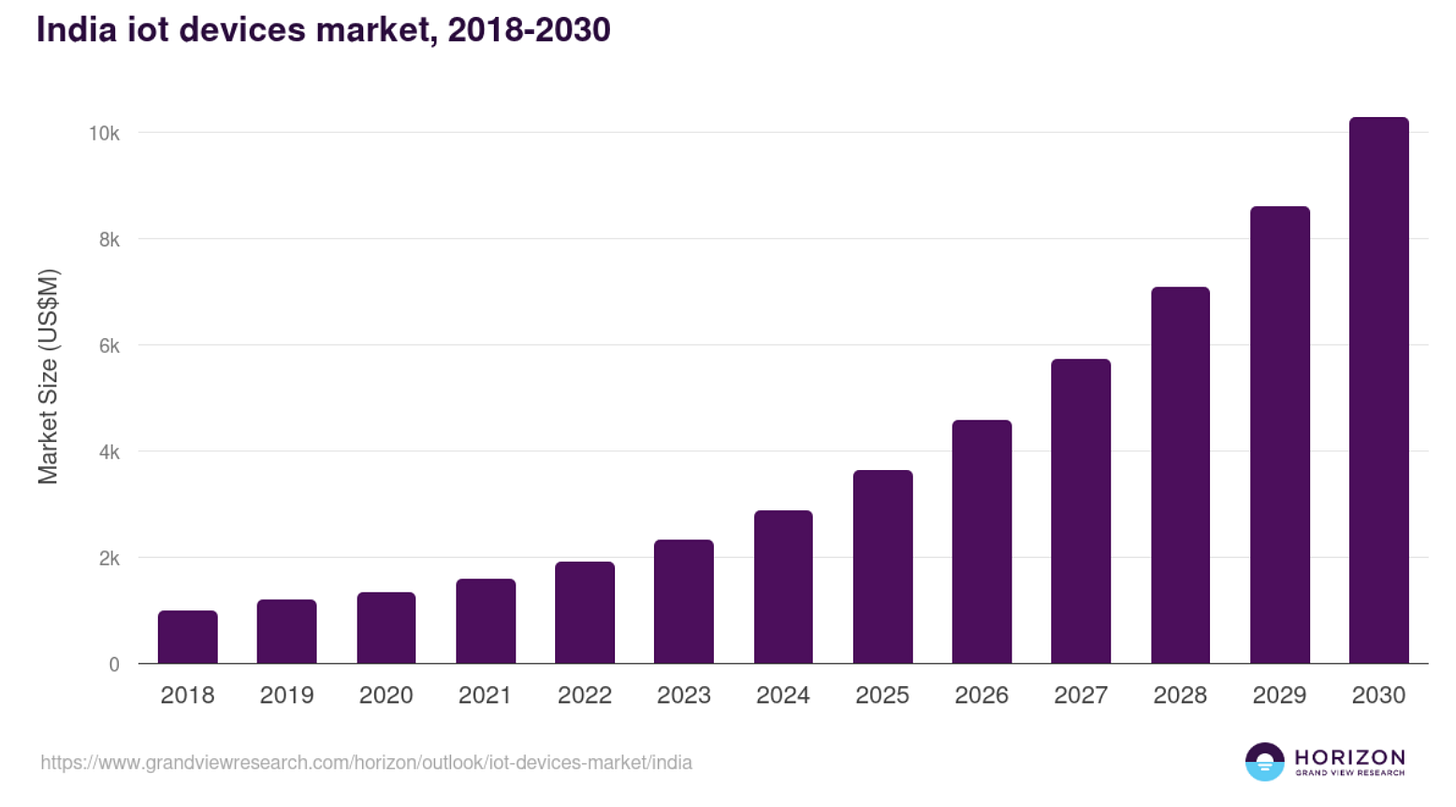
Zoom out: this acquisition comes at a time when India’s IoT devices market is slated to reach $10,726 million by 2030 at a steep CAGR of 23.2%. Netrasemi can embrace its investor backing and unique offering to make the best of this upward trajectory.
5. China’s BYD keeps beating Tesla in Europe 🔋
What’s happening: Tesla’s sales in Europe plunged again in July, marking the seventh straight month it has been outsold by China’s BYD.
The numbers so far:
- Tesla: 8,837 new registrations, a 40.2% year-on-year decrease.
- BYD: 13,503 new registrations, a 225.3% year-on-year increase.
- Market Share: Tesla's market share dropped to 0.8%, while BYD's rose to 1.2%.
Why it matters: Tesla is losing steam because its lineup is aging, the Model 3 and Y haven’t been refreshed in years. Meanwhile, Elon Musk’s controversies and a disappointing Cybertruck launch have dented its image. BYD, on the other hand, has aggressively entered Europe with cheaper models like the Dolphin and Seagull, backed by hybrid options and a fast-growing showroom network.

6. Stocks that kept us interested 🚀
1. Renewable energy push drives ABB India’s ₹173.5 crore win 🌱
ABB India has secured an order worth ₹173.5 crore from Siemens Gamesa Renewable Power in Chennai. The stock ended flat in Friday’s trading session.
The deets: the order is for manufacturing and supplying wind turbine converters. It covers 3.X turbine converters and electrical cabinets on a build-to-print basis, executed from ABB India’s Nelamangala facility.
Why it matters: the order from Siemens Gamesa represents a strategic win for ABB India, potentially offsetting some of the financial challenges observed in recent quarters. The deal also positions the company well within the renewable energy sector, signalling favourable prospects for future growth and stability.
Zoom out: India has set its sights on net-zero emissions by 2070, with interim goals of achieving 500 GW of renewable energy capacity by 2030. India’s renewable capacity has already expanded from 78 GW in FY2014-15 to 199 GW in FY2023-24, with solar contributing 80% of the new additions.

What else are we snackin’ 🍿
🚀 Green signal: Groww has secured SEBI approval for a $1 billion IPO, marking the largest primary market fundraise by an Indian capital market firm.
👔 Leadership shift: Former RBI Governor Urjit Patel has been appointed Executive Director at the IMF for three years, approved by India’s Appointments Committee.
✂️ Job slash: Nike will cut less than 1% of its corporate staff in a turnaround push under CEO Elliott Hill, following 2% cuts last February.
That’s a wrap! Don’t let the weekday blues get to you.
And if you’d like to place your brand on this newsletter, let us know.
Hit that 💚 if you liked this issue.