
 Newsletter
Exporters break a sweat, Trading closes early, and Glam is always good business.

🗓️ Morning, folks! ☀️
Today’s rabbit hole took us 73 light-years from Earth.

An international team has spotted what could be the first moon outside our solar system. That’s wild because we’ve already discovered 6,000+ exoplanets, but never a confirmed moon beyond our own solar system.
Anyway, Earth still has enough drama to keep us occupied. Here’s your business briefing.
A choppy Tuesday for Dalal Street.
The Sensex and Nifty ended in the red, though a late recovery during the Closing Auction Session (CAS) helped trim losses.
Metal and media were the only sectors to buck the trend, while IT, oil & gas, realty, infrastructure, consumer durables and FMCG declined 0.5-2%.
💡 Spotlight: Government’s new fuel security move ⛽
The government has increased the Special Additional Excise Duty (SAED), commonly known as the windfall tax, on exports of petrol, diesel and aviation turbine fuel (ATF).
The revised rates came into effect on August 3 as the government moved to secure domestic fuel supplies amid volatile global oil prices.
A windfall tax is a tax on companies that make unusually high profits because of events like a spike in global oil prices.
The revised rates: petrol export duty has been raised to ₹3.5 per litre from ₹2.5, diesel to ₹24 from ₹15.5, and ATF to ₹22 from ₹14.5 per litre.
What does this mean for consumers: the increase applies only to exports. There has been no change in the excise duty on petrol and diesel sold in the domestic market.
Let’s hit it! 💪🏻
1 Big Thing: Airtel says ‘hello’ to a good Q1 📲
Bharti Airtel reported a solid set of Q1FY27 results, with numbers beating street expectations.
The numbers 📊:
- Net profit: ₹8,167 crore, up 11.5% QoQ (vs ₹7,325 crore)
- Revenue: ₹58,539 crore, up 5.7% QoQ (vs ₹55,383 crore)
- EBITDA: ₹33,599 crore, up 6.7% QoQ (vs ₹31,492 crore)
- EBITDA margin: 57.4% vs 56.9% (QoQ)
- ARPU: ₹264 vs ₹257 (QoQ)
Let’s break it down: one of the key metrics to watch is ARPU (Average Revenue Per User). It shows how much revenue a telecom company earns from each active subscriber and is one of the best indicators of pricing power and customer monetisation.
What drove the growth: revenue crossed the ₹58,500 crore mark for the first time, supported by higher subscriber monetisation and an improvement in ARPU. India revenue grew 4.2% QoQ, while the Africa business delivered 5.7% constant currency growth.
Airtel also added 14.9 million customers during the quarter, taking its total customer base to 681 million across 15 countries.
Executive Vice Chairman Gopal Vittal said the quarter's performance was driven by robust growth across India and Africa, record postpaid customer additions, continued expansion of the homes business, and disciplined capital allocation.
While we are on earnings 💰,
FSN E-Commerce Ventures, the parent company of Nykaa, reported a more than three-fold jump in consolidated net profit for Q1FY27, driven by continued strength in its beauty and personal care business.
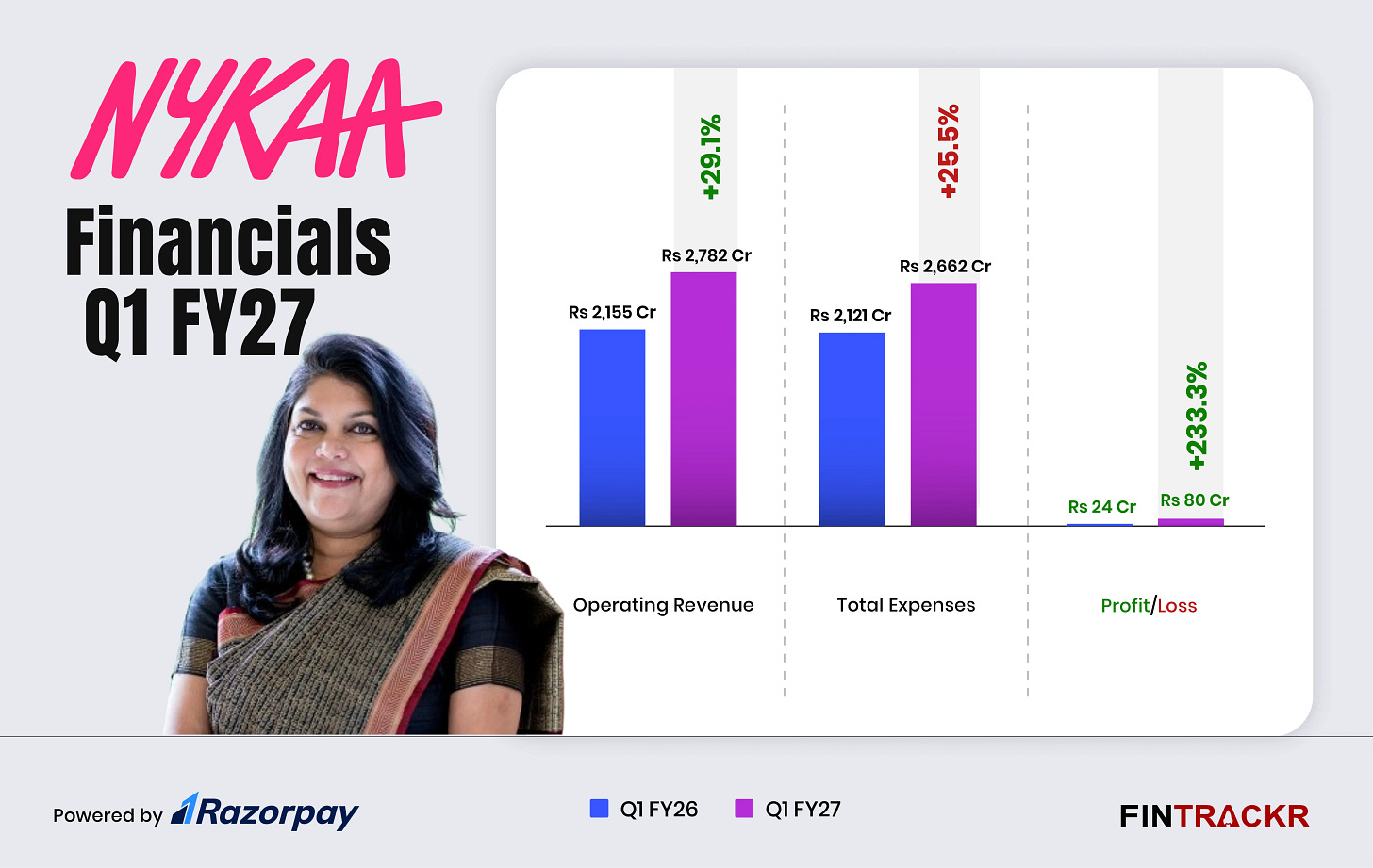
The snapshot: net profit rose to ₹79.8 crore, compared with ₹24.8 crore in the same quarter last year. Revenue from operations increased 29% YoY to ₹2,782 crore.
Expansion mode: Nykaa’s board approved the acquisition of a 51% stake in Aminu Wellness Private Limited for up to ₹32 crore. The deal expands Nykaa's presence in the wellness and personal care segment.
2. Why do brokers want investors out by 3 PM? 🔔
Several brokerages have started advising retail investors to close their trades before 3 PM to avoid unexpected price movements until the market gets used to a new closing system.
Why 3 PM: under SEBI’s new framework, regular trading will continue till 3:15 PM, after which the exchange will spend the next 15 minutes determining the official closing price.
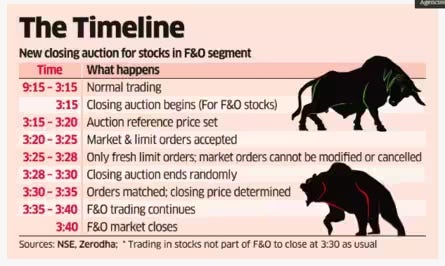
What’s changed: stock exchanges have introduced a Closing Auction Session (CAS). Earlier, the market’s closing price was simply the price of the last trade. Now, the exchange determines one official closing price after matching all buy and sell orders placed in the final few minutes.
Why was it introduced: SEBI says the new system will make the closing price more accurate and harder to manipulate. This matters because the closing price is used to settle futures and options, calculate market indices and value many investment portfolios.
The consequence: on the first day, several stocks closed at prices that were quite different from where they were trading just minutes earlier, catching many traders by surprise. Experts believe this happened because participation in the new auction was still limited.
National Stock Exchange (NSE) said 515 trading members placed orders on behalf of over 56,700 unique investors on the very first day, compared with 403 trading members and about 42,800 investors in the regular pre-open session.

Maybe work-life balance isn’t a myth. You’re just in the wrong industry.
3. If cars could talk… 🚘
On August 3, the Ministry of Road Transport and Highways (MoRTH) proposed rolling out Vehicle-to-Vehicle (V2V) technology in phases.

So, what is V2X: it lets vehicles ‘talk’ to each other and their surroundings in real time. Vehicles can warn each other about sudden braking, blind spots and pedestrians before drivers even spot the danger.
Why it matters: India records the highest number of road accident deaths in the world. The country accounts for nearly 11% of global road fatalities.
The catch: automakers, telecom companies, road authorities and the government will all need to work together. They must build secure software, reliable communication networks and upgraded roadside infrastructure.
If approved, vehicles with V2V systems will need to meet the new V2V safety standard from October 2027, with mandatory fitment starting October 2028.
We also broke down this story in video format, check it out here.
Is this a sign that a Tarzan level car is possible in the foreseeable future?
4. Who really rules Instagram? 👑
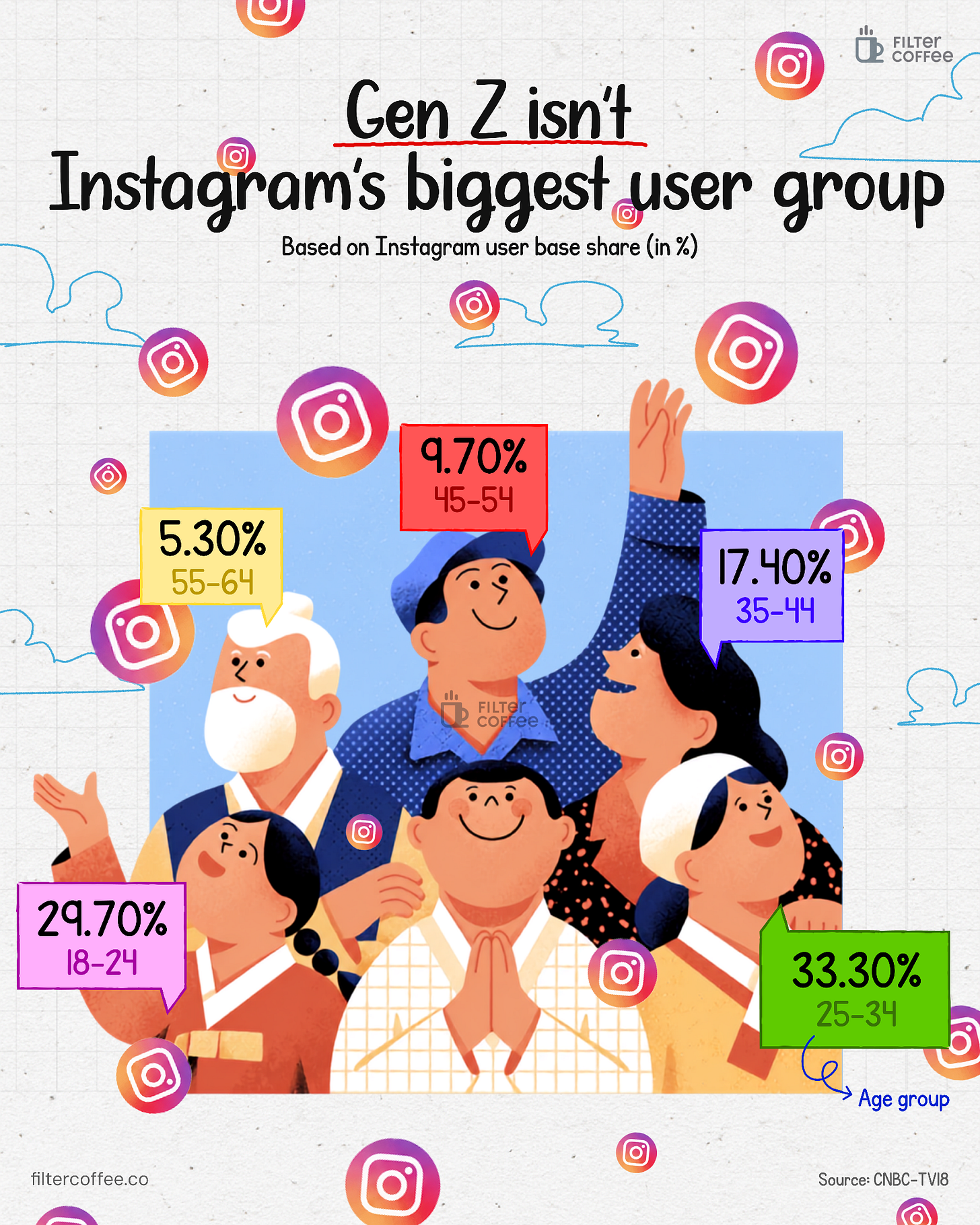
Most people think Gen Z dominates Instagram. Not quite.
While users aged 18-24 make up 29.7% of the platform, the 25-34 age group is actually the largest, accounting for 33.3% of Instagram’s user base.
5. How an AI bet wiped out $35 billion 📉
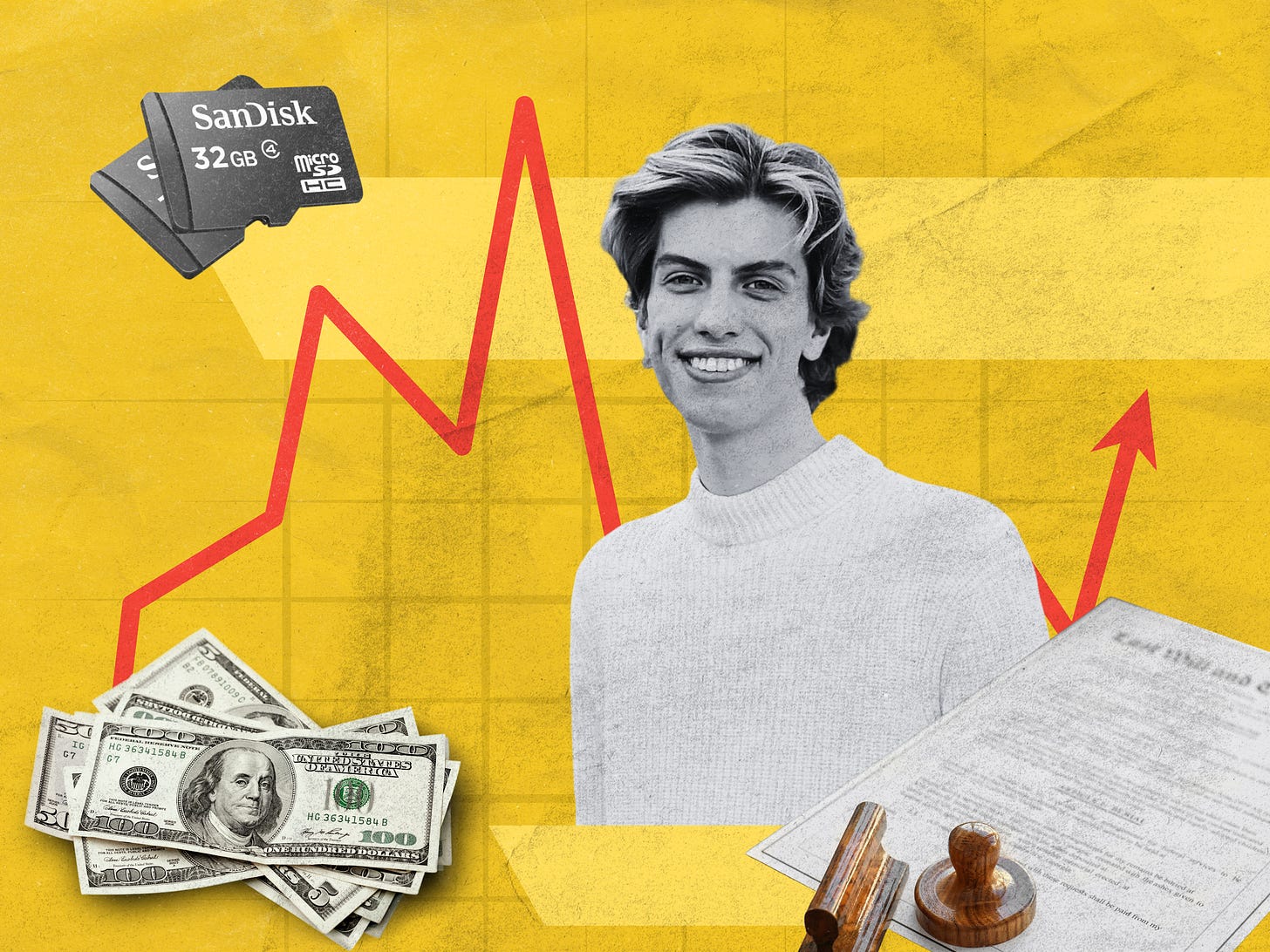
Leopold Aschenbrenner became one of AI’s most influential voices after publishing Situational Awareness, a paper that argued AGI (Artificial General Intelligence) was much closer than most people believed.
That conviction helped him launch one of Wall Street’s fastest-growing AI hedge funds, which briefly managed nearly $45 billion before a sharp market correction exposed the risks behind its strategy.
Here’s how a research paper turned into billions of dollars, and why the market eventually pushed back.
6. Stocks that kept us interested 🚀
What went up ⬆️
🛵 Ather Energy surged nearly 15% as its Q1 consolidated loss narrowed 71% and revenue increased 89%.
⚙️ MTAR Tech hit the 5% upper circuit for the fourth straight session supported by strong Q1 results and optimism around a key US client.
🤝 Godfrey Phillips gained 4% as Samir Modi sought peace with mother Bina Modi in family dispute.
💹 Restaurant Brands Asia jumped 20%, while KEI Industries and Alkyl Amines rose up to 10% after reporting strong Q1 earnings.
What went down ⬇️
📉 Greaves Cotton crashed 15% while DLF fell 4% after weak Q1 results.
🍯 Dabur India fell nearly 4% after FSSAI banned ‘100%’ claims on honey, ghee and coconut water.
What else are we snackin’ 🍿
🛢️ Ultra-mega order: L&T secured an ultra-mega offshore order worth over ₹15,000 crore from ADNOC Offshore to develop and upgrade multiple offshore facilities in West Asia.
📄 Mega OFS: the government is set to launch share sales worth ₹36,000 crore, led by LIC’s ₹31,000 crore offer for sale, with Paytm, Meesho and Arvind also lining up fundraises.
🤖 AI funding: AI startup Sarvam is set to raise $74 million (₹700 crore) in a Series B extension led by NVIDIA, weeks after becoming a unicorn.
That’s a wrap! Don’t let the weekday blues get to you.

And if you’d like to place your brand on this newsletter, let us know.
Hit that 💚 if you liked this issue.