
 Newsletter
Defence bets heat up, Venture town hot, and Sugar stocks get a sugar rush.
🗓 Morning, folks!
Indian markets lost steam on Tuesday, with Nifty and Sensex slipping and erasing Monday’s gains.
The drag came from banking and financial names, while metals and broader markets held firm. Now, all eyes are on the September 3-4 GST Council meeting, where a big tax cut, at least 10 percentage points on nearly 175 products, could be on the table.
💡 Spotlight: Sweet gains for Ethanol
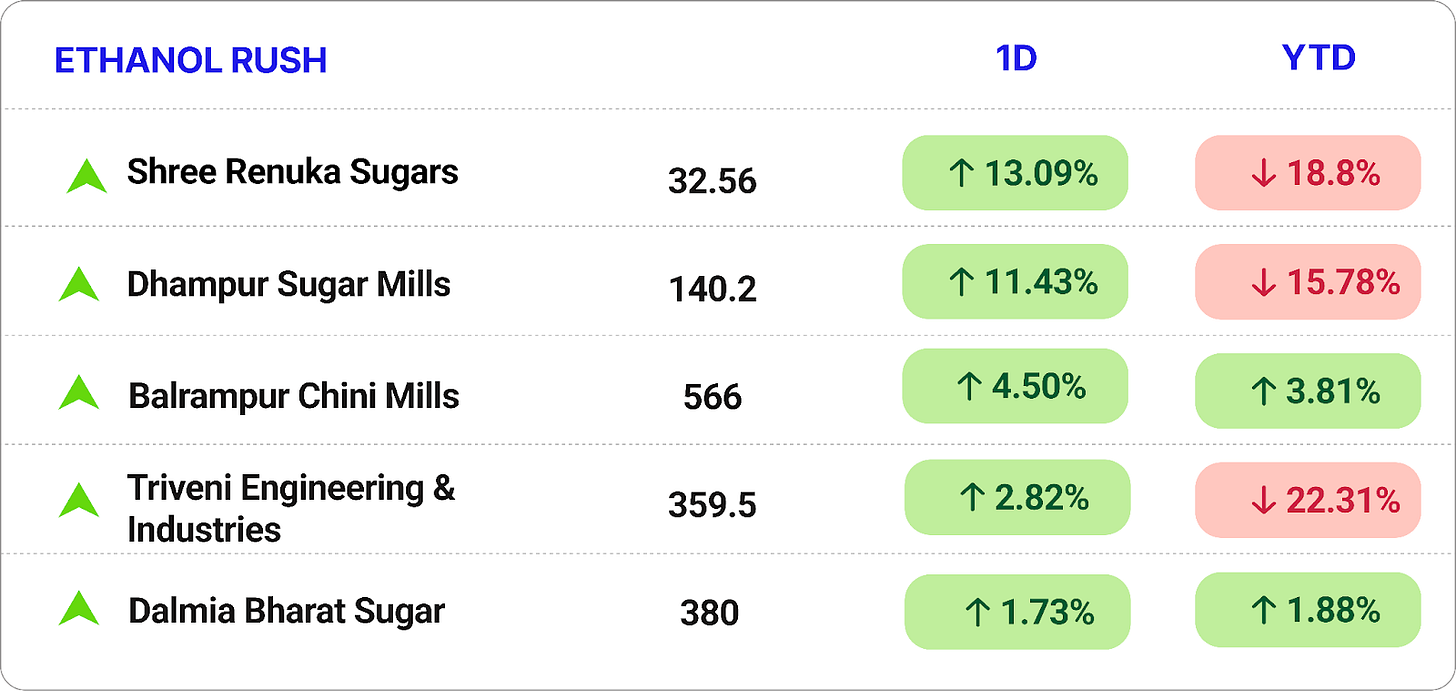
Sugar stocks just got a sugar rush! After the government scrapped all limits on ethanol production from cane juice, syrup, and molasses for 2025-26, names like Shree Renuka Sugars, Bajaj Hindusthan, KM Sugar Mills and other names soared 10-15% in trade.
The move overturns last year’s curbs that were imposed when cane supplies dipped. Now, mills have a free hand to churn out ethanol and put their B-heavy molasses to work. For the sugar industry, this is more than sweet relief, it strengthens a crucial second income stream beyond sugar.
With back-to-back good monsoons promising more cane, this decision sweetens the path toward India’s clean-fuel goal of 20% ethanol blending by 2025 and 30% in the years ahead.
1 Big Thing: 1 Big Thing: India unveils its first made-in-India chip 💻
India got its first chip on Tuesday as IT minister Ashwini Vaishnaw presented the Vikram 32-bit processor to PM Modi at the Semicon India 2025 event in Delhi. The minister also handed over test chips from four sanctioned projects after the PM inaugurated the summit.
The deets: Vikram is India’s first fully indigenous 32-bit microprocessor, developed by ISRO’s Semiconductor Lab. It is designed to withstand harsh launch vehicle conditions, making it apt for space applications. The fabrication and packaging were done at the Semiconductor Hub in Mohali, Punjab.
Why it matters: until now, India has been largely dependent on foreign chips for everything from defence to space to consumer electronics. Vikram marks a symbolic shift, showing India can design, make, and package its own processor. That means more control over critical tech, less import dependence, and a strong boost to Atmanirbhar Bharat.
Zoom out: in the last three and a half years, over ₹1.6 lakh crore worth of semiconductor projects have been approved across six states. Through its Design Linked Incentive scheme, 23 chip design projects have been sanctioned with startups like Vervesemi are building chips for defence, EVs, aerospace, and energy systems.
Big theme: from phones to planes, hospitals to highways, no system runs without chips. Globally, they’re seen as both an economic engine and a strategic asset. With countries racing to secure supply chains, India’s first homegrown chip is a statement of intent.
For India, Vikram is just the start. With a growing ecosystem, global partnerships, and strong policy backing, the country wants to move from being a chip taker to a chip maker and eventually, a chip exporter.
2. IGL bets on renewables with Rajasthan JV ⚙️
Indraprastha Gas announced a joint venture with Rajasthan Rajya Vidyut Utpadan Nigam (RVUNL) to set up a solar power project in the state. Investors cheered the update as shares closed 3% higher.
The deets: the JV will have equity participation in a 74:26 ratio, with IGL holding the majority.
Why it matters: IGL is best known for distributing compressed natural gas (CNG) and piped natural gas (PNG) in Delhi-NCR. With this JV, it is taking a step into renewables, aligning with India’s clean energy transition.
The move diversifies IGL’s portfolio beyond gas, giving it a foothold in solar power and reducing dependence on a single fuel business in the long term.
Zoom out: solar power is the fastest-growing part of India’s energy mix. The country has already crossed 82 GW of installed solar capacity, with a target of 292 GW by 2030.
Rajasthan, blessed with high solar radiation and vast land, is at the centre of this growth story. Big names from Adani to NTPC are also expanding projects there.
While we are on deals,
Syrma SGS announced a joint venture with Italy’s Elemaster, to be run via its subsidiary, now renamed Syrma SGS Elemaster.
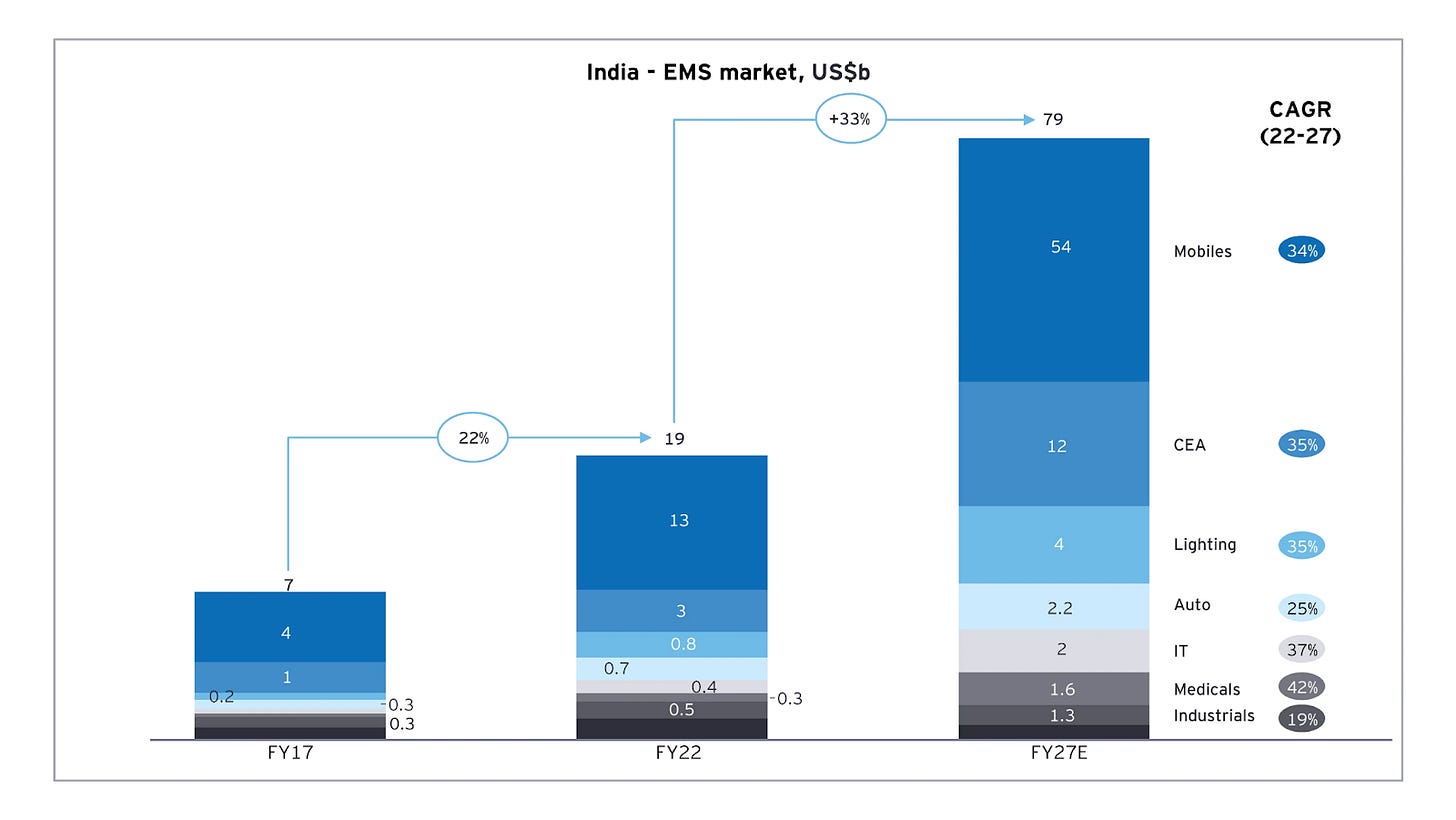
Syrma SGS is an electronics manufacturing services (EMS) company that designs and makes electronic products and components for global industries.
The deets: the JV will build a 20,000 sq ft plant in Bengaluru to make electronic parts and fully assembled products using advanced production lines. It will focus on high-reliability customers in railways, industrial and medical electronics.
The tie-up blends Syrma’s scale and low-cost execution with Elemaster’s design chops and credibility in Europe. The JV aims to capture margin-rich opportunities, expand wallet share with global clients, and give a Make in India push in critical electronics.
3. CityMall’s $47M Bharat boost 💰
CityMall has raised $47 million in a Series D round led by Accel, keeping its valuation flat at around $320 million.
CityMall runs a value e-commerce platform for Tier-II and Tier-III towns. It sells fashion, home, kitchen, and packaged food at low prices, distributed via a network of local community leaders.
The deets: existing backers including Waterbridge, Citius, General Catalyst also contributed. With this, CityMall’s total funding climbs to $165 million.
The why: new funds will go into expanding its distribution reach, boosting private label products, and making its supply chain more efficient.
The company is betting on “Bharat-first” consumers as families often overpay for basics due to limited options.
Revenues rose 22% to ₹460 crore in FY24, though losses widened to ₹159 crore with investments in tech and logistics.
Zoom out: India’s e-commerce growth is shifting beyond metros. Meesho and DealShare are chasing the same small-town shoppers, but with a $165M war chest and a lean supply chain model, CityMall is angling for a big bite of Bharat’s value-conscious market.
While we are on fundraises,
Speciality coffee chain Blue Tokai has raised $25 million in a bridge round from existing investors A91 Partners, Anicut, Verlinvest, and 12 Flags.
The company is doubling its growth ambitions. It now targets 800+ stores and ₹2,000 crore in revenue within four years, up from its earlier ₹1,000 crore goal by 2027.
4. UPL Global Limited buys 49% stake in Thailand’s Grow Chemical 🧪
UPL Global Limited has signed an agreement to acquire a 49% stake in Thailand-based Grow Chemical Ltd.
UPL Global Limited offers products for crop protection and biosolutions for sustainable agriculture. While Grow Chemical does sourcing and selling of products like fertilisers, herbicides, fungicides etc.
The deets: the deal involves cash infusion of $0.76 million into fresh equity capital of Grow Chemical Ltd. The funds will be used for sharing R&D, marketing, and distribution channels.
Why this matters: Thailand’s agritech market growth is expected to reach $113.96 million by 2029 at a CAGR of 6.08%. By partnering with a company that is well-established in that market, UPL can foray into this high-growth market and access Grow Chemical’s regional expertise.
5. LG & Panasonic supplier UKB is cashing in 🚀
UKB Electronics, a company that makes parts for big names like LG and Panasonic, has filed papers to raise ₹800 crore through an IPO.
What they do: UKB Electronics is an Electronics Manufacturing Services (EMS) provider that designs, develops, and produces a wide range of electrical and electronic components.
The deets: the IPO will be split into two parts: a ₹400 crore fresh issue (new shares, which will bring fresh money into the company) and a ₹400 crore offer-for-sale (existing promoters selling some of their shares).
The money from the new shares is expected to go into expansion and strengthening operations, as the company has already seen its profits jump 70% in FY25.
Why it matters: for everyday investors, this IPO is interesting because UKB is already a trusted supplier to global electronics giants. With India’s push to boost domestic electronics manufacturing, companies like UKB are expected to benefit from higher demand and localization policies.
6. Stocks that kept us interested 🚀
1. Bharat Electronics secures fresh orders worth ₹644 crore 📊
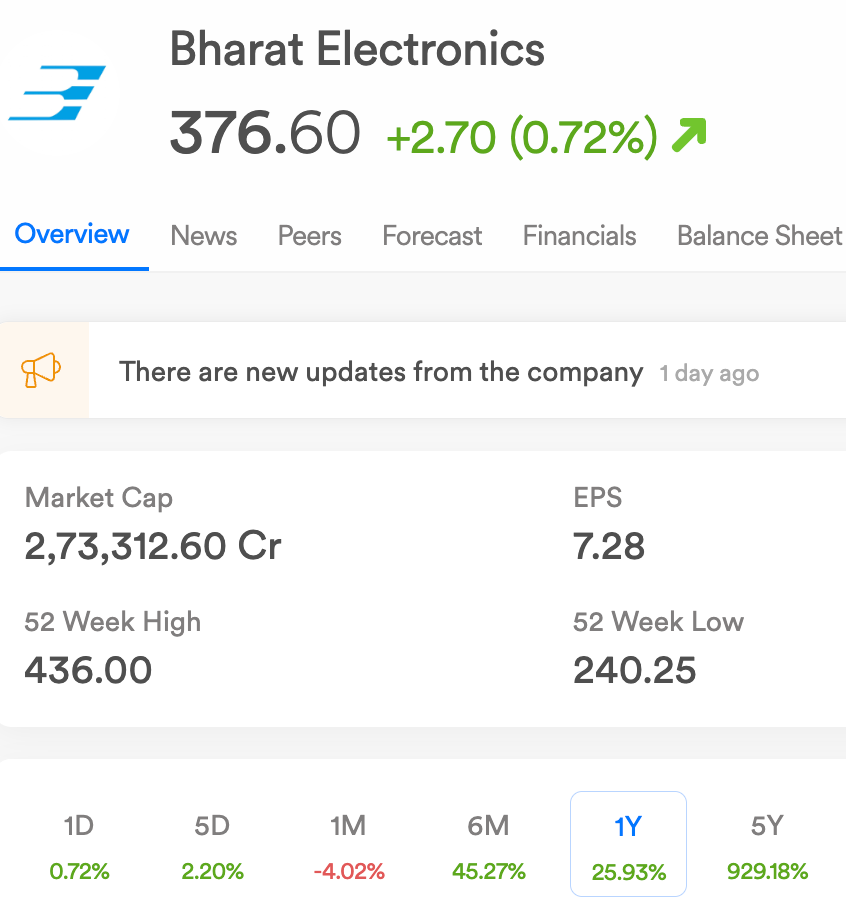
Bharat Electronics just bagged fresh orders worth ₹644 crore, adding to its already hefty order book. Investors cheered the update, with the stock climbing higher in Tuesday’s session.
What’s happening: the PSU firm did not disclose the details of the clients from whom these orders were received. The major orders include data centre, ship fire control system, tank navigation system, communication equipment, seekers, jammers, simulators, electronic voting machines, upgrades, spares, and services.
Company’s orderbook: as of April 1, BEL’s order book stood at ₹71,650 crore. Since the start of the financial year, it has announced order inflows of ₹7,348 crore, 27% of its full-year guidance of ₹27,000 crore (excluding a ₹30,000 crore missile order).
Looking ahead, BEL has highlighted a strong pipeline of orders worth ₹1 lakh crore, expected over the next 18-24 months.
2. AXISCADES flies high with jet upgrades and cabin wins ✈️
Shares of AXISCADES Technologies jumped 5% after it secured two pilot orders valued at $1.2 million.
AXISCADES is an end-to-end technology, product, and solutions provider aiding the creation of innovative, sustainable, and safer products worldwide in the Aerospace, Defence, and ESAI domains.
The deets: the order is for aircraft cabin interiors design, development, and retrofit solutions. These orders have been awarded by two global leaders, one a leading aerospace original equipment manufacturer (OEM) and the other a renowned aircraft cabin interior company with operations in Europe and the United States.
Why this matters: diversifying into interiors strengthens its end-to-end engineering services and positions it to capture opportunities in the fast-growing aircraft interiors market, fueled by modernisation needs and the demand for enhanced passenger experience.
That’s not all: the company has also won a big order tied to the Su-30 fighter jet upgrade. Its subsidiary, Mistral Solutions, will design and supply 10 special control units that help keep the jets cool while in operation.
The deal comes from India’s Combat Aircraft System Development and Integration Centre, the agency that manages upgrades for combat aircraft. This marks an important step in modernising the Su-30 fleet and strengthening India’s air power.
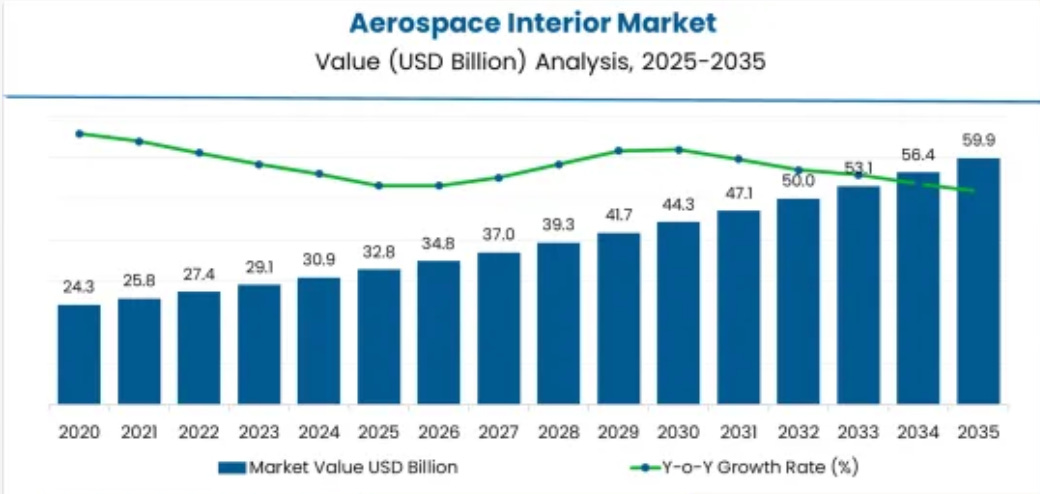
Zoom out: the aerospace interior market is expected to grow from $32.8 billion in 2025 to $59.9 billion by 2035, with a CAGR of 6.2%. This early growth is driven by the continuous evolution of passenger comfort, safety standards, and growing demand for advanced, sustainable materials in cabin interiors, including seating, lighting, and storage solutions.
What else are we snackin’ 🍿
💼 Pink slips: Salesforce cut 4,000 support jobs, shrinking its team from 9,000 to 5,000, as AI takes over nearly 45% operations.
🚘 Order slump: Tesla just got 600 India orders since July launch, below expectations; plans to ship 350-500 cars in 2024, starting September.
That’s a wrap! Don’t let the weekday blues get to you.
And if you’d like to place your brand on this newsletter, let us know.
Hit that 💚 if you liked this issue.