
 Newsletter
Mazagon’s profit surge, Qualcomm’s AI leap, and Premier’s IAF win.
🗓 Morning, folks!
Markets staged a solid comeback on Tuesday after a shaky start, as optimism over progress in US–China trade talks lifted sentiment.
Metals and insurance stocks led the rebound and SBI Life shined bright. On the flip side, Tech Mahindra and Bajaj Finserv weighed on the indices.
Broader markets mirrored the cautious optimism, with investors picking up beaten-down stocks on hopes that global policy easing could soon revive momentum. The mood, while still watchful, seems to be shifting back to “buy the dip” mode.
💡 Spotlight: Metal stocks shine on trade optimism 🔩
Metal stocks stood tall on Tuesday, with the Nifty Metal index climbing more than 1%, making it the day’s top gainer. Jindal Steel and Tata Steel led the rally, rising up to 3% each.
The trigger: fresh optimism around US–China trade talks, as both sides reportedly agreed on a new trade framework that could cool tariff tensions and ease export curbs on rare earth metals. That glimmer of peace in the world’s biggest commodity tug-of-war was enough to lift the mood back home.
Let’s hit it!
1 Big Thing: HAL & Russia team up to build India’s first homegrown passenger jet ✈️
Hindustan Aeronautics Limited (HAL) and Russia’s United Aircraft Corporation (UAC) have signed a deal to produce the SJ-100 commuter aircraft in India.
Note: this marks the first time since 1988 that a full passenger aircraft will be built in India.
The move: by partnering with Russia, the company is expanding into the civil aviation sector using its defence manufacturing expertise to build commercial planes.
This helps India reduce dependence on foreign aircraft like Airbus and Boeing, while boosting India’s aerospace ecosystem.
The twin-engine, narrow-body jet, already used by over 16 global airlines will soon be made right here for domestic and regional markets. HAL will hold the rights to manufacture it for Indian customers.
Why it matters: by producing the SJ-100 locally, it will make short-distance air travel more common and affordable, connecting smaller towns and cities that currently lack regular flights.
The numbers: India’s skies are getting busier over the next decade. The country will need 200 regional jets for domestic routes and 350 more for nearby international travel. That’s 550 aircraft in total and HAL wants to make sure they’re Made in India.
2. Megasoft acquires UK-based company to boost defense capabilities 🛩️
Megasoft just announced that its arm Sigma Advanced Systems has acquired a 100% stake in UK-based Nasmyth Group. The deal is valued at ₹213 crore.
Megasoft is an advanced systems provider that offers services like machining, fabrication, and assembly work. It primarily serves the defense and aerospace sector.
Nasmyth Group, on the other hand, specialises in manufacturing, precision engineering, and metal treatments for defense and aerospace sectors.
Why this matters: Nasmyth Group has several manufacturing facilities in the UK and one in India.
The deal will help Megasoft expand production as the company looks to pivot from its telecom business.
Big picture: the announcement comes days after India signed a massive $500 million missile deal with the UK.
While we are on deals,
KPI Green Energy is forming a strategic partnership with UAE-based Fabtech Group to develop green-energy powered life sciences projects on a global level.
KPI Green Energy builds solar and hybrid renewable energy power plants. While Fabtech Group is an engineering company that provides start-to-finish solutions for biopharma and healthcare projects.
The deets: under the partnership, KPI Green Energy will provide solar, wind energy, Battery Storage Energy Systems (BESS), and green-hydrogen based power to Fabtech’s projects. These projects will span across India, Middle East, and Africa.
Why this matters: the healthcare sector is responsible for 5% of global greenhouse gas emissions. With partnerships like these, the emissions could be brought down without compromising the continuous supply requirement.
Moreover, KPI Green Energy recently received regulatory approval to produce clean electricity worth 40.9 MW through its power-production arm.
3. Mazagon sails smooth with 28% profit boost ⚓
India’s biggest warship builder, Mazagon Dock Shipbuilders, had another strong quarter, riding on solid execution and better cost control.
By the numbers:
- Net profit at ₹749 crore, up 28.1% YoY vs ₹585 crore
- Revenue at ₹2,929 crore, up 6.3% YoY vs ₹2,756 crore
- Operating margin expanded to 23.7% from 18.5% last year
What drove the numbers: the growth was driven by higher project revenues and better operating margins. It also got a boost from steady progress on key naval projects like Project 15B destroyers and Project 17A frigates.
With the government doubling down on its Atmanirbhar Bharat push, the company’s strong execution and cost discipline are turning into profit power.
In the Union Budget 2025–26, India allocated a record ₹6.21 lakh crore for defence spending, marking a 4.7% increase from the previous year’s ₹5.94 lakh crore. This is the highest-ever defence outlay, reflecting India’s growing focus on military modernisation.
4. Can Qualcomm take on Nvidia in the AI chip race? ⚡
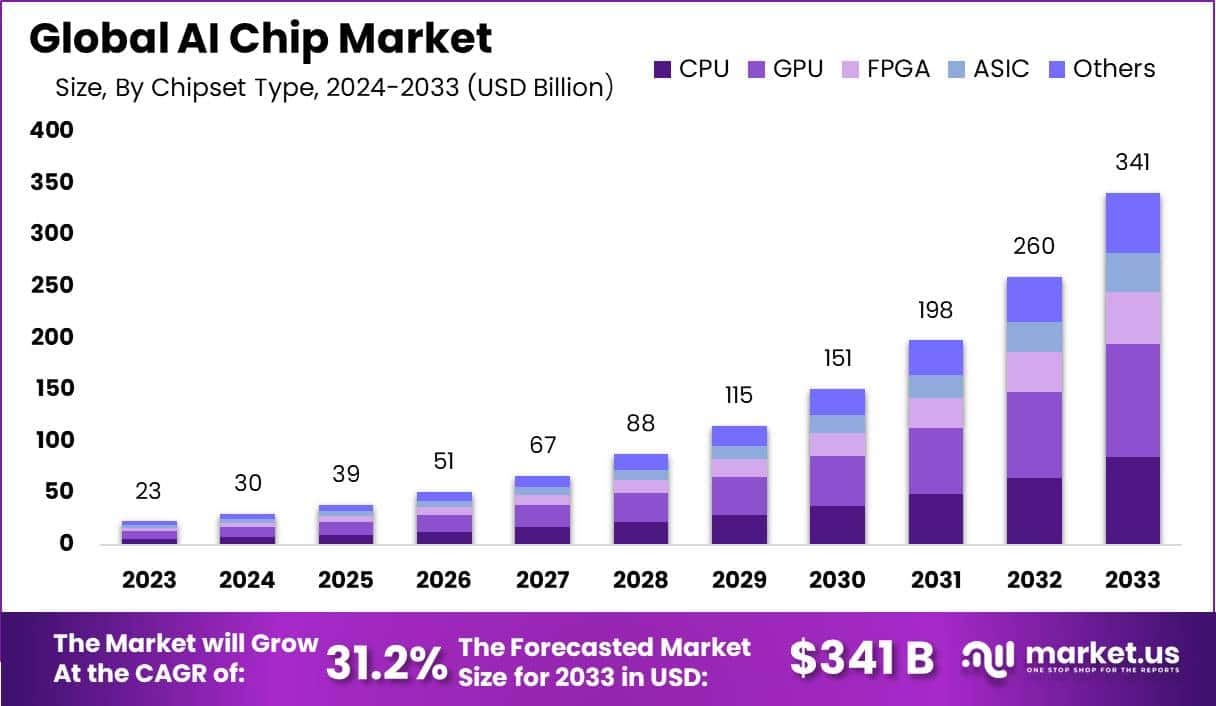
Qualcomm unveiled two new AI accelerator chips designed to compete head-on with Nvidia, the current king of AI semiconductors. The announcement sent Qualcomm’s stock soaring 11%, as investors cheered the update.
Context: until now, Qualcomm has been known for powering smartphones, not the data center.
But with AI200 launching in 2026 and AI250 following in 2027, the chipmaker is betting big on data center computing.
What’s the deal: the new chips will be built on Qualcomm’s existing Hexagon neural processing units (NPUs), the same tech that powers AI features in its phone chips.
Broader perspective: this marks a shift for Qualcomm from smartphones into a $6.7 trillion data center market expected by 2030.
Nvidia still holds over 90% of the AI chip market, but competition is heating up with AMD, Google, Amazon, and Microsoft all developing their own accelerators.
6. Stock that kept us interested 🚀
1. IDBI Bank shares surge 7% as long-awaited stake sale nears 💰
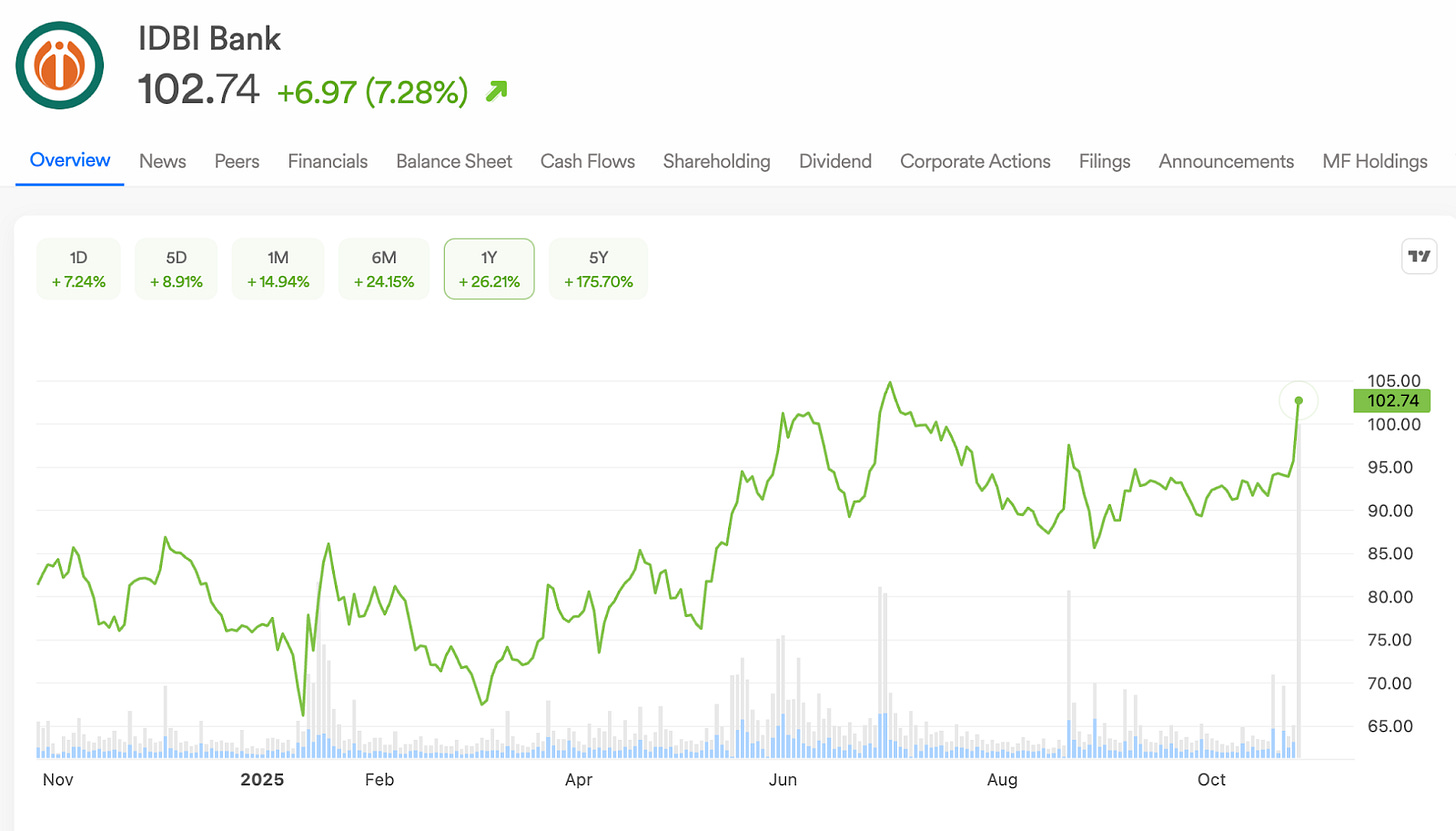
IDBI Bank rallied 7% on Tuesday after reports suggested the government is finally set to invite bids for its long-pending strategic stake sale.
Context: the government and LIC together hold nearly 95% in IDBI Bank and have been planning to offload around 60% since 2022. However, the process was delayed due to regulatory clearances and bidder due diligence.
Big theme: this divestment is a key part of India’s broader privatisation and banking reforms agenda.
For IDBI Bank, a successful sale would mean fresh capital, improved efficiency, and private sector management, helping it fully transition from a state-run lender to a competitive private bank. Investors see this as the bank’s turnaround moment after years of restructuring.
2. Premier Explosives bags ₹430 crore IAF order 💥
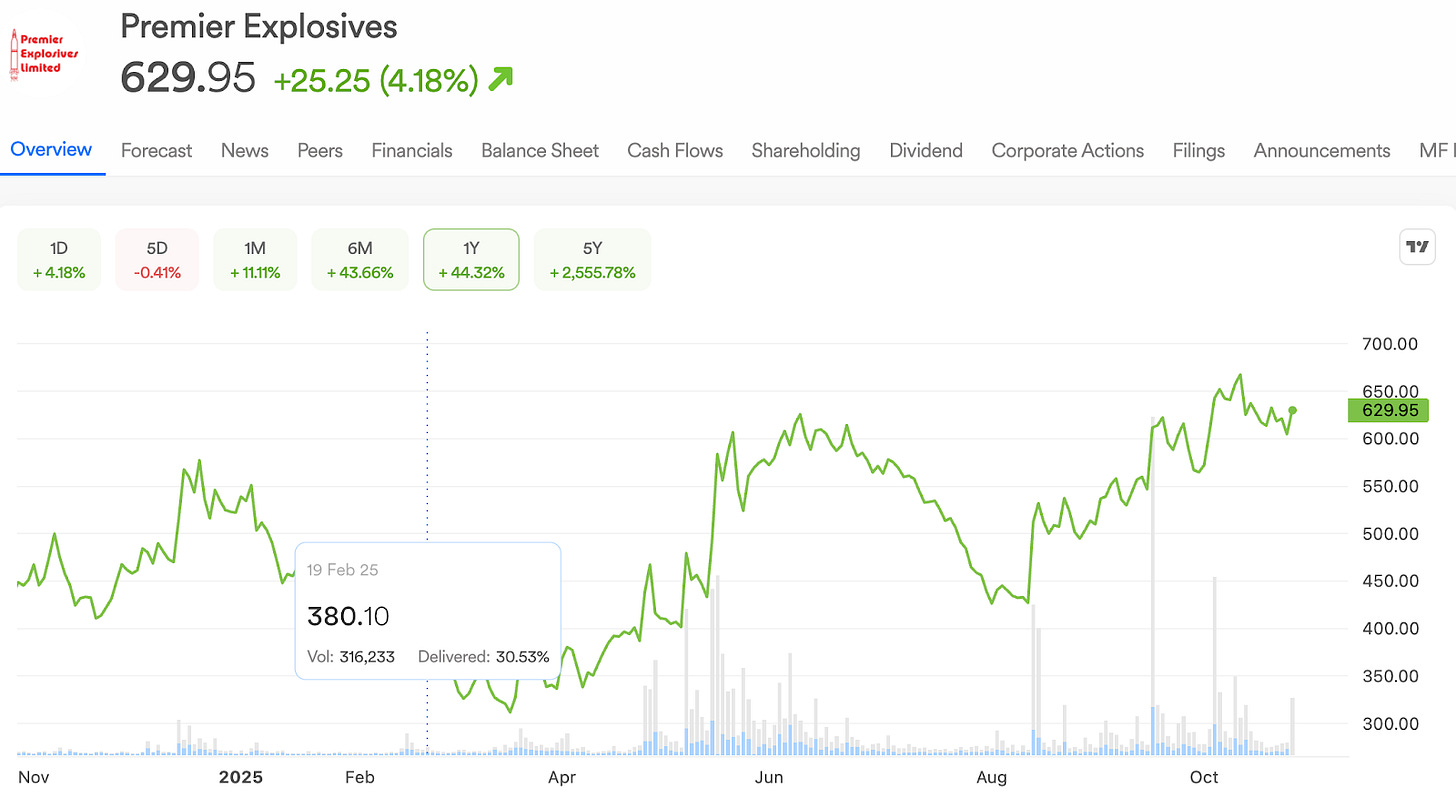
Premier Explosives bagged ₹429.6 crore worth of orders from the Ministry of Defence to supply chaffs and flares to the Indian Air Force. The stock shot up nearly 4% following the announcement.
Chaffs and flares are safety tools used by fighter jets and military aircraft to protect themselves from enemy missiles.
Zoom out: India’s missile countermeasure systems market which includes technologies like chaffs, flares, and electronic warfare systems is growing rapidly as the country focuses on modernising its armed forces and reducing import dependence.
DRDO has already developed indigenous chaff and flare systems, which are now being produced by companies like Premier Explosives and Bharat Dynamics for the Indian Air Force and Navy.
The broader defence countermeasure market in India estimated at around $1.5 billion in 2025 is expected to grow steadily.
What else are we snackin’ 🍿
💳 Global gateway: Infibeam Avenues’ unit got IFSCA nod to operate as a payment service provider at GIFT-IFSC, paving the way for cross-border digital payments.
🏭 Steady output: India’s IIP growth held at 4% in September, as manufacturing activity picked up to 4.8% from 3.8% in August.
🌾 Fertiliser boost: cabinet approved ₹37,952 crore nutrient-based subsidy for P&K fertilisers under the 2025–26 rabi season to keep prices affordable for farmers.
That’s a wrap! Don’t let the weekday blues get to you.
And if you’d like to place your brand on this newsletter, let us know.
Hit that 💚 if you liked this issue.