
 Newsletter
HUL Q2 meets street, Cipla joins hands with El Lilly, and OnlyFans steals revenue crown
🗓 Morning, folks!
Markets put up a cautious show on Thursday with Sensex & Nifty ending mostly flat. Gains came early but fizzled out as heavyweight stocks lost steam.
The drag came from Reliance Industries, which slipped nearly 3% from intraday highs after chatter around possible curbs on Russian oil imports. That single move was enough to cap the market’s mood.
But IT stocks came to the rescue as Infosys, HCLTech, and Tech Mahindra led the charge, riding on global tech strength and softer US bond yields.
💡 Spotlight: India’s ₹79,000 crore defence boost 🚀
The Defence Acquisition Council cleared ₹79,000 crore worth of defence purchases including next-gen missile systems, naval guns, and airborne strike tech.
The Army will get the Nag Missile System Mk-II to take down enemy bunkers and tanks, while the Navy adds Landing Platform Docks and lightweight torpedoes for stronger sea dominance.
The Air Force, meanwhile, will test out an autonomous long-range target destruction system that can detect, navigate, and strike on its own.
Let’s hit it!
1 Big Thing: Indian Army signs ₹2,700 cr carbine deal with Bharat Forge 🔫
The Indian Army has placed a ₹2,770 crore order for 4.25 lakh Close-Quarter Battle (CQB) carbines. Bharat Forge is the key supplier chosen to manufacture these next-gen weapons. The stock gained nearly 5% following the update.
CQB is a compact rifle built for short-range, fast-action combat.
The deets: the contract covers design-matched, compact 5.56×45 mm carbines built to strict Army specifications. These weapons are light, modular, and ideal for close combat and counter-insurgency missions.
Why it matters: this order upgrades soldier kits for mobility, reaction time, and reliability in cramped battlefields. It also gives a huge fillip to domestic defence manufacturing, putting firms like Bharat Forge squarely into strategic supply chains and creating local jobs and capabilities.
Zoom out: Bharat Forge has been winning steady orders from the Indian Army and defence PSUs, ranging from ATAGS howitzers to armoured platforms and now carbines, marking its shift from a parts supplier to a full-fledged defence OEM.
The company’s defence arm, Kalyani Strategic Systems, has also signed export deals for artillery and protected vehicles, putting Bharat Forge on the global map.
2. Tesla’s profits slip as AI costs surge 🤖
Tesla’s Q3 earnings hit a speed bump, with profits falling 29% year-on-year to $1.8 billion, missing estimates.
By the numbers: revenue rose 12% YoY to $28.1 billion, beating forecasts, but operating margin nearly halved to 5.8% from 10.8% last year.
The why: Tesla’s pivot to AI, robotics, and autonomous driving is proving costly. The company spent heavily on Nvidia H100 GPUs and AI talent as it preps for robotaxis and humanoid robots.
Meanwhile, US tariffs added over $400 million in costs, splitting evenly between its car and battery units. The result? Strong sales, but slimmer profits.
At the same time, AI-related costs soared, pushing overall expenses up 50% to $3.4 billion.
Company outlook: the company expects capital spending to rise substantially by 2026, beyond this year’s $9 billion, as the company gears up for its “next phase of growth.”
While we are on earnings,
HUL posted a decent Q2 with modest growth across top and bottom-lines, showing strong underlying momentum.
By the numbers:
- Revenue rose 2% YoY to ₹16,061 crore.
- Net profit grew 4% YoY to ₹2,694 crore.
- Underlying volume growth held steady at 2%.
Why it matters: even as external headwinds lingered, HUL held its ground thanks to strong brand equity and pricing execution. The board declared an interim dividend of ₹19 per share which signals confidence and shareholder reward, while the volume stability points to resilience in consumption.
3. Uniphore grabs $260M with NVIDIA boost 💥
AI startup Uniphore has raised $260 million in a Series F round from tech heavyweights NVIDIA, AMD, Snowflake, and Databricks, pushing its valuation to $2.5 billion. The funds will help expand its Business AI Cloud and global footprint.
The company was founded in 2008 in Chennai & began as a conversational AI firm focused on automating customer support. It has since evolved into a full-stack enterprise AI platform that combines speech recognition, computer vision, and generative AI to automate workflows
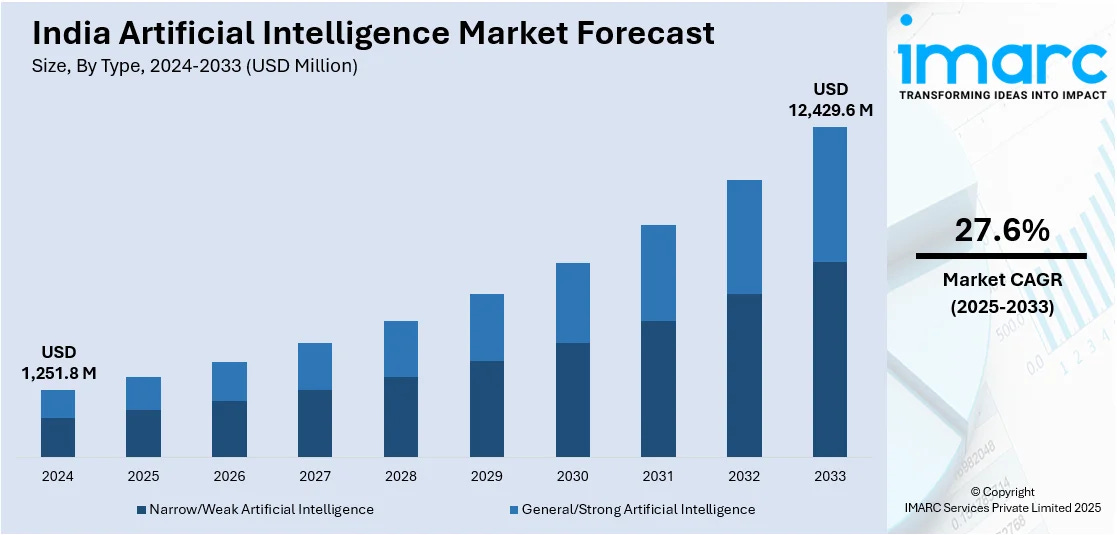
Zoom out: India’s artificial intelligence market is projected to surge from $1.2 billion in 2024 to ₹12.4 billion by 2033.
The rise will be driven by rapid adoption of AI-powered automation, data analytics, and enterprise AI solutions across industries like finance, healthcare, and manufacturing.
4. Cipla partners with US-based Eli Lilly to launch obesity drug 💊
Cipla has teamed up with Eli Lilly to distribute and promote Yurpeak (tirzepatide) in India. This marks the second launch of the breakthrough diabetes and obesity drug after Mounjaro. The move aims to make the blockbuster treatment more accessible across India.
The deets: under the deal, Lilly will continue to manufacture and supply the drug, while Cipla handles distribution and promotion.
Why it matters: the partnership marks an important step towards Cipla’s entry into the fast-growing obesity care segment while helping Lilly expand reach beyond major cities.
With obesity and diabetes cases surging, wider access to tirzepatide, a dual-action GIP and GLP-1 agonist, could be a game-changer for chronic care in India.
While we are on deals,
Premier Energies has acquired a 51% stake in Pune-based KSolare Energy for about ₹86.7 crore. The remaining 49% will be picked up by Syrma SGS Technologies for ₹83.3 crore.
KSolare makes on-grid, off-grid, and hybrid solar inverters with a production capacity of 5 lakh units annually. Its FY25 revenue surged 51% YoY to ₹342 crore, showing strong demand for clean energy tech.
With demand for home-grown energy solutions surging, this partnership adds muscle to India’s clean energy manufacturing ecosystem.
5. OnlyFans beats NVIDIA in revenue efficiency 😲
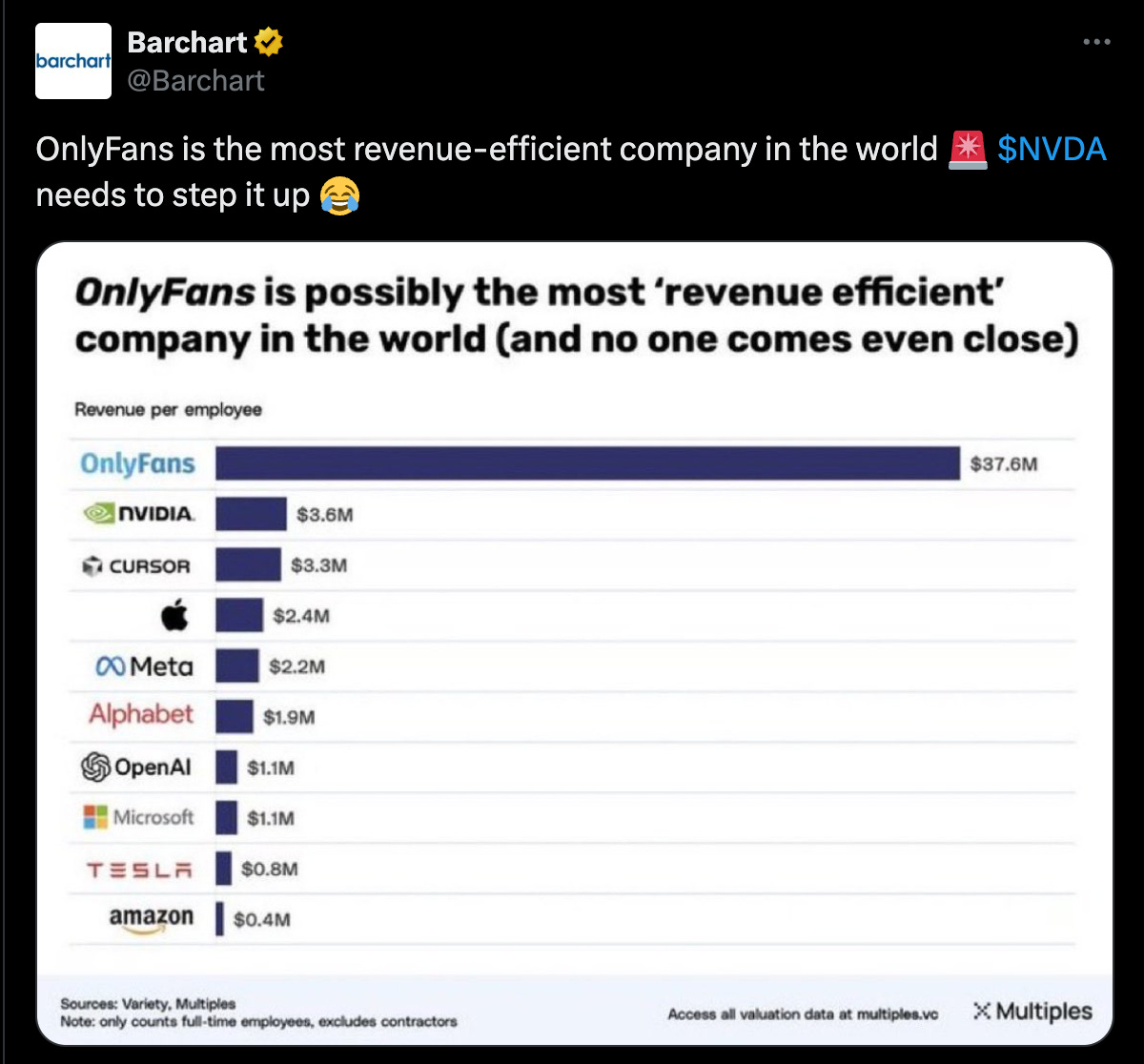
OnlyFans is officially the most revenue-efficient company in the world, beating giants like NVIDIA, Apple, and Meta.
A revenue-efficient company makes a lot of money with very few people or resources.
The deets: the content platform generates $37.6 million in revenue per employee, running with just 42 people.
For context, NVIDIA clocks in at $3.6M per employee, Apple at $2.4M, and Meta at $2.2M. The company’s 2.1 million creators who produce and sell content directly to fans, keeping 80% of their income while OnlyFans takes a 20% cut.
In FY24 alone, fans paid creators $7.2 billion, out of which the company earned $1.4 billion in revenue, all while spending little on traditional operations.
6. Stock that kept us interested
1. Bondada Engineering powers up with Adani project 🔋
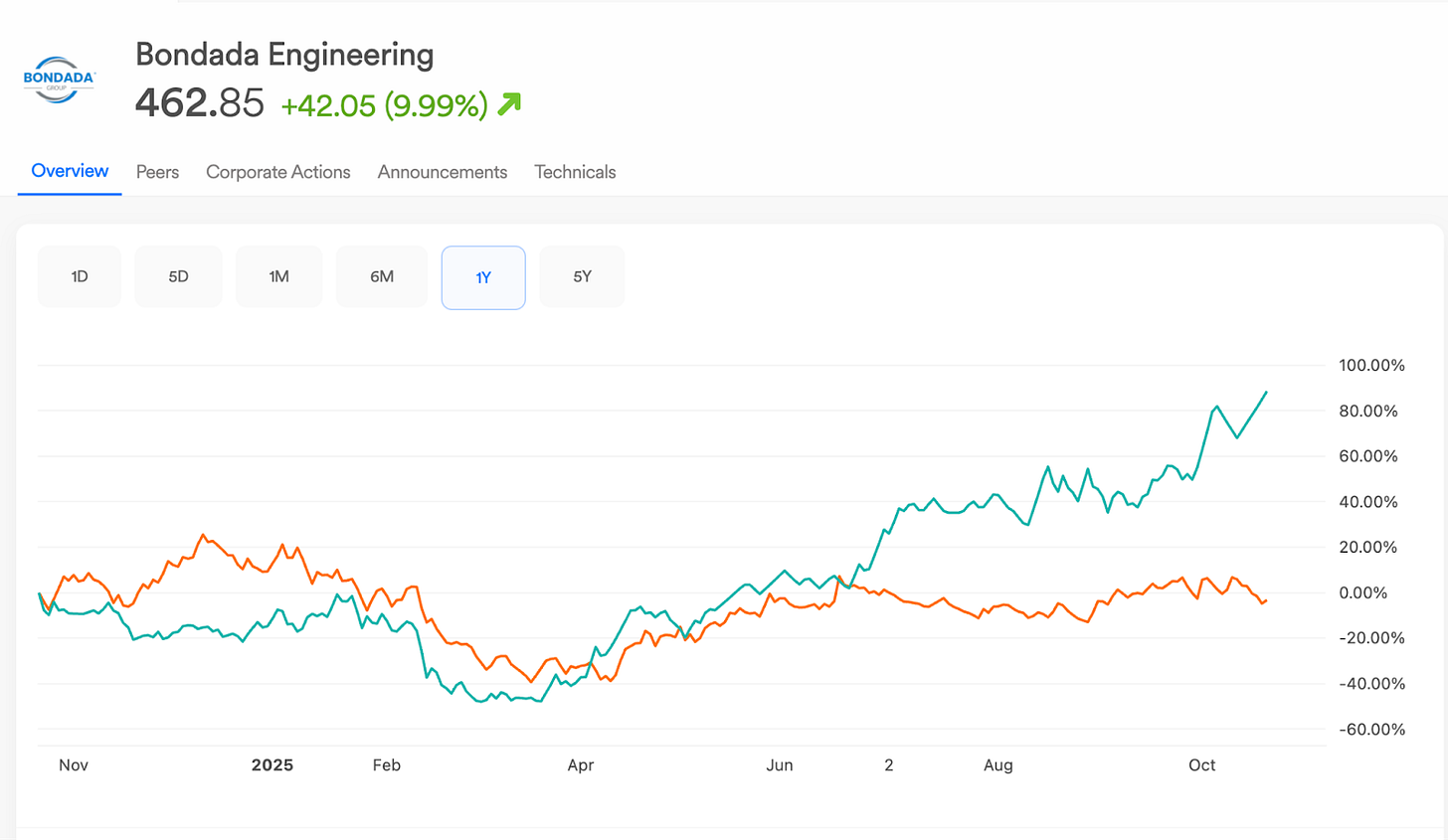
Shares of Bondada Engineering hit an upper circuit of 10%, after it received a letter of intent from Adani Green Energy for supply of goods worth ₹1,050 crore.
Bondada Engineering builds and maintains telecom towers and solar power projects. It also makes metal structures and works in defence and rail sectors.
What’s happening: the letter of intent covers work for a 650 MW solar project at Khavda Renewable Energy Park in Gujarat. It also includes complete design, engineering, manufacturing, procurement, quality assurance, packing, and delivery of all materials to the site needed for the Balance of System (BOS) for the solar power project.
FYI: Adani’s Khavda Renewable Energy Park, spread across 538 sq km in Gujarat’s Kutch region, is a 30 GW green energy project. Once completed, it will be the world’s largest power plant, surpassing all others, no matter the energy source.
What else are we snackin’ 🍿
🛫 Sky reconnect: China Eastern Airlines is resuming Shanghai-Delhi flights from November 9, with three weekly A330-200 services on Wed, Sat, and Sun.
👀 Global shores: Hero MotoCorp enters the UK via a partnership with MotoGB, marking its 51st global market after expanding into Italy and Spain.
😲 New launch: OpenAI has launched ChatGPT Atlas, an AI-powered browser for MacOS, aiming to rival Google Chrome and redefine how users search online.
And that’s a wrap. Pour yourself an extra one this weekend.
We’ll be back like clockwork on Monday!
Hit that 💚 if you liked this issue.