

 Newsletter
MSCI rejig, Solar manufacturing push, and AI feud.
🗓 Morning, folks!
💡 Spotlight: Suzuki Motor announced a massive $8 billion (₹70,000 crore) investment in India over the next 5–6 years. The plan includes boosting production, launching new models, and ramping up EV capacity, cementing India as Suzuki’s biggest market globally.
Adding to the momentum, PM Narendra Modi flagged off Maruti Suzuki’s maiden EV, the e Vitara, from its Hansalpur plant in Gujarat. The SUV will not only serve the domestic market but also be exported to over 100 countries, with the first shipment headed to the UK.
Together, these moves highlight India’s growing role as a global EV and auto manufacturing hub, as Suzuki bets big on capacity, exports, and clean mobility.
1 Big Thing: Trump doubles tariffs on Indian imports 🇺🇸
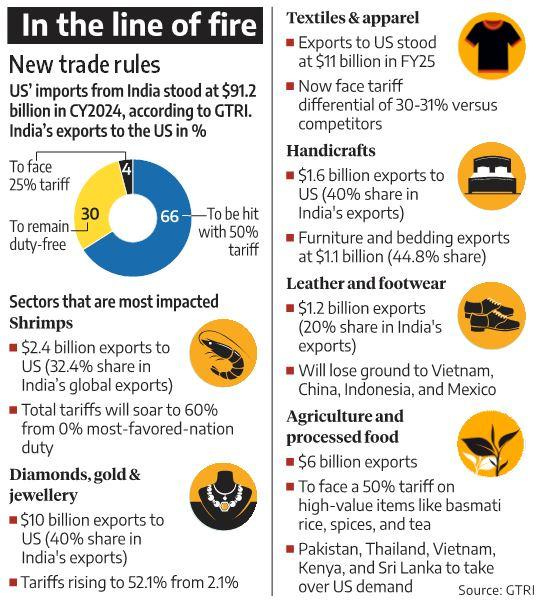
The Trump administration has moved ahead with its threat, imposing an additional 25% tariff on Indian imports , doubling existing duties to 50%.
This is the second round of tariffs in less than a month. Trump had earlier announced a 25% levy on Indian goods ahead of the August 1 reciprocal tariff deadline. The latest move doubles down on pressure, coming after Trump accused India of buying Russian crude oil and “funding the war in Ukraine.”
What’s going on: the two countries were set to hold another round of negotiations on August 25. Those talks have now been postponed indefinitely.
For India, the tariffs pose a significant challenge for exporters in sectors ranging from engineering goods to textiles, chemicals, and auto components. For US buyers, the duties mean higher costs on Indian imports, adding pressure on supply chains already stretched by geopolitical frictions.
Zoom out: India has so far reacted cautiously to the tariff escalation, calling for dialogue. Officials have emphasised that the trade relationship with the US is “strategic and mutually beneficial” and stressed the need to resolve disputes through talks.
New Delhi has also highlighted that Indian exporters and American consumers alike would bear the brunt of higher duties. At the same time, India is quietly weighing retaliatory measures but is likely to hold back in the near term, keeping the door open for negotiations.
2. MSCI adds four Indian stocks to Global Standard Index 📈
MSCI announced that four Indian stocks have been added to its Global Standard Index in its latest review on August 26.
MSCI, short for Morgan Stanley Capital International, is a global firm that creates stock market indices. These indices are tracked by big international funds that manage trillions of dollars. When MSCI updates its index, by adding, removing, or changing the weight of companies, funds are forced to buy or sell those stocks, often causing big price moves.
What’s happening: the four new Indian stocks added this time could together attract about $1 billion in foreign inflows.
Breaking it down:
- Swiggy: the food delivery and quick-commerce platform could see inflows of about $293 million.
- Vishal Mega Mart: a recent listing that has performed strongly may attract $256 million.
- Waaree Energies India: this renewable energy player is expected to get around $230 million.
- Hitachi Energy India: estimated inflows stand at roughly $233 million.
On the flip side: some companies are being dropped from the index. Sona BLW could see outflows of $165 million, while Thermax may face $117 million in exits.
3. Jakson Engineers to invest in solar manufacturing push ☀️
Jakson Engineers is set to invest over ₹8,000 crore for setting up a 6 GW integrated solar manufacturing plant in Madhya Pradesh.
What’s happening: this also marks the largest solar manufacturing investment in the State, marking a significant milestone for both the company and India’s renewable energy sector.
On the tariffs front: India now sends almost all its solar equipment to the US, 97% in FY23 and 99% in FY24. With the US-China trade war heating up, Indian solar companies see a big chance to grab more market share. Players like Waaree Energies and Vikram Solar are even planning to set up plants in the US to ride this wave.
Back home: India’s solar manufacturing capacity has surged to 100 gigawatts in just two years, thanks to government schemes. Demand is rising too, solar capacity grew 60% in FY25 to 24 gigawatts.
The concern: India is likely to add only about 40-50 gigawatts of solar projects each year, while its panel-making capacity could reach 190 gigawatts by 2027. That means factories may end up producing far more panels than the local market needs.
To tackle this, the government has issued the new ALMM-II order for solar cells, which requires projects bidding after August 31, 2025, to use only approved, India-made cells, a move meant to balance supply and demand.
4. Altum Credo nets ₹170 cr to expand its affordable housing ambitions 🏠
Altum Credo Home Finance has raised ₹170 crore in equity from existing investor British International Investment (BII).
Altum Credo is a Pune-based company that provides affordable housing to homeowners belonging to informal or low income segments.
The deets: the company currently serves over 15,000 customers across six states with over ₹1,000 crore of assets under management (AUM).
Zoom out: the funding comes at a time when there is heightened investor interest in the affordable housing market. Last week, companies like Weaver Services and Vastu Housing also received fresh funding. The sector itself is slated for growth as it is reported to reach a valuation of $9.46 billion by 2030 at a CAGR of 19.8%.
5. Stocks that kept us interested 🚀
1. UIDAI’s big Aadhaar push fuels Protean & BLS
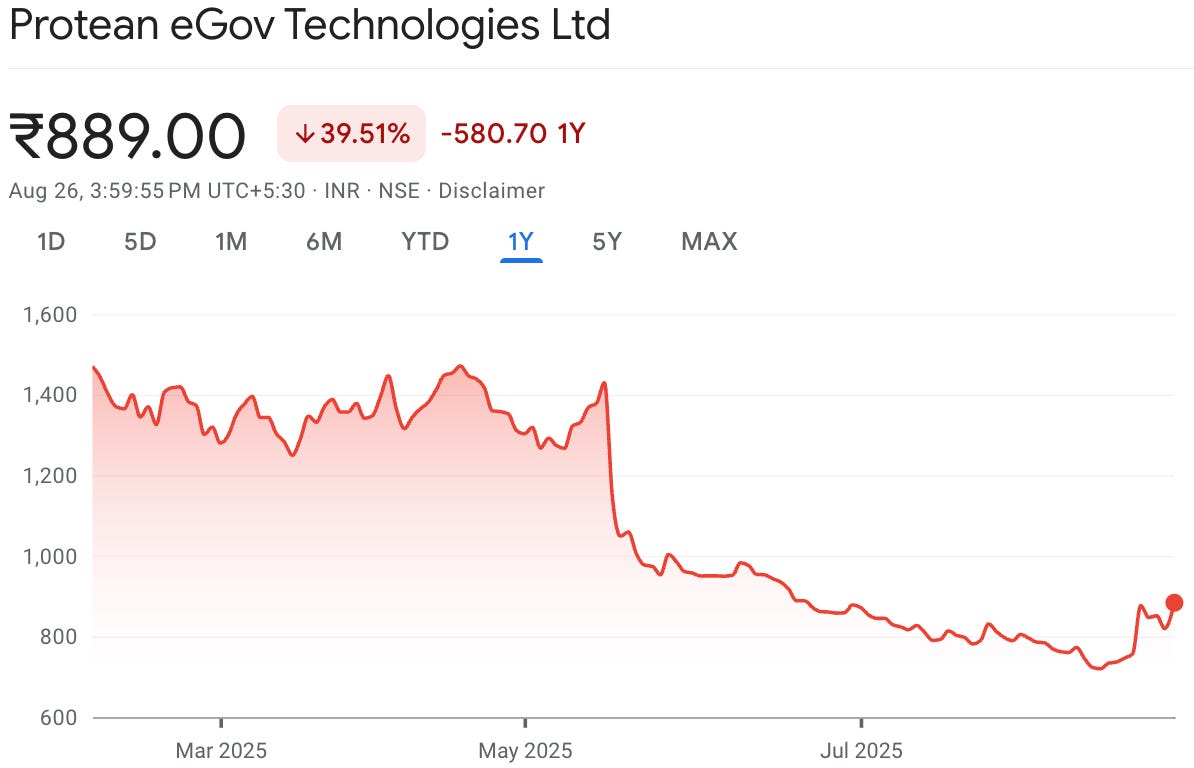
UIDAI has handed out massive contracts to two listed players including Protean eGov Technologies and BLS International Services to expand Aadhaar Seva Kendras across the country. Together, the projects are worth over ₹3,200 crore and will run for six years.
The deets: the centres will handle enrolments, biometric updates, and related services through both appointments and walk-ins, with a focus on semi-urban and rural regions.
The project also cements BLS’ presence in government service outsourcing and ensures long-term revenue visibility.
Why it matters: Aadhaar is the backbone of India’s digital economy, powering banking, fintech, subsidies, and e-governance. For both Protean and BLS, these contracts are marquee wins that not only guarantee multi-year revenues but also reinforce their role in the country’s expanding digital public infrastructure.
2. Waaree Energies’ arm wins 452 MW US project deal 🔋
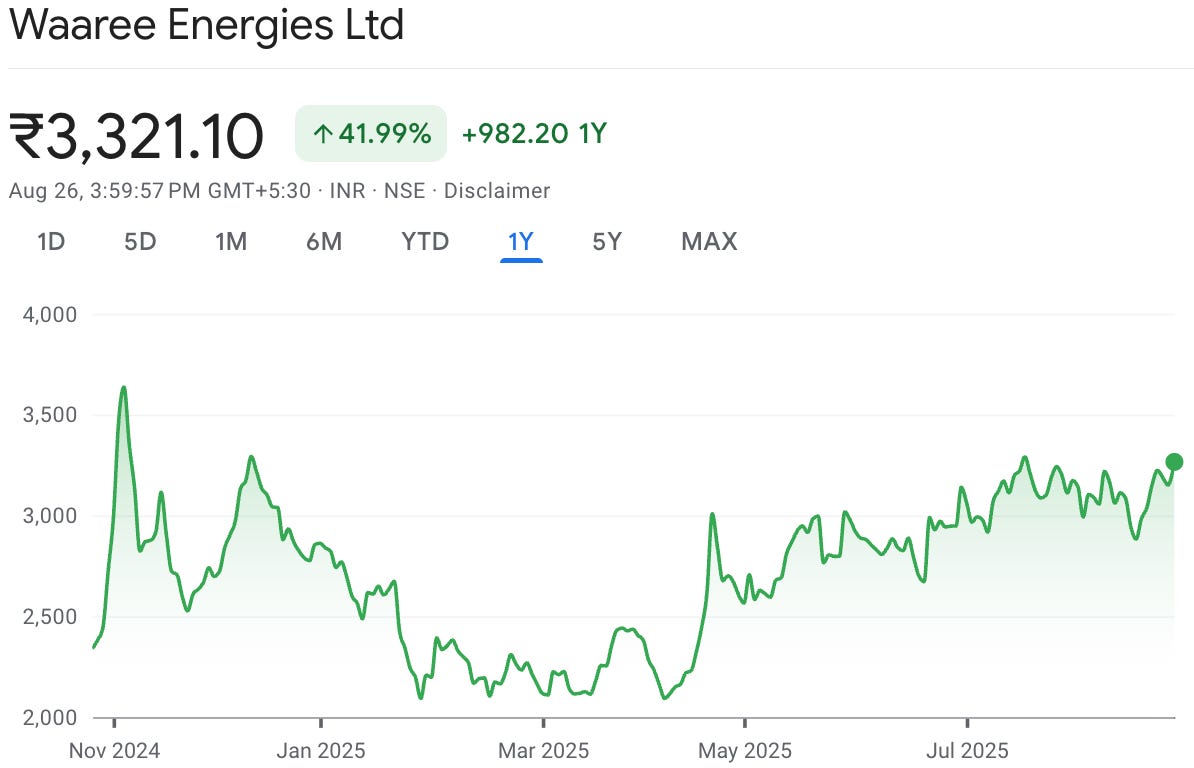
Waaree Energies shares went up, after its wholly-owned subsidiary, Waaree Solar Americas, received a fresh order for the supply of 452 megawatts of solar modules from a renowned United States-based developer and operator of utility-scale solar and energy storage projects.
Mumbai-based Waaree Energies is a renewable energy company. It offers innovative solar solutions, including panel manufacturing, EPC services, project development, and rooftop systems.
The deets: the order is a one-time contract and will be executed over the financial years 2025-26 and 2026-27.
Why it matters: Waaree has secured a series of global orders as it works to double manufacturing capacity at its Brookshire, Texas plant to 3.2 gigawatts by 2025-end. The expansion highlights the company’s rising presence in the US renewable energy market.
What else are we snackin’ 🍿
🚨 AI feud: Elon Musk sues Apple and OpenAI, alleging iPhones unfairly promote ChatGPT while shutting out rival chatbots.
🚀 D-street debut: Ardee Engineering, a Telangana-based firm in pre-engineered buildings and civil works, has secured SEBI approval to launch a ₹580 crore IPO.
That’s a wrap! Don’t let the weekday blues get to you.
And if you’d like to place your brand on this newsletter, let us know.
Hit that 💚 if you liked this issue.