
 Newsletter
Industrial activity slows, Tilaknagar grabs Imperial Blue, and November GST collections soften.
🗓 Morning, folks!☀️
Markets opened strong on Monday but closed flat, with the Sensex and Nifty ending with cuts.
The softness was driven by a slowdown in manufacturing activity and rupee hitting a record low at 89.7 against the dollar. Sector-wise, auto was the top performer, rising nearly 1% on the back of strong November auto sales, followed by metals which gained 0.5% and IT which rose 0.3%.
A muted start to the week, but there’s still room for a rebound.
💡 Spotlight: October IIP falls to 14-month low🔻
India’s industrial output grew 0.4% in October, down from 4% in September, largely due to fewer working days during the festive month.
Sector-wise, mining and electricity dipped 1.8% and 6.9%, respectively. However, manufacturing rose 1.8%, supported by strong performance in basic metals (+6.6%).
Overall, the data presents a mixed picture, but momentum could pick up in the coming months, supported by the GDP growth-led rally.
Let’s hit it!
1 Big Thing: November GST collections hit ₹1.70 lakh crore 📊
India’s gross GST collections grew at a slower pace in November 2025, rising just 0.7% year-on-year to ₹1.70 trillion.
For context, in October the gross GST collection had grown 4.6% to about ₹1.95 lakh crore, compared with ₹1.87 lakh crore in the same month last year.
The why: slower growth in November reflects the impact of the GST rate rationalisation approved by the GST Council. The central government slashed rates on many commonly consumed items, which naturally reduced the tax collected on them.
GST collections are the total tax money the government earns from the sale of goods and services across India each month.
There was also a big fall in compensation cess. The amount collected from this tax dropped to ₹4,737 crore from ₹12,398 crore last year, and the final money earned after adjustments fell to ₹4,006 crore.
Domestic GST revenue took a small hit too, down 2.3% year-on-year, mostly because of lower IGST flows within the country.
In simple terms, IGST flows refer to the tax collected when goods or services move from one state to another in India.
Among states, Arunachal Pradesh, Nagaland, Manipur, Meghalaya and Assam recorded growth, with Arunachal leading at 33%.
At the same time, Mizoram, Sikkim and Ladakh saw steep declines of 41%, 35% and 28%, showing how smaller tax bases can create more volatile numbers.
2. Tilaknagar completes Imperial Blue acquisition 🍾
Tilaknagar Industries has bought Imperial Blue Whisky from Pernod Ricard India for ₹3,442 crore. This makes it one of the biggest deals in the Indian-made Foreign Liquor (IMFL) space by a domestic company.
Tilaknagar Industries is an alcoholic beverage maker and is a IMFL company operating across categories like brandy, whisky, rum, and gin.
What’s going on: the company has completed the acquisition of the Imperial Blue brand on a slump sale basis. It has also taken over all activities related to the production, bottling, marketing and sale of alcoholic and other beverages under this brand.
For context, slump sale is buying a business division in one single deal including its assets, operations, and everything that comes with it without breaking it up or pricing each item separately.
With this transaction, Tilak Industries now gains ownership of the “Imperial Blue” brand and associated trademarks, including “Imperial Black” and “Imperial Red”.
What will the companies gain: with this acquisition, Tilaknagar strengthens its entry into the whisky segment and expands its pan-India footprint.

3. NVIDIA and LTTS join hands for lung care 🫁
L&T Technology Services has teamed up with NVIDIA to create an AI tool that builds a digital twin of the lungs.
Think of it as a highly detailed 3D model that helps doctors understand what is happening inside the body more clearly.
What’s brewing: the platform is designed to help with lung related diagnosis and navigation. It brings together LTTS skills in medical engineering, AI based diagnostics and imaging, along with NVIDIA’s powerful computing and AI technology.
The system takes CT scan images and turns them into a 3D digital version of the lungs. It uses advanced AI to show airways, blood vessels, lung sections and even small problem areas in sharp detail.
Big theme: AI is gaining ground in healthcare and the biggest tech players are racing to secure their space.
Nvidia in particular has expanded rapidly over the past two years, taking on everything from surgical robots to drug discovery. The company says medical imaging was one of its first steps into healthcare and this project builds on that push.
While we are on deals,
Quick Heal Technologies has secured a ₹64.2 crore contract with the NFSU Research and Innovation Council for implementing Integrated Cybersecurity Solutions.
NFSU, India’s forensic sciences university, uses its Research and Innovation Council to drive research, innovation, tech development and key collaborations in national security.
What’s going on: the deal fits squarely into Quick Heal’s broader cybersecurity roadmap and strengthens its goal of delivering end to end security solutions to large institutions.
4. Wakefit eyes ₹1,300 crore IPO 💸
Wakefit Innovations has filed its Red Herring Prospectus (RHP) for a ₹1,300 crore IPO, bringing it one step closer to listing.
Wakefit has grown into one of India’s fastest rising home and furnishings brands among organised players, becoming a go to name for mattresses, furniture and everything home.
What’s poppin: the company first filed its IPO papers with SEBI in June, and the market regulator gave the green light in October.
The IPO will be a mix of a fresh issue worth ₹377.1 crore and an offer-for-sale (OFS) of 4.67 crore shares by existing shareholders.
By the numbers: the company posted a ₹35 crore loss in the year ended March 2025, widening from a ₹15 crore loss the year before.
But revenue told a different story, jumping 29.1% to ₹1,273.7 crore from ₹986.4 crore, showing strong demand and rapid scale up.
5. Stocks that kept us interested 🚀
1. Sterling & Wilson wins ₹1,381 crore Adani Green order ☀️
Sterling and Wilson Renewable Energy announced a five-year agreement with Adani Green Energy & received an order worth ₹1,381 crore. The company’s stock surged 1.5% on the back of this news.
The deets: the order is for supply and service of all the supporting equipment needed for three solar projects at the Khavda Renewable Energy Park in Gujarat, one of the world’s largest renewable energy sites.
Why it matters: with this win, the company’s total order book rises to ₹6,450 crore. By partnering with Adani Green, the country’s largest renewable energy developer, the company further establishes itself as a dependable solar player known for strong execution and quick turnaround.

2. Wockhardt gets US FDA nod for antibiotic Zaynich ✅
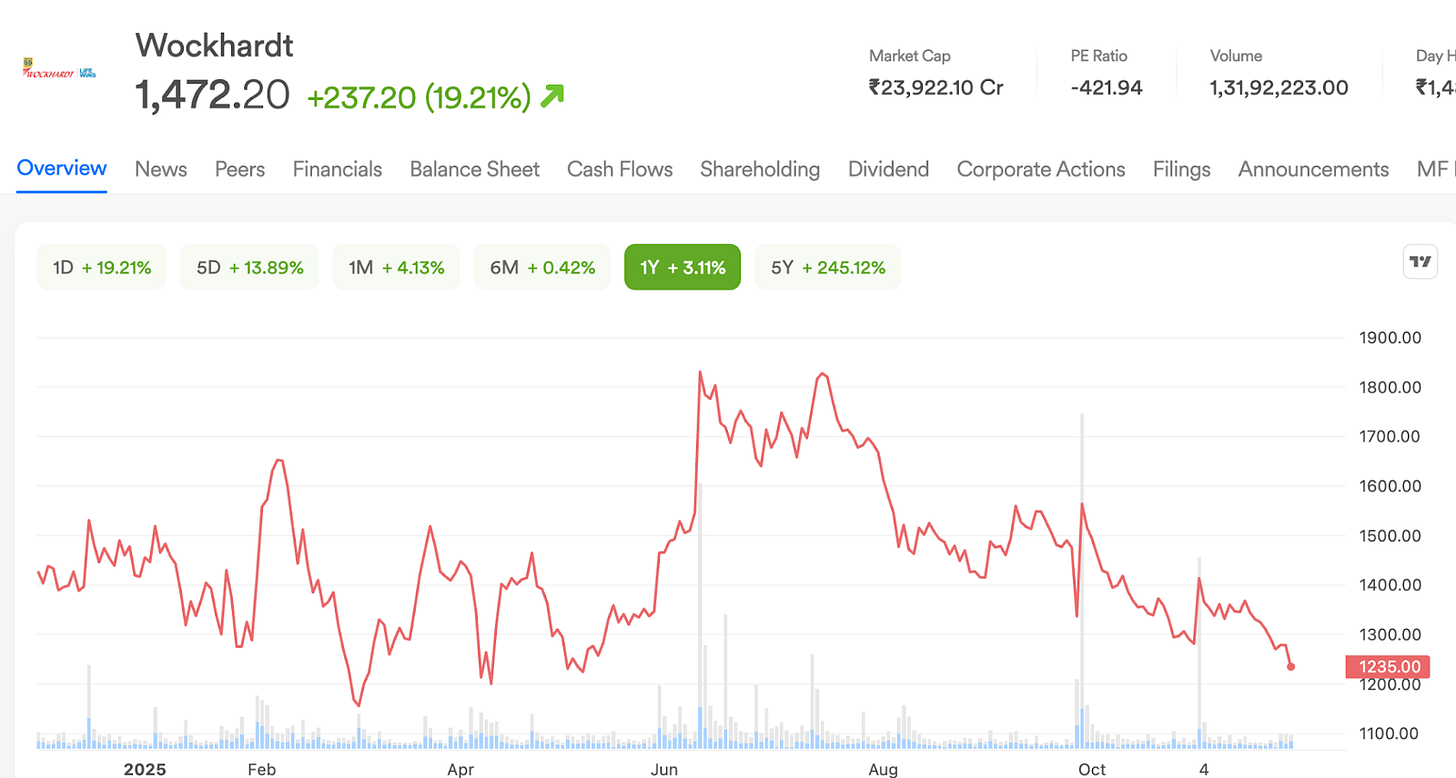
Shares of Wockhardt jumped 19% after the US Food and Drug Administration officially accepted its New Drug Application for Zaynich, a first of its kind antibiotic.
Zaynich is Wockhardt’s new antibiotic designed to fight tough, drug resistant bacterial infections, an area where the world has seen very few real breakthroughs in recent years.
Why is this big: this is the first time the US FDA has accepted a New Drug Application for a completely new chemical entity developed by an Indian company.
Wockhardt’s goal is to introduce a new antibacterial solution to global markets at a time when the world urgently needs fresh tools to fight rising antimicrobial resistance.
Bottomline: most large pharma companies have stepped back from antibiotic research because it is costly and less profitable, leaving only a handful of players working on breakthrough molecules.
An Indian company pushing a new drug into the US system stands out against this global backdrop.
3. HG Infra charges up with battery energy storage deal 🔋
HG Infra Engineering shares ticked up after the company sealed a battery energy storage deal with Gujarat Urja Vikas Nigam.
Gujarat Urja Vikas Nigam manages power generation, transmission and distribution in Gujarat, oversees state electricity companies and supports reliable, affordable energy development.
Breaking it down: HG Choraniya Bess, a fully owned arm of the company, has signed an agreement to set up a large battery energy storage system with a capacity of 300 MW and 600 MWh.
In simple terms, it is like building a giant power bank for the electricity grid that can store a lot of energy and release it when needed.
Why it matters: battery energy storage is becoming a key part of India’s power infrastructure because it helps balance intermittent renewable energy like solar and wind. With Gujarat being one of the country’s biggest renewable hubs, adding storage can improve grid stability and reduce blackout risks.

What else are we snackin’ 🍿
💉 Pharma win: Lupin has been granted FDA approval for its biosimilar injection, marking a key step in expanding cancer treatment options.
📵 Logout mess: the Department of Telecommunications has enforced SIM-linked rules for messaging apps severely impacting Whatsapp Web operations where users will logout every 6 hours.
🚗 Clean luxury: Vietnamese EV automaker, VinFast has announced the launch of their seven-seater model in India by February 2026.
That’s a wrap! Don’t let the weekday blues get to you.
And if you’d like to place your brand on this newsletter, let us know.
Hit that 💚 if you liked this issue.