

 Newsletter
Imagine opening ChatGPT, asking it to summarise a report, generate an image, or answer a question.
It feels instant. Weightless. Almost magical.
But behind every prompt lies a hidden cost that few people think about: water.
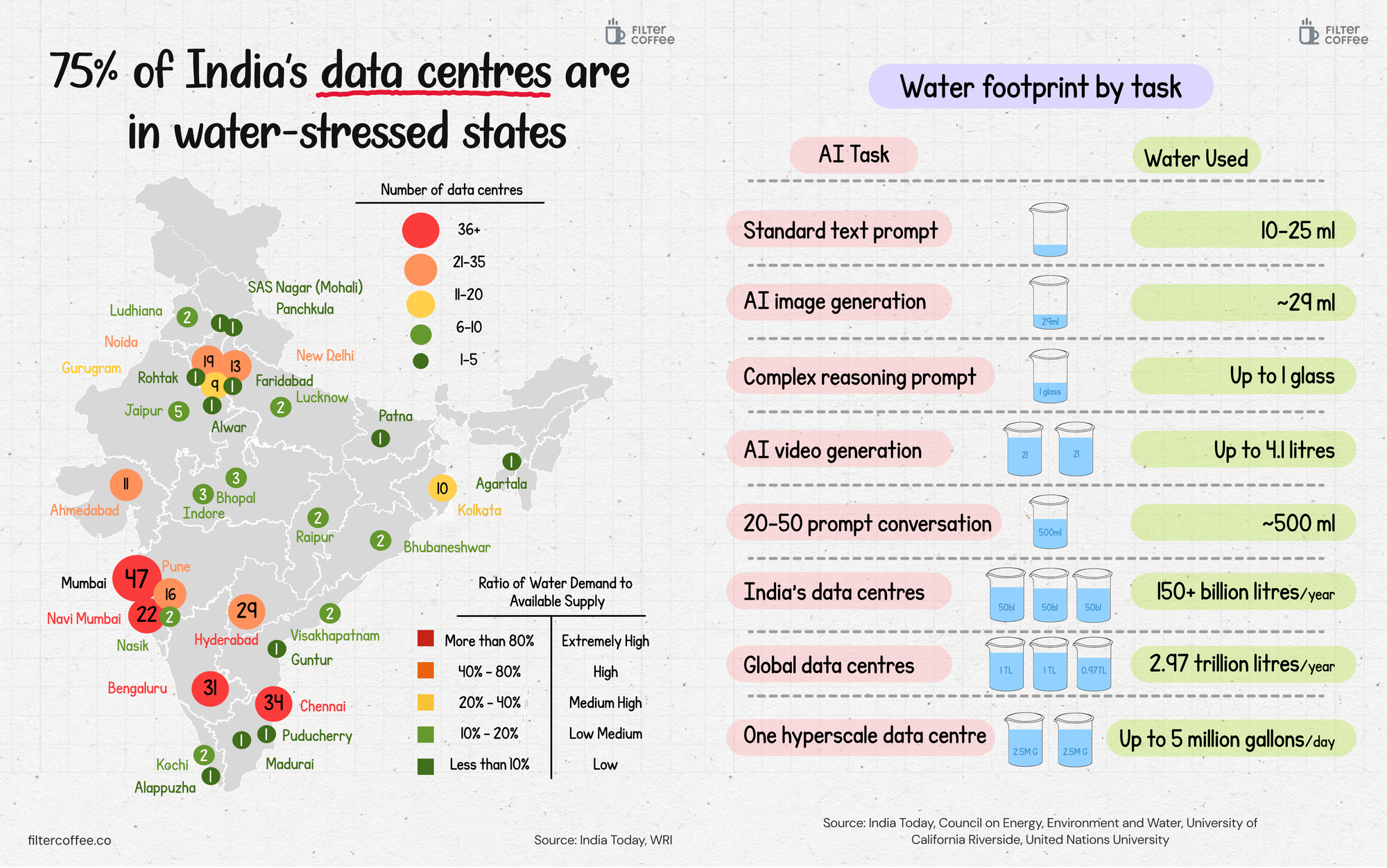
Researchers estimate that every 20 to 50 queries to a large language model like ChatGPT can consume roughly the equivalent of a 500 ml bottle of water.
Most of this water isn't used by the AI itself, but by the massive data centres that keep servers cool while they process billions of requests. On a per-query basis, the number may seem insignificant. But scale changes everything.
AI adoption is exploding globally. Millions of people now rely on tools like ChatGPT for work, education, coding, research and entertainment.
Every interaction requires computing power, and every increase in computing power requires more infrastructure. That infrastructure is increasingly concentrated inside large data centres filled with servers operating around the clock.
And data centres have a thirst problem.
India's data centre industry is expanding rapidly as companies race to build the infrastructure needed for AI, cloud computing and digital services.
Global technology firms are committing billions of dollars to new facilities, while cities such as Mumbai, Chennai, Bengaluru and Hyderabad are emerging as key hubs. Yet nearly 75% of India's data centre capacity is located in water-stressed states, creating a challenge that receives far less attention than discussions around chips, GPUs or AI models.
The concern becomes easier to understand when viewed globally. Morgan Stanley estimates that AI-related data centres could consume more than one trillion litres of water annually by 2028, an eleven-fold increase from 2024 levels. Nearly half of the world's data centres are already located in regions facing high water stress.
Even technology companies are starting to acknowledge the issue.
Google recently disclosed that a single query to its Gemini AI assistant consumes approximately 0.26 millilitres of water. The number sounds trivial until it is multiplied across billions of interactions every day. And many researchers argue that these estimates still exclude indirect water consumption linked to electricity generation and semiconductor manufacturing.
Yet the story is not entirely negative. The same technology that consumes water is also helping conserve it.
AI-powered systems are improving irrigation efficiency, detecting pipeline leaks, forecasting floods and helping utilities manage scarce water resources more effectively. In some cases, AI tools have helped reduce agricultural water usage by as much as 80%, while water utilities have used advanced analytics to significantly cut losses from leakages.
That leaves policymakers, companies and consumers facing a difficult balancing act. AI is becoming one of the defining technologies of this decade, and the infrastructure supporting it will continue to grow. The question is no longer whether we build more data centres, but how we build them.
For years, conversations around AI focused on algorithms, models and computing power. But as the technology becomes embedded in everyday life, another resource is moving into focus.
Water. Because the future of AI will not be determined only by the intelligence of machines, but also by the resources required to keep them running.