

 Newsletter

The moment your first salary hits your bank account, there is one piece of advice that seems to follow, regardless of how much you earn: start an SIP.
Whether you earn ₹20,000 a month or ₹2 lakh, the suggestion is usually the same. Put a little money away every month and keep investing. It has become almost a rite of passage for a new generation of Indian earners.
The numbers show just how popular the habit has become. In August 2026, investors put ₹32,297 crore into mutual funds through SIPs, the highest monthly contribution on record. The number of SIP accounts crossed 10.75 crore, while SIP assets stood at ₹18.62 lakh crore.
The growth over the past few years has been substantial. Monthly SIP contributions were ₹9,923 crore in August 2021. Five years later, they are more than three times that amount.
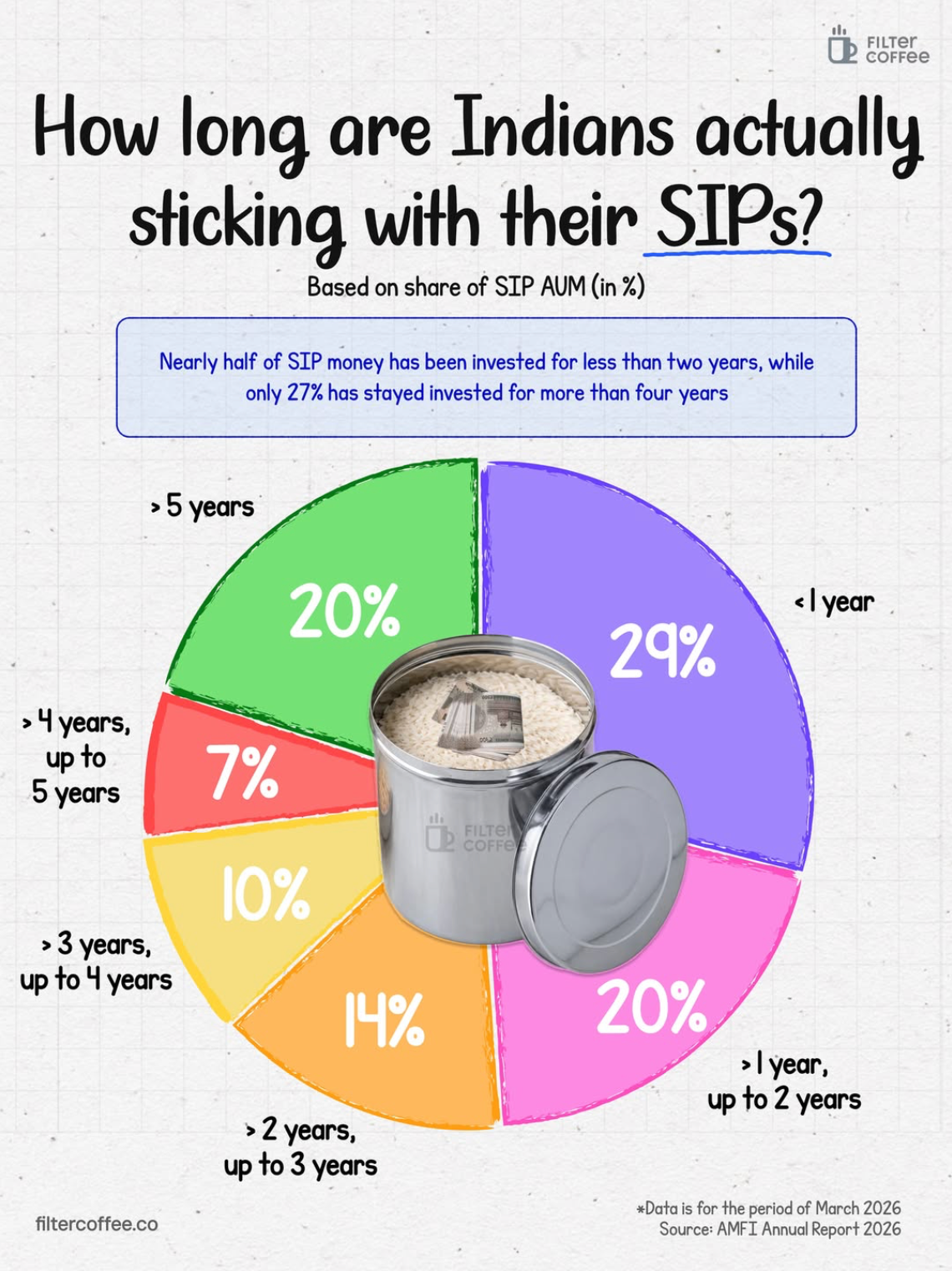
But the money coming into SIPs today is still relatively young. Nearly half of SIP assets have been invested for less than two years. This is partly a reflection of how quickly the investor base has expanded. In FY26 alone, 7.19 crore new SIPs were registered, while 6.80 crore were discontinued or completed.
The longer-term numbers are more encouraging. The share of SIP assets that have remained invested for more than five years has been rising steadily. AMFI-Crisil data shows it increased from 6.3% in March 2020 to 17% in March 2025.
That matters because the benefit of an SIP does not come from simply setting up an auto-debit. The idea is to keep investing across different market conditions and allow the investment to compound over several years. Someone who starts during a strong market and stops when markets fall misses a large part of what the strategy is meant to achieve.
For years, the challenge for the mutual fund industry was getting Indians to invest in market-linked products at all. That behaviour has changed considerably. SIPs have moved from being something a financially savvy investor might consider to something routinely discussed when a young person starts earning.
The monthly contribution numbers tell us how much money is entering the system today. The holding-period data will tell us how much of that money eventually becomes long-term capital.
For now, one thing is clear: SIPs have become a mainstream part of how Indians invest, while the question of how long investors stay invested is still playing out.