
 Newsletter
The next time you see an Indian fighter jet, board a train or buy an insurance policy, there’s a decent chance the company behind it is older than the country itself.
That sounds like a history lesson. It isn’t.
Just look at what happened this week. Hindustan Aeronautics, founded in 1940, reported a 15% jump in quarterly profit to ₹1,590 crore. Its shares rose after the results as investors focused on the company’s growing defence opportunity.
Now think about that for a second. A company that existed before Independence is still being judged by investors on what it can build for India decades from now.
HAL isn't alone.
Garden Reach Shipbuilders & Engineers traces its roots back to 1884. In June 2026, it was upgraded to Navratna status after its revenue climbed from ₹1,754 crore in FY22 to ₹7,002 crore in FY26. Profit rose almost four times over the same period, reaching ₹748 crore.
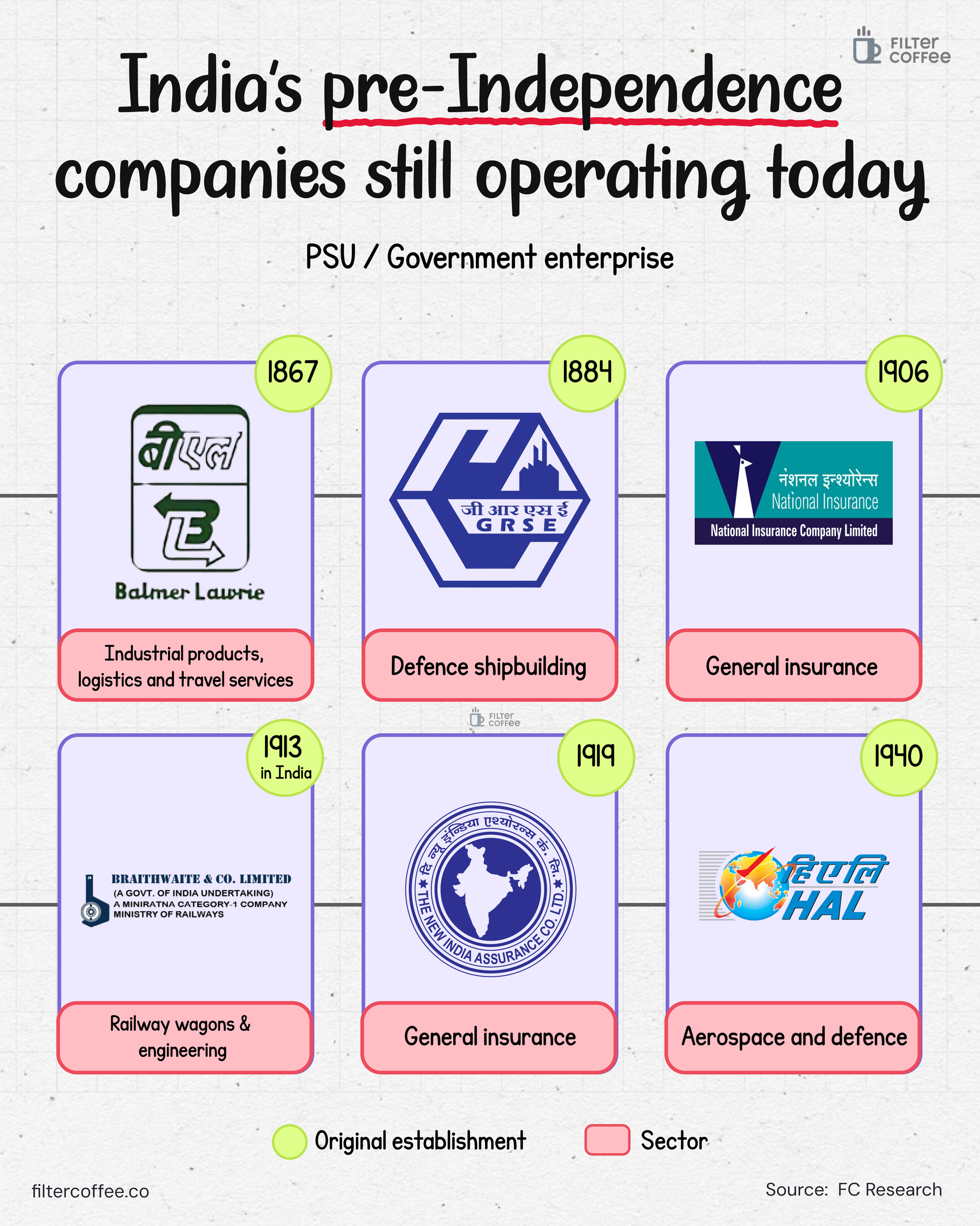
Then there is Balmer Lawrie, which began in 1867, long before the first Indian stock market boom. Today, the company operates across industrial packaging, logistics, travel and lubricants. Its FY26 consolidated turnover was about ₹2,763 crore, with a profit of ₹202 crore.
And New India Assurance, founded in 1919, is still one of the country's biggest general insurers. In FY26, its gross written premium grew 8.2%, while its Indian market share increased from 12.56% to 12.74%.
We often talk about India as a young economy filled with startups, new-age businesses and companies trying to build the next big thing. But underneath all of that sits an older India that never really went away.
These companies have lived through Independence, wars, nationalisation, liberalisation, economic crises and technological revolutions. Some changed industries. Some changed ownership. Some nearly disappeared from public attention.
But they adapted, and today, many of them are benefiting from themes that are distinctly 2026: defence spending, domestic manufacturing, infrastructure and India's push to become less dependent on imports.
Maybe that is the strangest part of the story. Some of the companies building India's future aren't new at all.
They were here before India was.