
 Newsletter
India’s banking system has suddenly found itself with a problem banks usually don't complain about: too much money.
Surplus liquidity crossed ₹10 lakh crore in early September and reached around ₹11.16 lakh crore by September 7. That is a huge jump from the ₹3.67 lakh crore average seen in August and ₹1.07 lakh crore in July. The RBI has been trying to pull some of this money back, including through reverse repo auctions.
The main reason goes back to a scheme the RBI launched to bring more dollars into India. Banks were encouraged to raise foreign currency deposits from Indians living overseas and swap those dollars with the RBI. The response was far bigger than expected. By August 31, the scheme had brought in $127.23 billion through FCNR(B) deposits, taking total foreign currency mobilisation through the RBI's special measures to $136.38 billion. The FCNR(B) window was even closed a month early because the response was so strong.
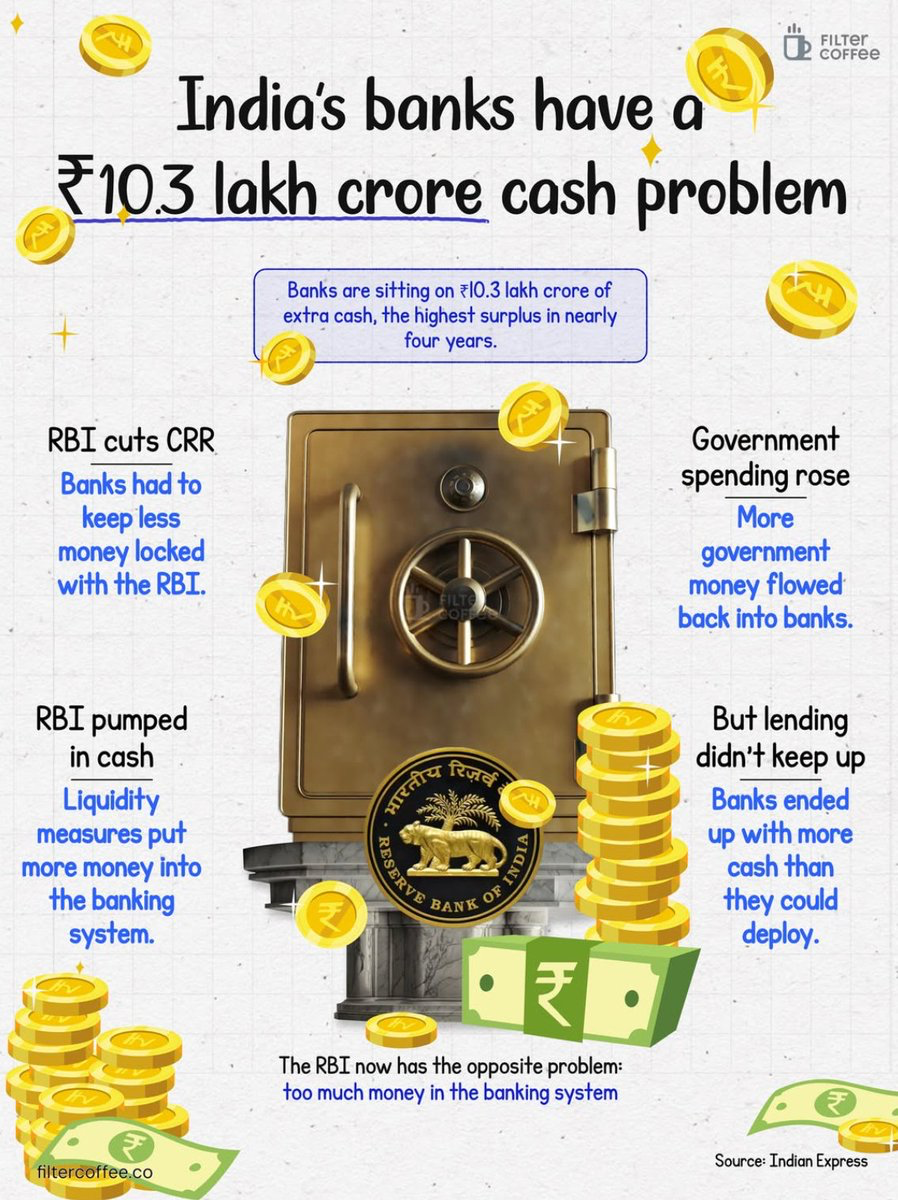
Here is where the problem starts. When banks brought those dollars to the RBI, they received rupees in return. So India gained a huge pile of foreign exchange reserves, but the banking system simultaneously received a huge amount of rupee liquidity.
Government spending added to the flow. The earlier cut in the cash reserve ratio also meant banks had more money available for lending. Put together, money was entering the system much faster than the RBI wanted.
You can see the effect in money markets. The weighted average call rate fell to around 4.93%, below the RBI's 5.25% repo rate. When banks have more cash than they need, they are willing to lend that cash to each other at lower rates.
That creates a headache for the RBI. Its policy rate is supposed to influence borrowing costs across the economy, but an enormous liquidity surplus can push short-term rates below the level the central bank intends.
So the RBI has started taking the excess money back. It absorbed ₹6.02 lakh crore through two VRRR auctions, and has also been looking at longer-duration reverse repos and foreign exchange swaps to deal with the more persistent part of the surplus.
And this is what makes the situation unusual. The RBI spent months trying to attract dollars into India because the rupee was under pressure. It succeeded spectacularly. Now it has another problem to manage: all those dollars have created a mountain of rupees inside the banking system.
The question now isn't whether India has enough liquidity. It is how long the RBI can keep that liquidity from spilling into the wider economy.