
 Newsletter
India’s ports have quietly pulled off something big.
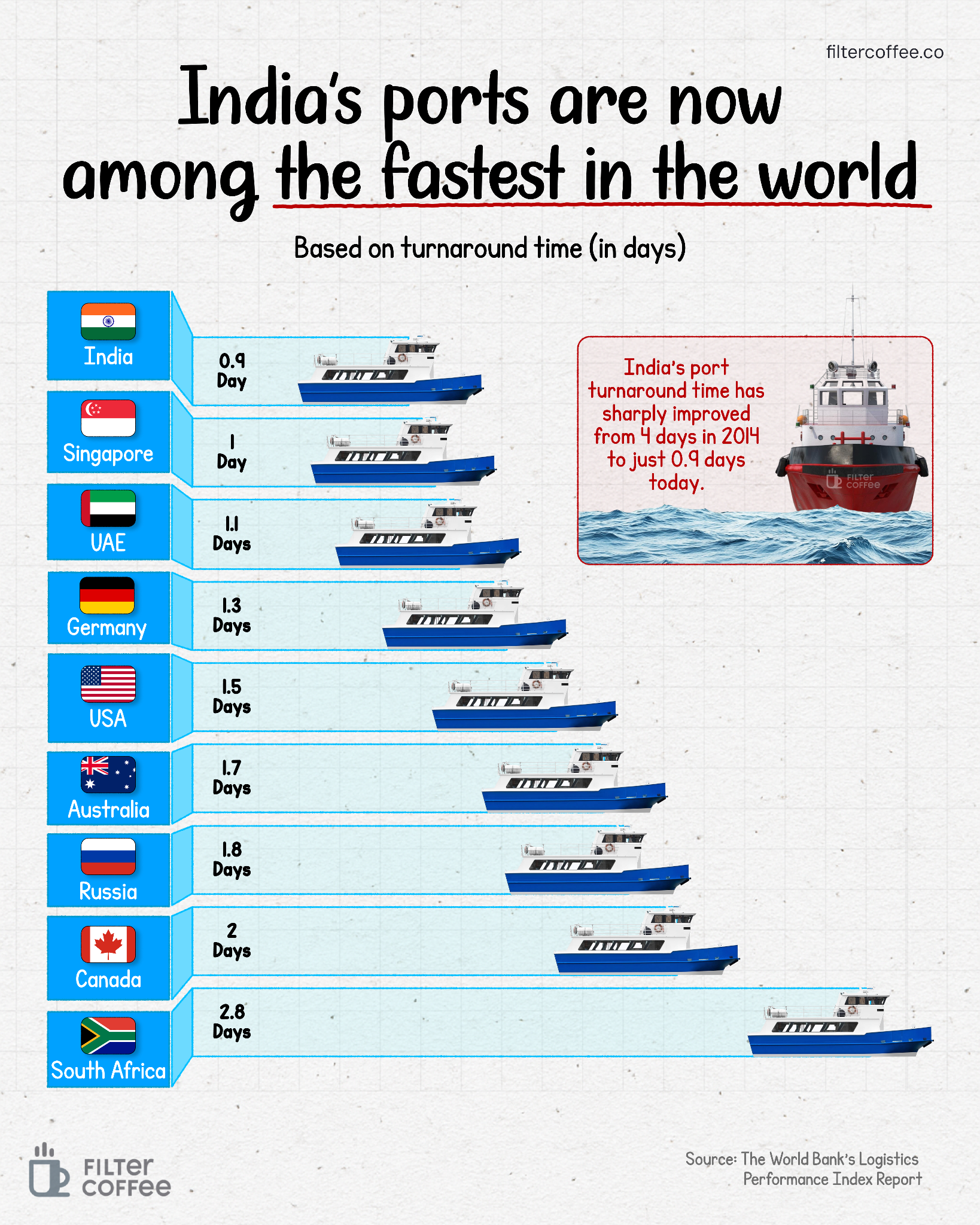
According to recent global comparisons, ships at Indian ports now spend an average of just 0.9 days before moving on, a significant improvement from nearly 4 days a decade ago.
This drop has pushed India into the league of the fastest port systems in the world, even ahead of places like the US, Germany and Australia on turnaround time.
This is not just a feel good statistic but the outcome of a much larger shift that has been building over the past ten years.
To begin with, scale is a key factor.
India’s major ports handled a record 915 million tonnes of cargo in FY26, growing over 7% year on year. The previous year, they were already at 855 million tonnes.
Container traffic is rising too, with Jawaharlal Nehru Port (JNPA) crossing 7.3 million TEUs, its highest ever. Ports like Paradip and Deendayal are now handling over 150 million tonnes each, which would have been unthinkable a decade ago.
Now think about what used to go wrong.
Earlier, ships would queue outside Indian ports for days. Cargo would take time to load and unload. Paperwork was slow. Coordination between customs, port authorities and logistics players was messy.
All of this added to delays, and delays meant higher costs. For a country that depends heavily on trade, that was a serious bottleneck.
So what changed?
A big part of the answer lies in a government push called Sagarmala. Since its launch, more than 800 projects worth over ₹6 lakh crore have been identified, and over 300 of these have already been completed.
These projects are not just about building more ports, but also about modernizing existing ones, improving connectivity to roads and railways, and creating logistics parks around them.
Technology has also played a huge role.
Digitization of port processes has reduced paperwork and improved coordination. Mechanization has sped up cargo handling. Better planning has reduced idle time for ships.
The result is visible in the numbers as the average turnaround time at major ports has dropped from around 96 hours in 2015 to under 50 hours recently.
And when measured using global benchmarks like the World Bank’s logistics index, it comes down even further.
Private investment is another piece of the puzzle.
Public private partnerships in ports have picked up pace, with investments jumping from about ₹1,300 crore in FY23 to nearly ₹4,000 crore in FY25.
Port land allocations alone could unlock future investments worth close to ₹70,000 crore. This means ports are no longer just government operated infrastructure, but evolving into competitive, efficiency driven ecosystems.
Then comes the next big ambition. India does not just want faster ports. It wants to become a global transshipment hub.
Today, a large share of India’s cargo still gets routed through foreign ports like Colombo or Singapore before reaching global destinations which adds cost and time but projects like the Vizhinjam port in Kerala are designed to change that.
With expansion plans to scale capacity from about 1 million TEUs to 5 million TEUs, India is trying to capture that lost opportunity.
But there is still a gap between progress and potential.
Ports are getting faster, but India’s logistics costs are still high at about 13–14% of GDP, compared to 8-10% in developed economies. Gains at ports need support from better roads, rail and last mile connectivity.
So the real story is not just that ships are moving faster through Indian ports. It is that India is slowly fixing one of its oldest economic bottlenecks.
If this momentum continues, faster ports could translate into cheaper exports, more competitive industries and a stronger position in global trade.
The ships may be spending less than a day at port now, but the impact of that change could last much longer.