

 Newsletter
According to IDC, India shipped nearly 114 million wearable devices in 2025.
That sounds like a huge number until you realise the market actually shrank by about 4% year-on-year because smartwatch demand started cooling after years of explosive growth.
The problem was simple. Most consumers had already bought their first smartwatch. Many realised they barely used half the features. Others discovered that ultra-cheap devices often gave unreliable health readings. The market that once grew on affordability suddenly needed a new reason to exist.
And that reason is turning out to be health.
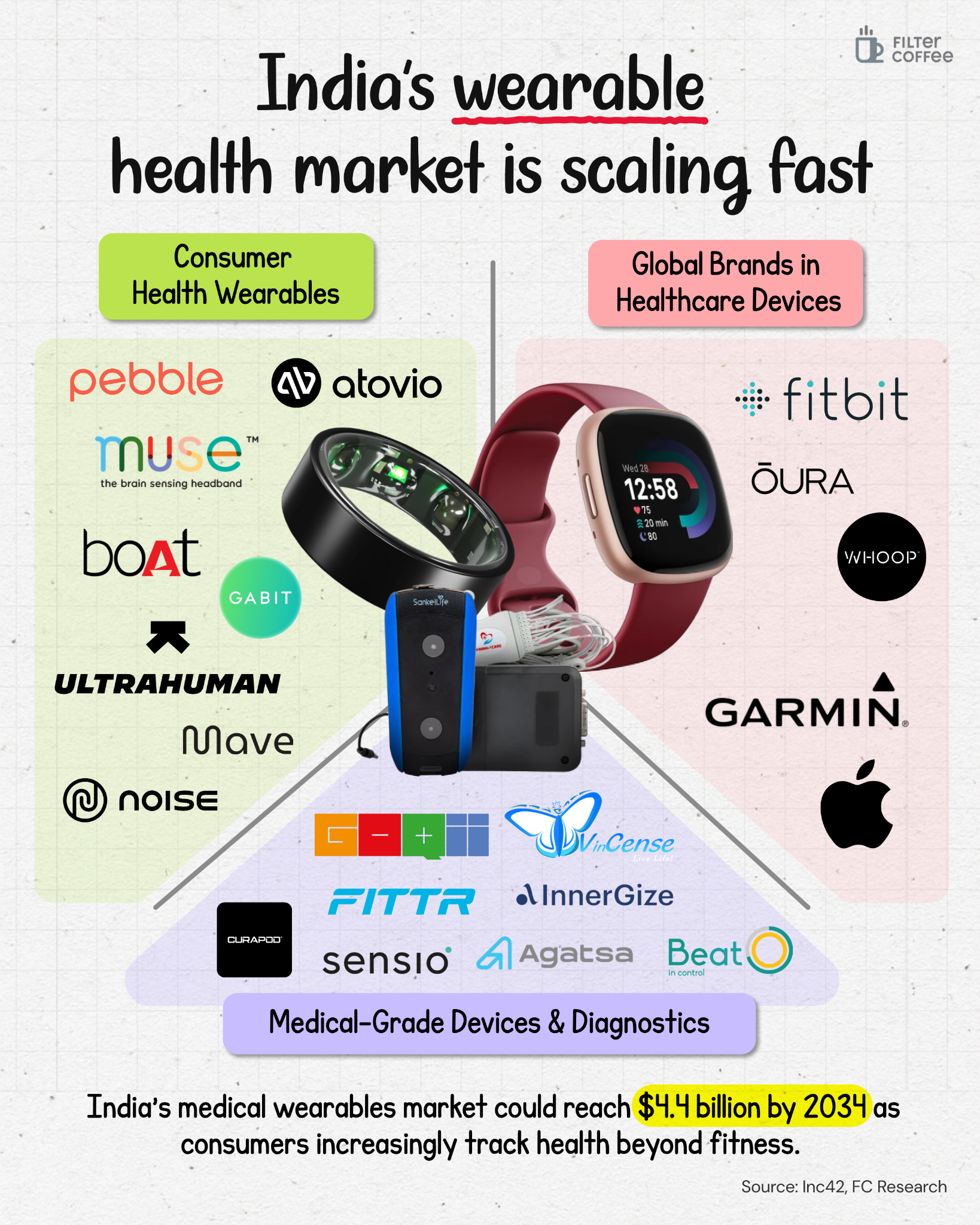
India’s medical wearables market is now expected to touch nearly $4.4 billion by 2034. That number is important because it indicates that wearables are slowly becoming part of India’s healthcare infrastructure itself.
The shift is subtle but powerful.
Earlier, people bought wearables to count steps. Now they want to track sleep quality, stress, recovery, glucose levels, blood pressure, heart rhythms and long-term health risks before symptoms even appear.
That is why the next wave of wearable companies looks very different from the previous one.
A few years ago, the stars of India’s wearable story were mostly audio and gadget brands entering smartwatches because the margins looked attractive.
Today, the ecosystem is splitting into three clear layers. The first is consumer wellness wearables led by companies like Noise, boAt, Pebble and Ultrahuman.
The second is global premium health-tech players like Apple, Garmin, WHOOP and Oura bringing subscription-driven health ecosystems into India.
The third and perhaps most important layer is medical-grade diagnostics where startups are building devices that can actually support doctors, clinics and chronic disease management.
This third layer is where the story becomes far bigger than gadgets.
India already has more than 100 million diabetics. Hypertension and cardiac risks are rising rapidly in urban India. Hospitals remain overcrowded and preventive healthcare is still underdeveloped.
In such a situation, wearables start making much more sense because they shift monitoring from hospitals to homes. Instead of waiting for an annual health checkup, consumers can now track vitals daily through connected devices. That changes behaviour. It also changes healthcare economics.
Take smart rings for example.
Globally, smart rings were once considered niche wellness accessories. In India, they are quickly becoming the premium end of wearable health tracking because they are smaller, less distracting and can continuously monitor health metrics without looking like bulky gadgets.
Bengaluru-based Ultrahuman has become one of the biggest examples of this shift. The company reportedly crossed ₹565 crore in revenue in FY25 and even turned profitable, driven largely by its smart ring business. That is unusual in a hardware market where profitability is often difficult.
Then came another signal that India’s wearable story is entering a more serious phase.
Oura, one of the world’s biggest smart ring companies, officially entered India in 2026 with devices priced close to ₹40,000. That pricing alone says something important. Companies now believe Indian consumers are willing to spend premium amounts on continuous health intelligence.
And the business model is evolving too.
Earlier, wearable brands earned money mostly by selling hardware once. Now many companies want recurring subscription revenue through personalised insights, coaching, recovery scores, AI-driven recommendations and health analytics.
The watch or ring is slowly becoming just the entry ticket into a much larger health data ecosystem.
This is also why companies outside traditional healthcare are suddenly paying attention.
Insurance firms are exploring wearable-linked wellness programs. Fitness platforms are integrating wearable data into training plans. Corporate wellness programs are increasingly offering health trackers to employees. Even diagnostic startups are building connected ECG monitors, glucose trackers and remote patient monitoring systems that work directly through smartphones.
At the same time, regulation is becoming more important because the line between a fitness gadget and a medical device is getting blurry. If a wearable claims it can detect heart irregularities, monitor glucose or support diagnosis, regulators will eventually demand stronger clinical validation.
India’s data privacy rules are also tightening, which matters because health data is among the most sensitive forms of personal information.
And beneath all this sits the biggest shift of all.
India’s wearable boom is increasingly being driven by anxiety around health, rising lifestyle diseases and the desire to catch problems early before they become expensive medical emergencies.
That changes the entire story.
The first phase of India’s wearable market was about affordability and mass adoption. The second phase may end up becoming something much bigger: a country trying to build a preventive healthcare layer through devices people wear every single day.