

 Newsletter

Bond markets have always been a tough and a tricky topic to crack, and right now, something is happening globally. So, let’s break it down in the simplest way possible.
What’s the news: investors are selling bonds across major global markets, pushing bond yields to multi-year highs. But before we get into why, let’s understand what bonds, bond markets and yields actually mean.
What are bonds: when a government or company needs money, instead of taking a bank loan, it can borrow from investors by issuing bonds.
Bonds are very different from stocks. When you buy a stock, you own a small piece of a company. When you buy a bond, you are essentially lending money to a government or company, which promises to repay you along with a set amount of interest.
What is a bond market: it is a marketplace where government and corporate bonds are bought and sold.
It allows investors with money to lend it to governments or companies that need funds for projects and other expenses. You may also hear it referred to as the debt, fixed-income or credit market.
What are bond yields: a bond yield is basically the return you earn from a bond.
For example, say you have a ₹1,000 bond that pays you ₹50 a year. Your yield is 5%.
FYI: bond prices and yields move in opposite directions. When investors sell bonds, their prices fall and yields rise. When bond prices rise, yields fall.
Okay, now that we have the basics down, let’s connect the dots.
Why are global bond yields rising?
The US 10-year Treasury yield has climbed to 4.8%, a level last seen in January 2025. And it’s not just the US. Bond yields in the UK, Germany, France and Japan have also surged to multi-year or even multi-decade highs.
Rising inflation reduces the value of a bond’s fixed payments because your money buys less. Investors then demand higher returns to compensate, making older bonds with lower returns less attractive. As investors sell them, bond prices fall and yields rise.
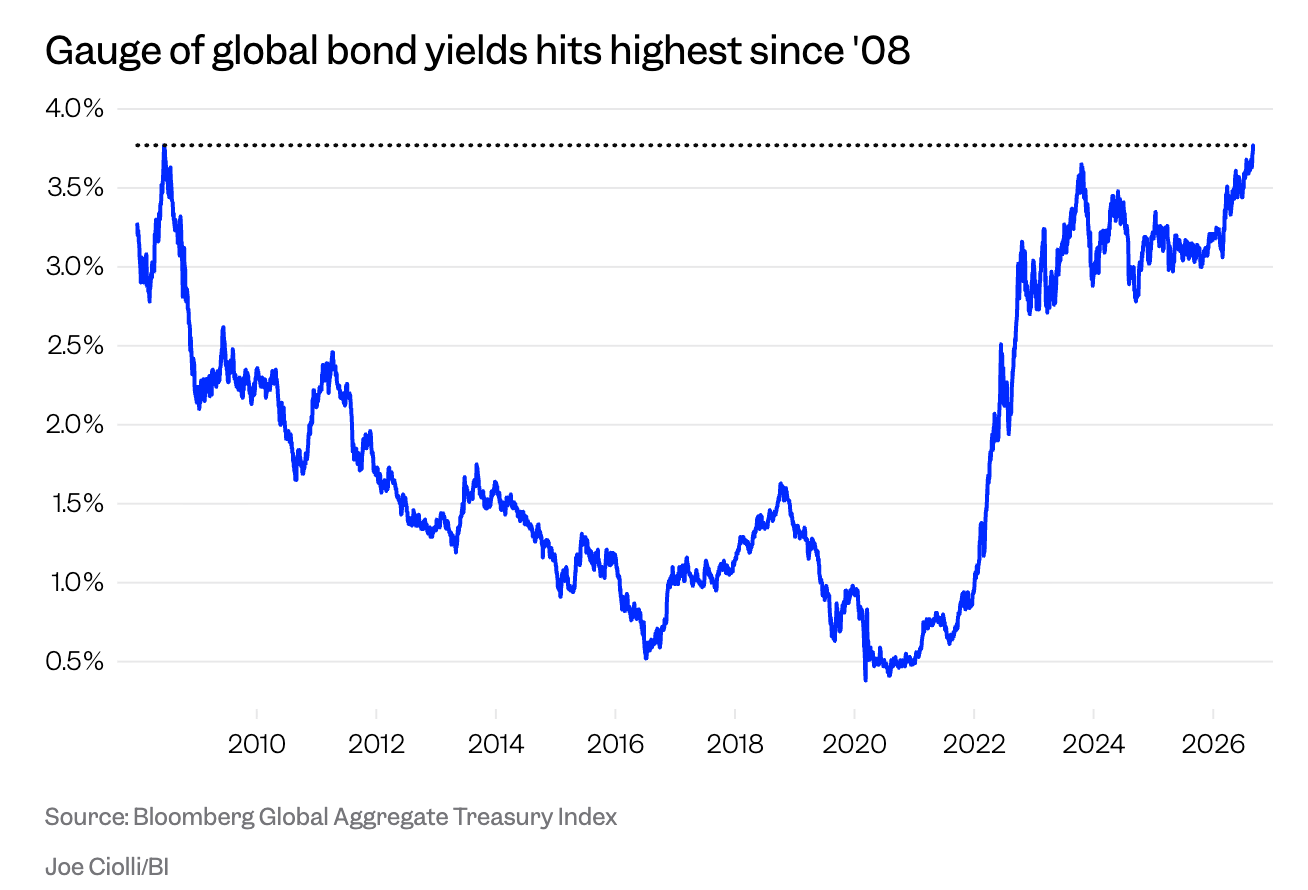
So, what’s driving this?
Rising oil prices amid US-Iran tensions are fuelling inflation concerns. If inflation stays high, central banks may need to keep interest rates higher or raise them further. That makes newly issued bonds more attractive, pushing down the prices of existing bonds and driving their yields higher.
Then there’s government debt. The US debt pile has crossed $40 trillion, while government debt is at or above 100% of GDP across most G7 economies, except Germany.
Higher borrowing requirements can mean governments need to offer investors higher yields to attract enough money. A hawkish speech by US Federal Reserve Chair Kevin Warsh at the Jackson Hole symposium has also increased traders’ expectations of further rate hikes.
Why do rising bond yields matter?
Bond yields help set the tone for borrowing costs across an economy, from government debt to mortgages, car loans and other forms of credit. When yields rise, borrowing becomes more expensive, which can eventually weigh on spending, investment and economic growth.
For instance, US 30-year mortgage rates have climbed to a one-year high of nearly 6.7% alongside the rise in 10-year Treasury yields. Governments also face higher borrowing costs when they refinance or issue new debt.
Where does India stand?
India has largely stayed away from the sustained bond-market sell-off seen in several major economies. Although Indian bond yields rose 11 basis points in August, their biggest monthly increase in FY27, they remain below the Iran war peak of nearly 7.2%.
Some context: the current global bond sell-off may look painful, but it is still nowhere close to the rout seen four years ago, when soaring inflation forced central banks into a rapid series of interest-rate hikes.
While the latest sell-off has pushed yields to multi-year highs across some of the world’s biggest bond markets, the scale of the move remains a fraction of what investors experienced in late 2022.