

 Newsletter

Every time the Union Budget comes closer, the middle class slips into a familiar headspace. Conversations drift toward income tax.
WhatsApp groups become unexpectedly active. Everyone hopes this will finally be the year some real relief shows up. Most years, that hope fades quickly.
Budget 2025 broke that pattern.
When Finance Minister Nirmala Sitharaman announced that individuals earning up to ₹12 lakh annually would pay zero income tax, it landed as genuine relief, not a technical adjustment. For salaried employees, the benefit stretched further.
With a ₹75,000 rebate, the effective tax-free limit moved to ₹12.75 lakh. That is money back in pockets. Money for EMIs, school fees, rising grocery bills, or simply breathing room in a stretched monthly budget.
Naturally, this headline grabbed attention. But if you stop there, you miss the more interesting part of Budget 2025.
A big part of that story sits in capital expenditure.
For FY26, the government allocated ₹11.21 lakh crore towards capex, a modest increase of 0.9% from FY25. On its own, that number feels underwhelming. But look closer and the picture changes.
When you include effective capital expenditure by both the Centre and states, the total rises to ₹15.4 lakh crore. That is the government doubling down on a belief it has held for years. Infrastructure spending drives jobs, demand, and long-term growth more reliably than short-term consumption boosts.
Interestingly, not all sectors were treated equally.
Railways, a regular budget favourite in recent years, saw no increase in allocation. That pause feels intentional. After years of heavy investment, the message seems to be about execution and efficiency rather than expansion for expansion’s sake.
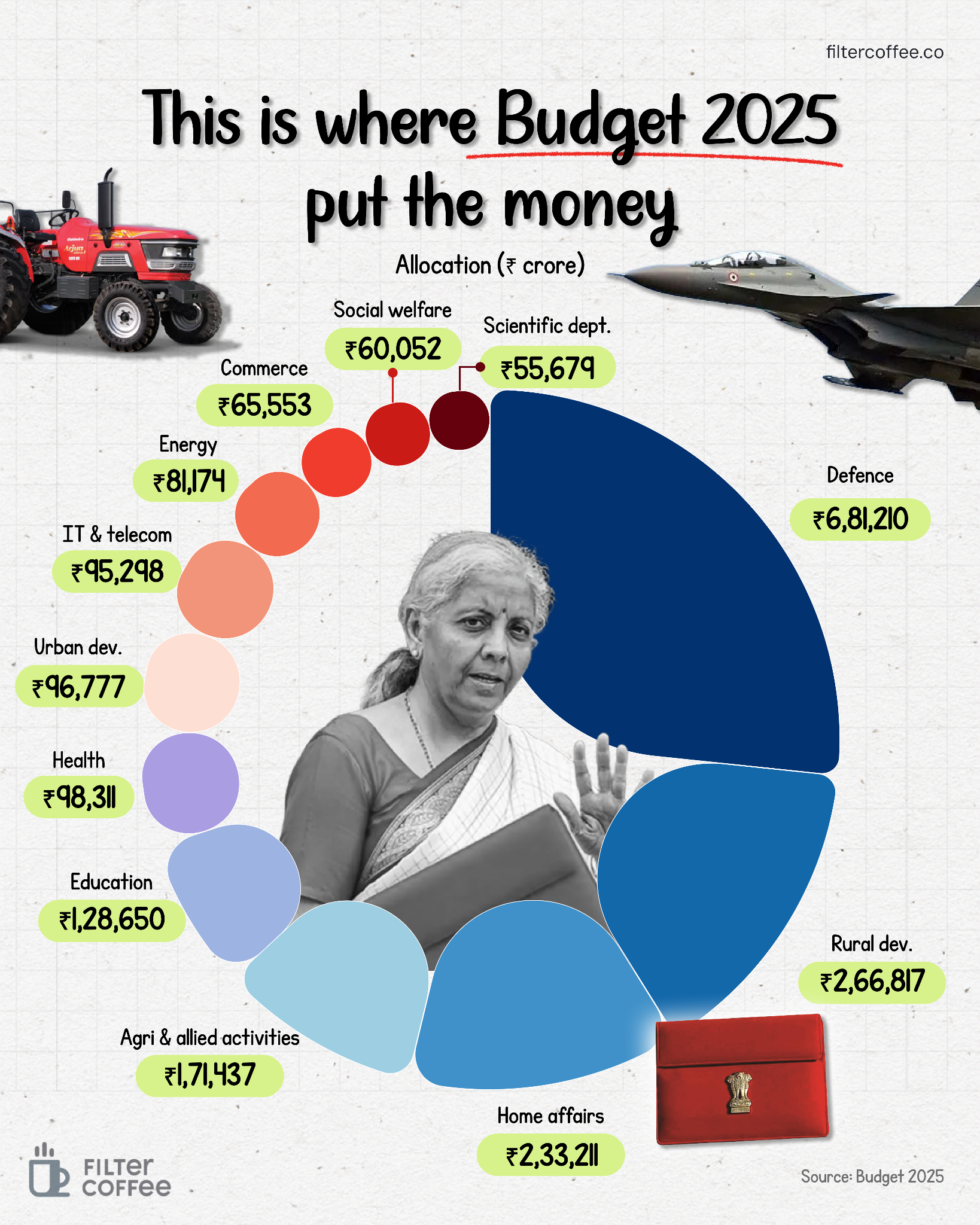
Defence, however, remained a clear priority. The allocation for FY26 rose to ₹6,81,210 crore, nearly 10% higher than last year. Defence spending now carries industrial weight. Capital outlay alone stands at ₹1,92,387 crore, with projected expenditure of ₹1,60,795 crore.
The naval fleet was allocated ₹24,390 crore. Another ₹63,099 crore went into other equipment. It signals continued momentum toward modernisation and domestic manufacturing, without shouting about it.
Agriculture also received meaningful attention. The sector was allocated ₹1.71 lakh crore, up from ₹1.51 lakh crore last year.
More importantly, the budget introduced the PM Dhan-Dhaanya Krishi Yojana. It targets 100 low-productivity districts and aims to improve yields, promote crop diversification, and support sustainable farming practices. Better irrigation, easier access to credit, and long-term resilience sit at the core of this move.
Healthcare quietly had a solid year.
The allocation rose to ₹98,311 crore, marking nearly 10% YoY growth. The National Health Mission alone received ₹37,226.92 crore. Ayushman Bharat PM-JAY was allocated ₹9,406 crore, while ₹4,200 crore went to health infrastructure under PMABHIM. The pharma PLI scheme received an additional ₹2,445 crore. These numbers do not make headlines, but they matter when capacity, access, and resilience are tested.
Education followed a similar path.
Budget 2025 allocated ₹1,28,650 crore to the sector, up 6.6 percent from last year. Schools received ₹78,572.1 crore, while higher education got ₹50,077.95 crore. Beyond the numbers, the announcements stood out. A ₹500 crore Centre of Excellence in Artificial Intelligence for education. Ten thousand new medical seats next year. Seventy-five thousand more over five years.
Rural development emerged as one of the biggest winners.
With ₹2,66,817 crore allocated, it became the second-highest funded sector after defence. At the same time, urban development was not ignored. The Ministry of Urban Affairs received ₹82,577 crore, along with a proposed ₹1 lakh crore urban challenge fund aimed at transforming cities into growth hubs, improving water access and sanitation.
So yes, Budget 2025 delivered what the middle class wanted. Tax relief arrived, and it arrived meaningfully. But beyond that, the budget focused on continuity. On spending where returns compound slowly.