

 Newsletter

The FIFA Men's World Cup has just wrapped up, and once again, football reminded the world why it remains the biggest sporting spectacle on the planet. The tournament expanded from 32 to 48 teams for the first time, delivered 104 matches instead of 64, drew billions of viewers across continents, and was projected to generate almost $8.9 billion in revenue during the 2023 to 2026 cycle.
However, while football continues to dominate globally, cricket has quietly become one of the richest sports businesses in the world, and India is almost entirely responsible for that transformation.
At first glance, the comparison feels unfair. Football is played professionally in almost every country. FIFA has 211 member associations, more than the United Nations has member states. Cricket, on the other hand, is followed passionately by a handful of countries, with India accounting for the overwhelming majority of its audience.
Even though cricket is played seriously in far fewer countries than football, its global governing body has quietly become the second-richest international sports federation in the world.
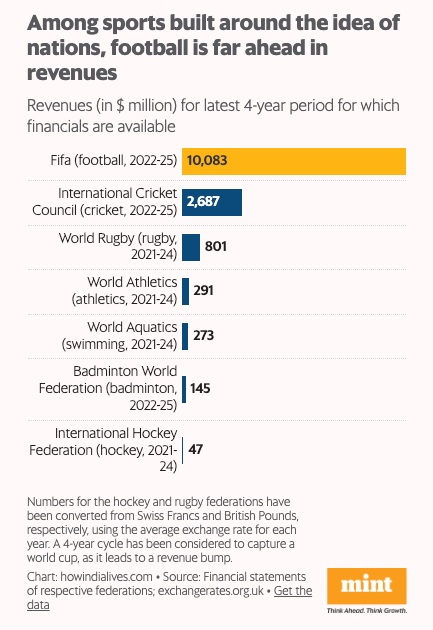
According to the latest financial statements, FIFA generated about $10.1 billion during its latest four-year cycle, while the International Cricket Council (ICC) earned about $2.69 billion over the same period. No other international sports federation comes close.
That is still only about one-fourth of FIFA's revenue, but it is comfortably ahead of World Rugby at about $801 million, World Athletics at $291 million, World Aquatics at $273 million, the Badminton World Federation at $145 million and the International Hockey Federation at just $47 million. For a sport with a far smaller global footprint, that is an extraordinary achievement.
So, how did cricket become so rich without becoming nearly as global as football?
Sports are no longer built only on stadiums, trophies and fan loyalty. They are built on media rights, streaming platforms, sponsorships and advertising. In simple terms, sports today are media businesses first and sporting events second. The more hours of live content a sport can create, the more valuable it becomes to broadcasters, advertisers and streaming platforms.
Football still leads because it has unmatched global reach. The FIFA World Cup attracts audiences from every continent, allowing FIFA to sell broadcasting rights across more than 220 territories.
Broadcasting contributes roughly 44% of FIFA's revenue, sponsorships account for another one-third, while ticket sales and hospitality generate most of the remaining income. The scale is enormous because every major multinational brand wants to be associated with the tournament, whether it is Coca-Cola, Adidas, Visa or Hyundai. No other international sporting event delivers that combination of worldwide attention and commercial value.
Cricket, however, found a different way to grow.
For years, the ICC depended heavily on the men's ODI World Cup, held once every four years. Revenue would spike during World Cup years and then fall sharply afterwards. That pattern has now changed completely. The ICC has built a much more consistent calendar by expanding its portfolio of events.
Alongside the ODI World Cup, it now organises the Men's and Women's T20 World Cups, the Champions Trophy and the World Test Championship. Each tournament adds another opportunity to sell broadcasting rights and sponsorships, creating a steadier stream of income instead of relying on one blockbuster event.
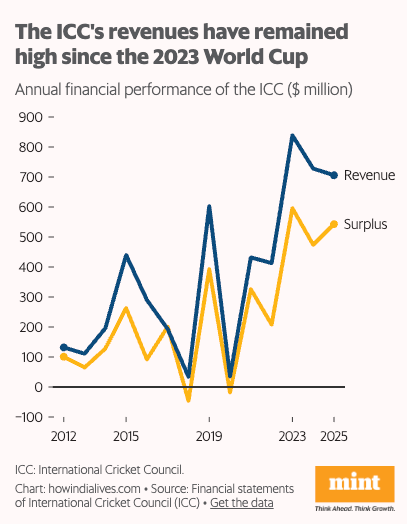
The numbers show just how dramatic that shift has been. The ICC generated a record $839 million in revenue during 2023, when India hosted the ODI World Cup. More importantly, revenue did not collapse after the tournament ended.
It remained at $728 million in 2024 and around $706 million in 2025. Also, sporting organisations usually experience sharp revenue swings between major tournaments. The ICC has largely escaped that cycle by creating multiple premium events that broadcasters are willing to pay for.
But the biggest reason cricket's economics changed is not the ICC. It is India.
The Board of Control for Cricket in India (BCCI) has become the financial engine of global cricket. During 2024-25, the BCCI reported revenue of about ₹11,055 crore, roughly $1.3 billion. That means India's cricket board alone generated nearly half the revenue earned by the ICC over an entire four-year cycle. Even more remarkable is where much of that money comes from. The Indian Premier League.
When the IPL began in 2008, many people viewed it as a shorter version of cricket designed mainly for entertainment. Today, it has become one of the most valuable sports properties in the world.
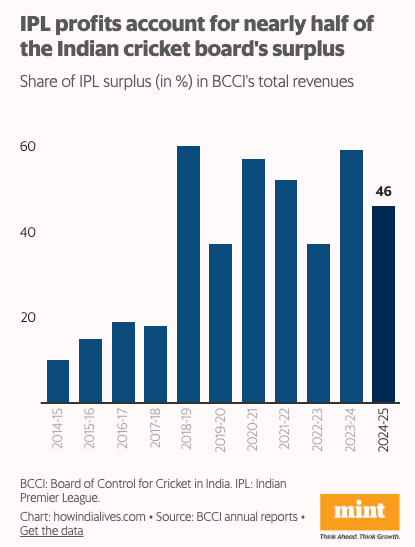
In seven of the past twelve years, IPL revenues have exceeded the BCCI's own traditional revenues. In five of the last seven years, the tournament has contributed between 40% and 60% of the board's annual surplus. In other words, a tournament lasting barely two months now finances a large part of Indian cricket for the remaining ten months of the year.
That financial strength also translates into influence. Under the current revenue-sharing model, the BCCI reportedly receives about 38.5% of the ICC's distributable earnings, far more than any other member board.
This is why decisions involving international cricket increasingly revolve around India's broadcasting market, scheduling preferences and commercial interests. Cricket may be an international sport, but financially it has become heavily dependent on one country.
Traditional international tournaments are slowly facing competition from private franchise leagues. Consider broadcasting deals. The NFL in the United States earns around $10 billion every year from media rights. The NBA generates roughly $6.9 billion annually.
England's Premier League earns about $5.2 billion every year. Even the broadcasting value associated with the 2026 FIFA World Cup works out to about $4.3 billion. The IPL, despite operating for only a few months each year and serving a much smaller audience, commands media rights worth roughly $900 million annually.
The reason is straightforward. International tournaments are short. A World Cup may last one month every four years. Broadcasters earn from that excitement, but only briefly. Franchise leagues, on the other hand, keep viewers engaged every week, every season and every year.
More matches mean more advertisements, more subscriptions, more sponsorship opportunities and more reasons for fans to remain connected. Live sports is one of the few forms of content that people still prefer watching in real time, making it extremely valuable in the age of streaming.
This shift is forcing sports administrators to rethink how they build their competitions. FIFA expanded the World Cup to 48 teams partly to increase the number of matches and commercial opportunities. Cricket has responded by creating more ICC tournaments and strengthening franchise leagues. Women's competitions are receiving greater investment because they represent one of the fastest-growing areas in global sports.
Technology is also becoming a larger part of the business through streaming platforms, digital memberships, fantasy sports and sports betting in markets where it is legal.
Yet football still enjoys one advantage that cricket cannot easily replicate. Geography. Football belongs to almost everyone. Cricket, despite all its commercial success, still depends heavily on South Asia for its audience and revenue. That limits how much it can grow internationally.
FIFA's commercial strength comes from the fact that almost every major economy has fans, sponsors, broadcasters and national teams invested in the sport. Cricket has become incredibly profitable without becoming truly global, but reaching football's scale would require expanding well beyond its traditional markets.
That does not make cricket's rise any less impressive. In fact, it makes it more remarkable. The sport has climbed to become the world's second-richest international sports business without enjoying football's universal appeal.
India transformed cricket's economics by creating one of the most successful sports leagues in history, attracting record broadcasting deals and turning live cricket into premium entertainment. Football remains the world's biggest sports business because of its unmatched global reach, but cricket has proved that you do not need billions of fans to build a billion-dollar industry. Sometimes, all it takes is one market that watches, spends and cares enough to change the economics of an entire sport.