
 Newsletter

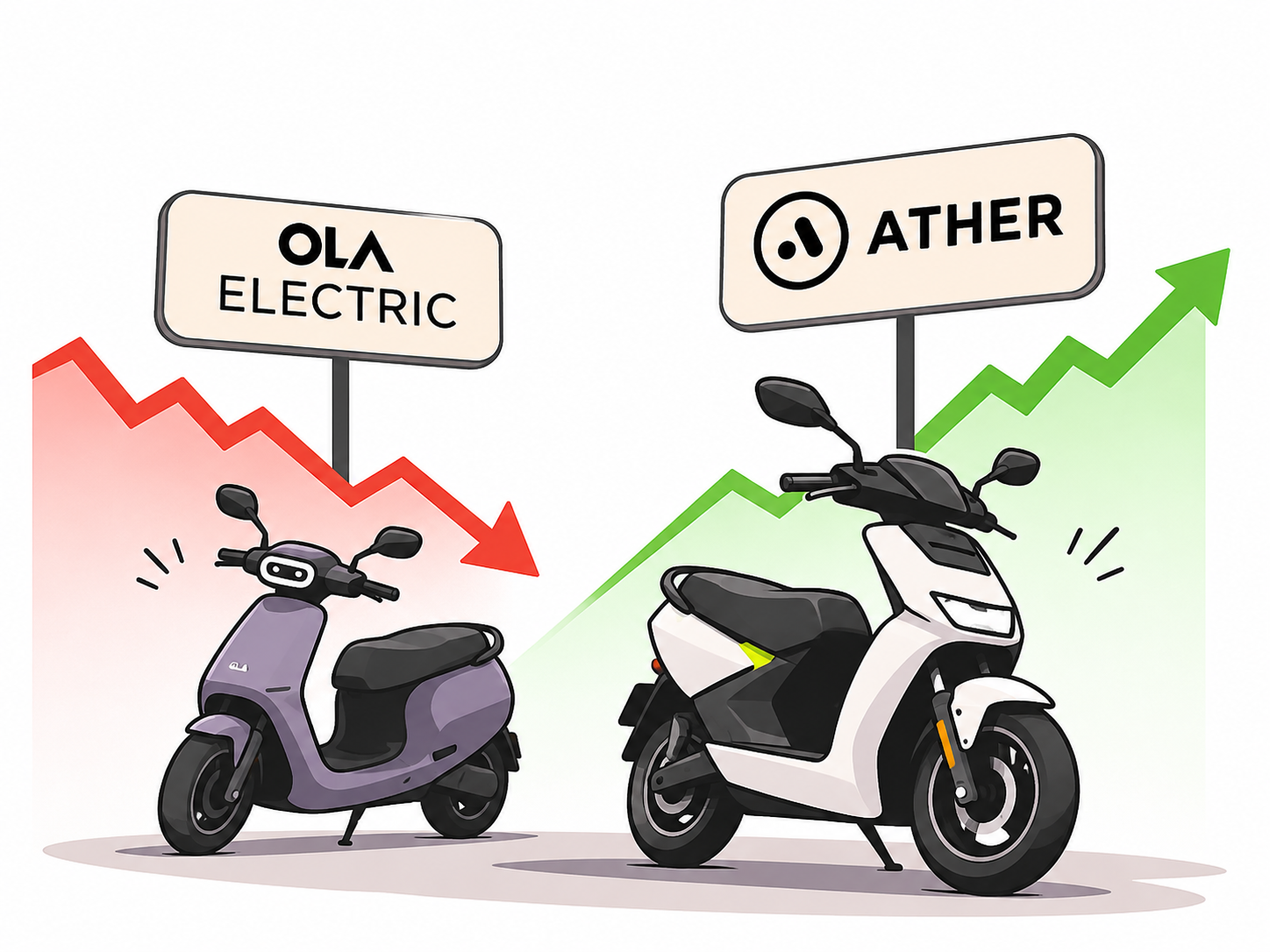
Ola Electric has reported another difficult quarter. Its revenue fell 39% year-on-year to ₹421 crore in the September quarter, while its net loss stood at ₹362 crore. Rival Ather Energy, meanwhile, reported 63% revenue growth to ₹1,464 crore and posted a small net profit of ₹1.26 crore.
And this is happening when India's electric two-wheeler market is growing rapidly. Industry registrations rose nearly 83% during the quarter, reaching approximately 6 lakh vehicles. Yet Ola's registrations declined 17% to 41,650.
So, how did a company that once dominated India's electric scooter market end up struggling to keep pace?
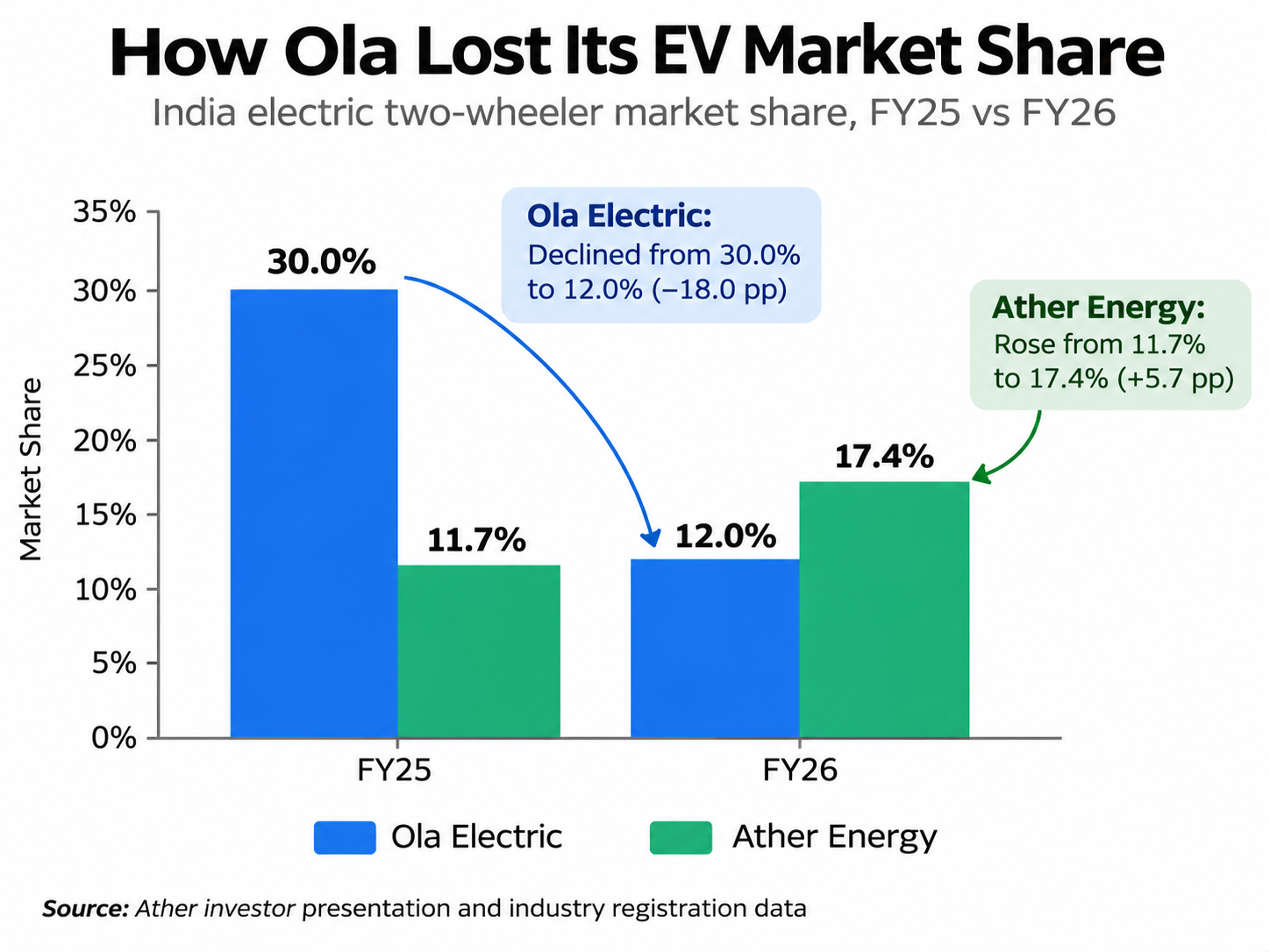
In FY24, Ola controlled nearly 35% of India's electric two-wheeler market. By FY26, its share had dropped to roughly 12%. Ather moved in the opposite direction, increasing its market share from around 12% in FY25 to 17% in FY26. Meanwhile, established manufacturers such as TVS and Bajaj also expanded rapidly, overtaking both startups.
A large part of Ola's early success came from its aggressive expansion strategy. Unlike traditional automobile companies, which rely on independent dealerships, Ola initially sold scooters through its own stores and online channels. This gave the company greater control over pricing, sales and customer relationships.
But running a nationwide network of company-owned stores, service centres and delivery operations also meant carrying substantial operating costs.
And servicing became a major headache.
In 2024, the National Consumer Helpline received 10,644 complaints involving Ola Electric, covering delayed repairs, warranty disputes and other service problems. The consumer watchdog subsequently ordered an investigation. Ola later acknowledged that problems with service execution had damaged customer trust.
Ather, meanwhile, was expanding its customer base through a different strategy.
Its initial 450-series scooters were positioned around performance and technology. But in 2024, the company introduced the Rizta, a family-oriented scooter offering a larger seat, more storage and everyday practicality.
The product opened up a broader market. Within 21 months of its launch, Ather had sold more than 2.5 lakh Riztas.
Its FY26 investor presentation shows how this played out across India. In Gujarat and Odisha, where Ather credits the Rizta for its growth, its combined market share increased from 4.1% to 19.2% between Q1 FY25 and Q4 FY26.
In Maharashtra, Madhya Pradesh and Chhattisgarh, expanding dealerships helped lift its combined share from 4% to 16.6%.
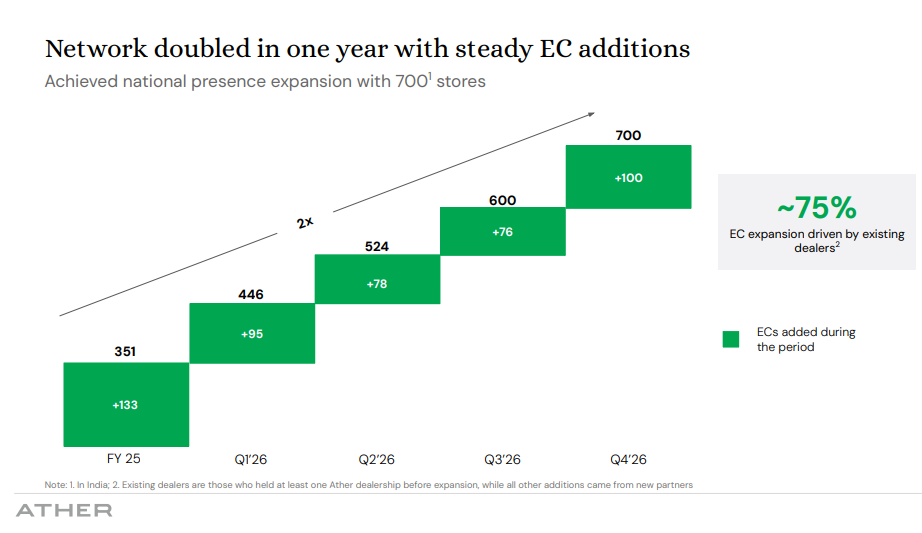
Ather also doubled its experience centres from 351 to 700 in FY26, alongside 548 service centres. Around 75% of that retail expansion came through existing dealership partners.
Ola is now adopting a similar dealer-led approach. After expanding to thousands of company-operated touchpoints, the company stopped accepting orders through its own stores on 1 November 2026 and plans to close most of them by December.
It had appointed 255 dealer partners operating 319 stores by 8 November, with plans to reach 700 stores by March 2027.
According to Ola's latest shareholder letter, the transition should reduce operating expenses by another ₹50 crore. Dealers will also pay for vehicles when ordering them and maintain their own inventory, reducing the amount of money Ola needs to keep tied up in stock.
The financial differences between the two businesses are equally revealing.
During FY26, Ather reduced its manufacturing and sourcing cost per scooter from ₹1,48,918 in FY24 to ₹1,10,199, an improvement of approximately 26%. Its adjusted gross margin rose from 9% to 24% during the same period.
Ather is also earning money beyond selling scooters. Software packages, charging, accessories and servicing contributed around 15% of its revenue in the latest quarter, compared with 12% a year earlier.
Ola's automotive business still generates a gross margin of nearly 30%. But with quarterly automotive revenue of ₹420 crore and operating expenses of ₹269 crore against gross profit of ₹125 crore, the company continues to lose money at the operating level.
Ola is simultaneously investing in manufacturing its own battery cells. It has commissioned 6 GWh of cell capacity and expects higher production yields to eventually reduce battery costs. But its cell business generated just ₹3 crore in revenue against an ₹84 crore net loss during the September quarter.
The investment could improve Ola's cost structure over time, although scaling battery manufacturing requires considerable capital.
Ola now maintains that demand is exceeding supply and that component availability is restricting production. It expects monthly vehicle production to increase to 25,000 units by December, alongside the expansion of its dealer network.
The next few quarters will show whether that restructuring can revive sales.
Ather has gained ground by expanding into family scooters, improving manufacturing economics and building a wider dealer network. Ola, which once set the pace for India's electric scooter market, is now reorganising the very distribution model that helped it grow so quickly.
And with TVS, Bajaj and other manufacturers expanding too, recovering that lost market share will be considerably harder than winning it the first time.