
 Newsletter

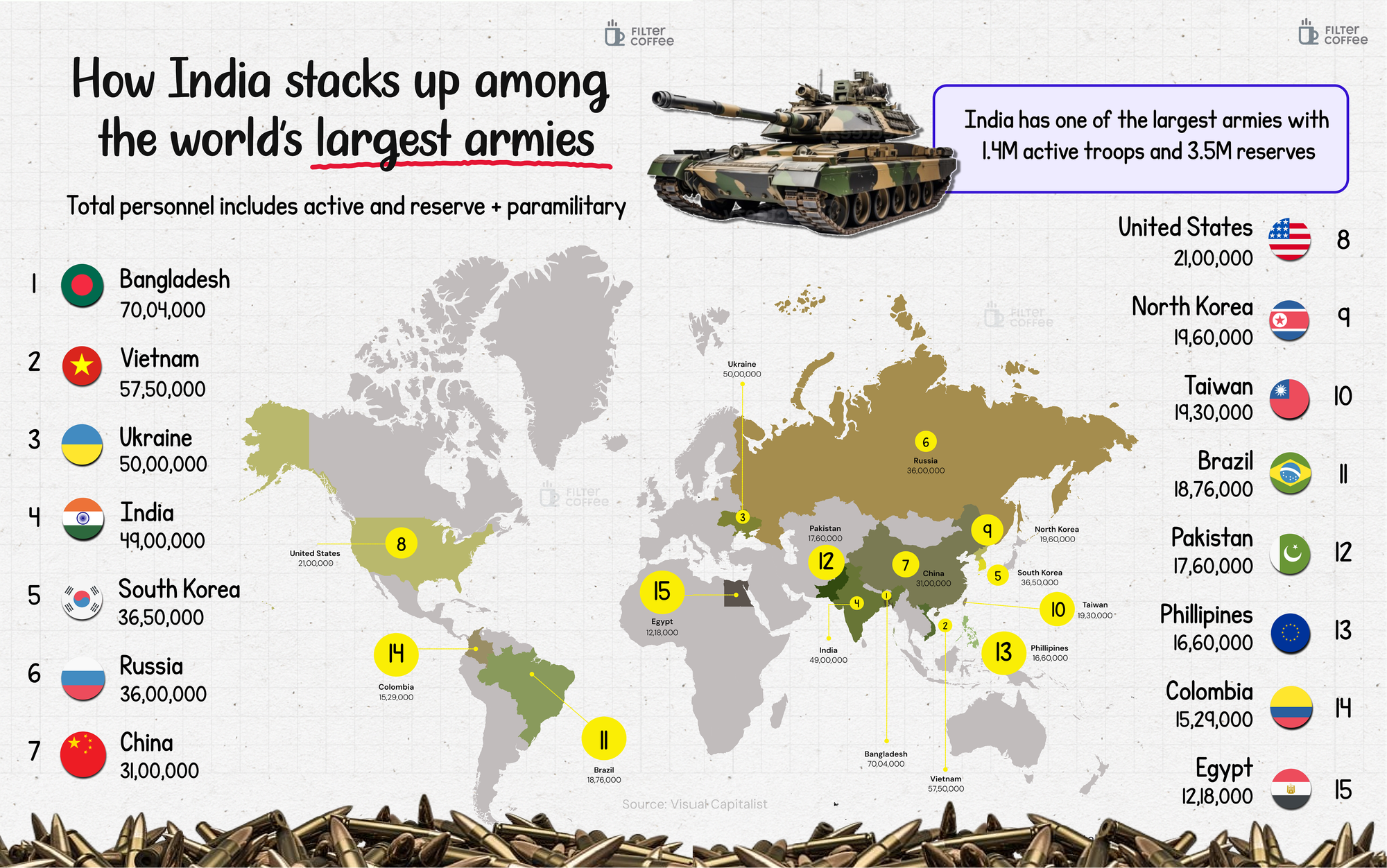
India has one of the largest armies in the world, with roughly 14 lakh active troops and a total strength close to 49 lakh when you include reserves and paramilitary forces. That’s the headline doing the rounds right now, placing India among the top four globally by sheer manpower.
You may assume that a bigger army means a stronger country. But that’s not really how modern militaries work anymore.
Because having more soldiers doesn’t automatically mean having more power.
Take the United States. It has around 21 lakh personnel in total, much lower than India’s overall count. Yet, it consistently ranks as the most powerful military in the world. Why? Because today, wars are less about how many boots you can put on the ground and more about how effectively you can deploy technology, intelligence, and coordination.
And India seems to have understood this shift.
Over the last year, the conversation around India’s military has moved away from just headcount to capability. The Union Budget for FY26 allocated a record ₹6.81 lakh crore to defence, marking a steady increase of about 9.5% year-on-year.
Out of this, roughly ₹1.8 lakh crore is being spent on capital expenditure, which essentially means buying and upgrading equipment. More interestingly, over ₹1.1 lakh crore of that is earmarked specifically for domestic procurement. That’s a big signal. India isn’t just trying to maintain a large army, it’s trying to build its own military ecosystem.
And this shift is already visible on the ground.
In early 2025, the Defence Acquisition Council cleared proposals worth over ₹54,000 crore. These include things like high-powered engines for T-90 tanks, which are critical for operations in high-altitude regions like Ladakh. India’s focus is not just on numbers anymore. It’s on making those numbers work better in real-world conditions.
At the same time, the structure of the army itself is changing. The Agnipath scheme, which introduced short-term recruitment through Agniveers, is reshaping how soldiers are inducted and retained. Instead of a purely long-term force, India is experimenting with a younger, more flexible pool of personnel. It’s still a work in progress and has sparked debates, but the intent is clear. A leaner, more agile force is being prioritised over a purely large one.
And then there’s the idea of integration.
Recent operations and official briefings have emphasised “jointness” between the Army, Navy, and Air Force. In simple terms, instead of operating as three separate units, the goal is to function as one coordinated system. Because modern conflicts are rarely fought in isolation.
There’s also a shift happening in who makes up the army. The number of women officers has gone up from around 3,000 a decade ago to over 11,000 today. In terms of scale, but it signals a broader transformation in how the military is evolving as an institution.
But perhaps the most underrated piece of this puzzle is infrastructure.
Having lakhs of soldiers means very little if they can’t move quickly when needed. That’s why India has been investing heavily in border infrastructure. The Border Roads Organisation alone has seen its allocation rise to over ₹7,000 crore, and in late 2025, more than 100 strategic projects worth around ₹5,000 crore were completed. Roads, tunnels, bridges. Not glamorous, but absolutely critical. Because in places like Ladakh or Arunachal Pradesh, logistics can decide outcomes before a single shot is fired.
And then there’s an angle most people don’t immediately connect to the military: exports.
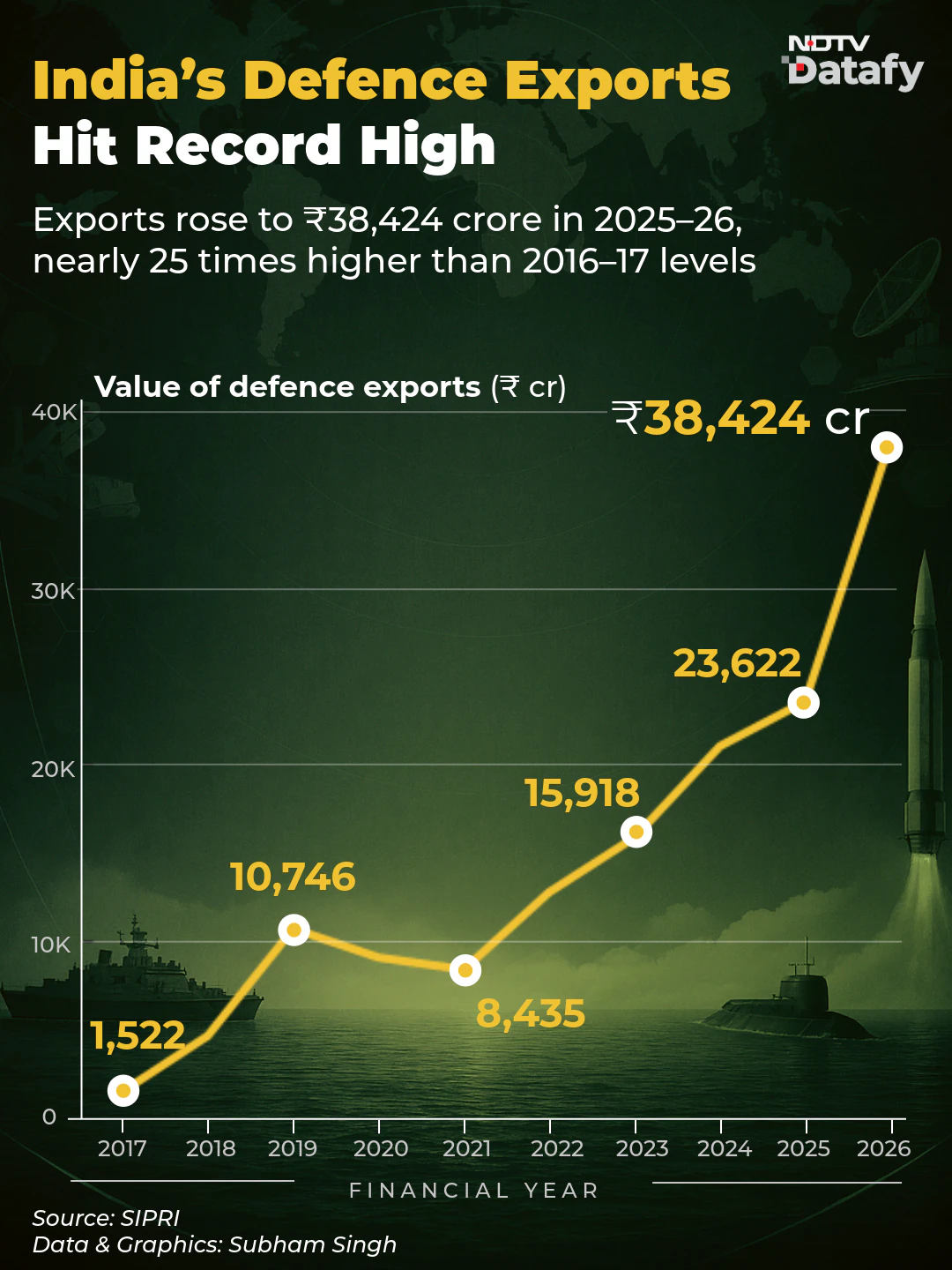
India’s defence exports have jumped sharply, crossing ₹38,000 crore in FY26, up more than 60% in a single year. That’s not just about revenue. It’s about influence. Countries that buy your defence equipment also build strategic relationships with you. So India’s military strength is now slowly translating into economic and geopolitical leverage.
Put all of this together, and the story starts to look very different.
Yes, India still has one of the largest armies in the world by sheer numbers. That hasn’t changed. But the real shift is happening beneath the surface. From manpower to modernisation. From imports to domestic manufacturing. From isolated forces to integrated operations. From size to strategy.
So the next time you see a chart ranking the world’s largest armies, it’s worth pausing for a second. Because the real question isn’t just how big an army is. It’s how well that army is built for the kind of conflicts the future will bring.
And that’s the transition India is currently trying to make.