

 Newsletter

For decades, discussions around India's wealthiest people were overwhelmingly dominated by men. Mukesh Ambani. Gautam Adani. Azim Premji. Shiv Nadar. Kumar Mangalam Birla. The occasional woman appeared on the list, but often as an exception rather than a trend.
India's richest woman today isn't a Bollywood celebrity, a startup founder or even a stock market star.
It's Roshni Nadar Malhotra.
In 2025, after receiving a significant stake transfer in HCL's promoter entities from her father Shiv Nadar, Roshni's wealth surged to roughly ₹2.8 lakh crore according to the Hurun India Rich List. That made her not just India's richest woman, but one of the three wealthiest people in the country. Around the same time, Forbes continued to rank Savitri Jindal among India's wealthiest individuals, with a fortune approaching $40 billion.
According to the Hurun India Rich List 2025, India now has more than 100 women on its rich list and over two dozen female dollar billionaires. That is still a small share of India's overall wealthy population, but the direction of travel is hard to ignore.
What's even more interesting is where this wealth is coming from.
A generation ago, India's richest women were largely associated with family-owned industrial groups. Savitri Jindal became one of India's wealthiest individuals after taking over leadership responsibilities following the death of her husband Om Prakash Jindal. Smita Crishna Godrej remains linked to one of India's oldest business dynasties. Vinod Rai Gupta's wealth is tied to Havells, one of India's biggest electrical equipment companies.
But the newer generation of wealthy women tells a different story.
Take Falguni Nayar. Before founding Nykaa, she spent nearly two decades as an investment banker. Most entrepreneurs dream about starting a company in their twenties. Nayar started hers at nearly 50. Today, Nykaa has become one of India's most successful consumer internet companies and made her one of the country's most prominent self-made billionaires.
Or consider Kiran Mazumdar-Shaw, who built Biocon into India's largest biopharmaceutical company despite entering an industry where women founders were almost unheard of when she started.
Then there is Radha Vembu, one of the key shareholders behind Zoho, a software company that quietly built a global business while staying private and avoiding Silicon Valley's growth-at-all-costs playbook.
The result is that India's women-rich list increasingly reflects the changing structure of the Indian economy itself. Steel, infrastructure and manufacturing still matter. But technology, healthcare, beauty, software and financial markets are creating entirely new pathways to wealth.
Rekha Jhunjhunwala is another example of this shift. Much of her wealth comes from her stake in the portfolio built by legendary investor Rakesh Jhunjhunwala. Her presence highlights another trend that often goes unnoticed. India's stock market boom has become a significant creator of wealth, especially as retail participation continues to expand.
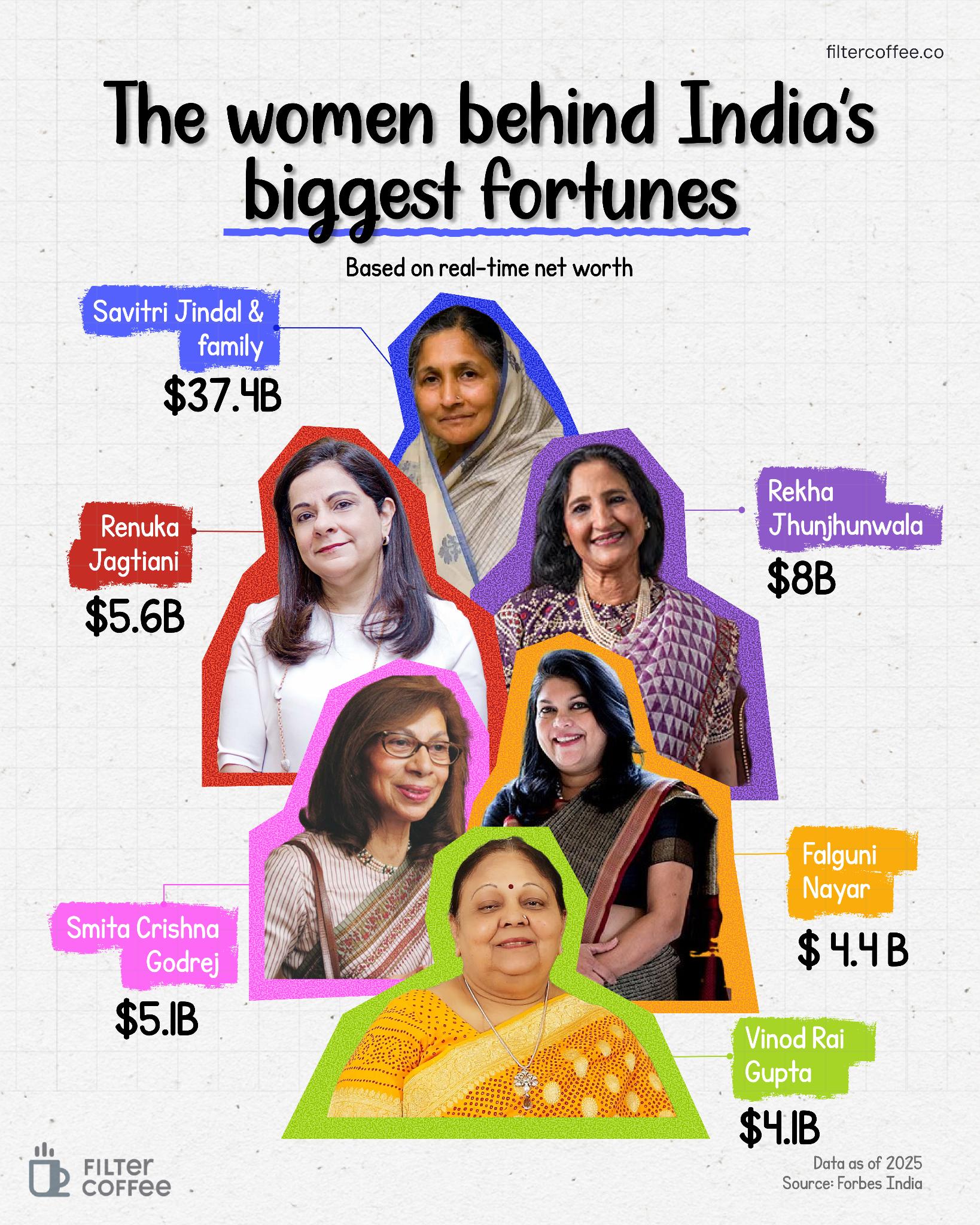
The numbers behind this transformation are staggering.
India today has more than 330 billionaires, making it one of the world's largest billionaire hubs. The country is adding wealthy individuals faster than most major economies. Household participation in equities has surged over the last decade. Startup creation has exploded. India now has more than 100 unicorns. Meanwhile, sectors such as technology services, pharmaceuticals, financial services, renewable energy and consumer brands have created wealth on a scale that would have been difficult to imagine twenty years ago.
Yet there is an important caveat.
The rise of wealthy women does not automatically mean gender equality in business.
Women remain significantly underrepresented among startup founders receiving venture capital funding. Various industry reports show female-founded startups continue to attract only a small fraction of total VC investment. Female labour force participation, while improving, remains below many comparable economies. Boardroom representation has increased due to regulatory changes, but leadership positions remain disproportionately male.
In other words, the women appearing on rich lists represent progress, but they are not yet proof that the playing field is level.
That is what makes this moment so fascinating.
India's richest women are no longer a single category. Some inherited large industrial empires. Some built companies from scratch. Some accumulated wealth through technology, investing or consumer brands. Together, they tell the story of an economy that is becoming more diverse, more entrepreneurial and more open to different routes to success.
And perhaps that is the bigger takeaway from these rankings.
The real story is not that India has wealthy women. It always did.
The real story is that India is finally producing wealthy women through multiple paths at the same time. Through boardrooms, stock markets, startups, technology firms, beauty brands, pharmaceuticals and industrial conglomerates.
The fortunes may be measured in billions, but what they really reveal is how India's economic landscape is changing. And if current trends continue, the next generation of India's richest women may look very different from the last.