

 Newsletter

You probably consumed products from at least three unlisted companies today.
Maybe you started your morning with an Amul coffee, packed a Parle-G biscuit in your bag, grabbed a Bisleri bottle on your commute, or opened a packet of Haldiram's bhujia while watching Netflix. These brands are so deeply embedded in Indian life that it's easy to assume they must be stock market giants.
But here's the surprising part: you can't buy shares in any of them.
More than 22 crore demat accounts now exist in the country. Millions of first-time investors are buying everything from banks and IT companies to defence and railway stocks. Yet some of India's most iconic consumer brands remain completely out of reach.
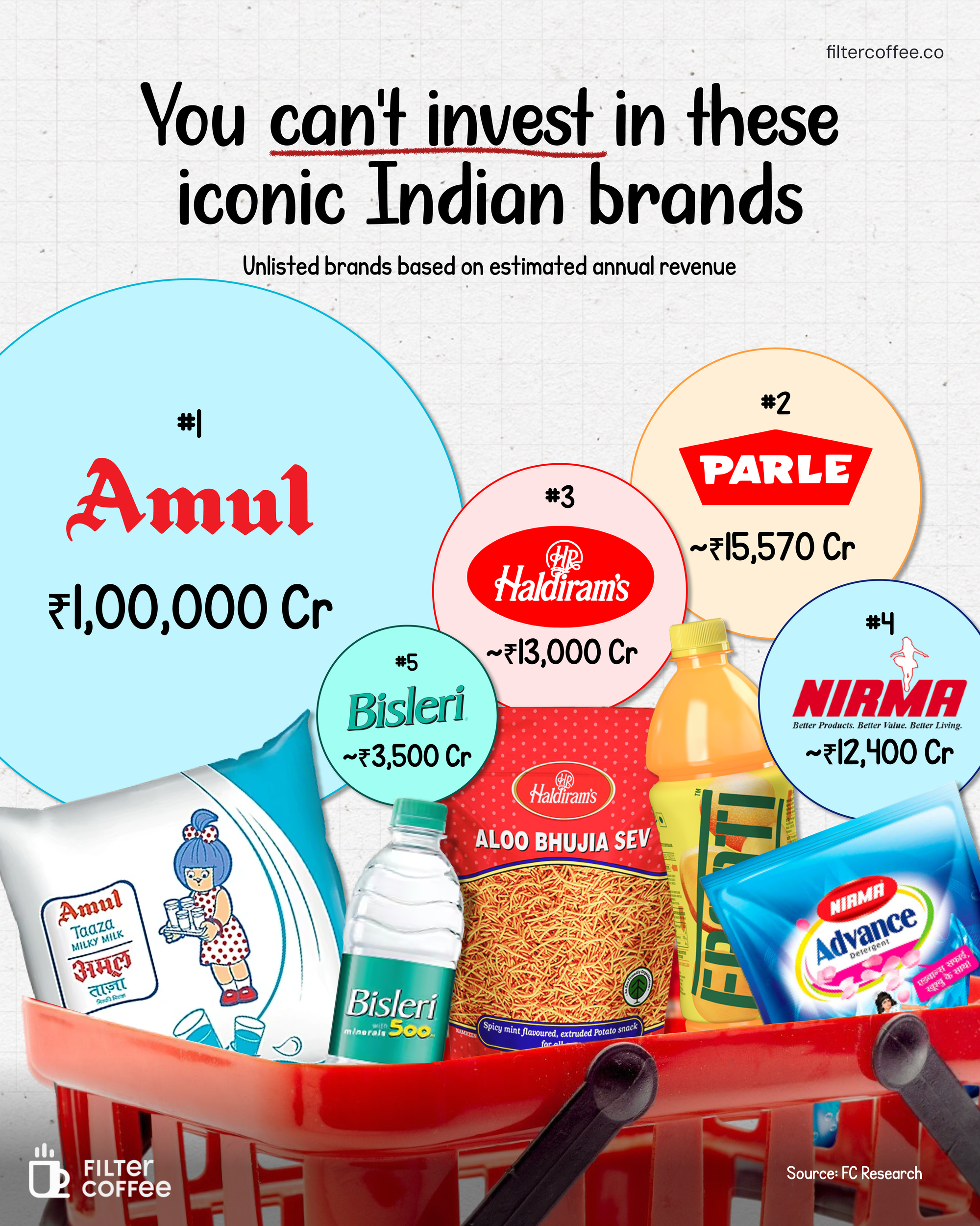
Take Amul. The dairy giant generated revenue of around ₹1 lakh crore, making it larger than many listed consumer companies. Parle Products, the company behind Parle-G, reportedly generates annual revenue of over ₹15,000 crore. Haldiram's has built a snacks empire with revenues estimated at around ₹12,977 crore. Nirma continues to generate thousands of crores through its diversified operations, while Bisleri remains India's most recognisable packaged water brand.
These are not small family businesses operating under the radar. They are massive enterprises serving millions of customers every day.
So why aren't they listed?
The answer comes down to something many founders value more than capital: control.
When a company goes public, it gains access to money from investors. That capital can be used to expand factories, enter new markets, acquire competitors, or invest in technology. But public money comes with public scrutiny. Quarterly earnings become headline news. Analysts start questioning decisions. Investors expect growth. Share prices become a daily scorecard.
Many business owners simply don't want that trade-off.
Parle is perhaps the best example. The Chauhan family has built one of India's largest FMCG businesses while remaining privately held. Although reports of a potential IPO have surfaced from time to time, the company has historically relied on its own cash flows to fund growth. As a result, it has been able to expand without diluting ownership or operating under the scrutiny that comes with being a publicly listed company.
The same logic applies to several other family-owned businesses. If a company can fund its growth through profits, bank loans, or private capital, listing becomes a choice rather than a necessity.
Then there is Amul, which is an entirely different story.
Amul is not a conventional corporation. It operates through a cooperative structure owned by millions of dairy farmers across Gujarat. The objective is not maximising shareholder returns but ensuring farmers receive fair prices for their milk. Listing such a structure would fundamentally alter how the organisation functions. In many ways, Amul's success proves that billion-dollar enterprises do not always need traditional shareholder models.
Haldiram's offers another interesting case. For decades, the company expanded organically while remaining privately controlled. Only recently has the company begun attracting significant private equity interest. Reports suggest investors have valued the business at tens of billions of dollars, demonstrating that enormous value can be created even without a stock market listing.
Bisleri's story is equally fascinating. Over the years, there have been multiple reports about potential sales, strategic partnerships, and acquisition discussions. Yet the company continues to remain privately held. The brand's strength comes not from market hype but from decades of consumer trust built bottle by bottle.
Of course, staying private is not always perfect.
Listed companies often have easier access to large pools of capital. Public ownership can improve transparency, governance, and succession planning. It can also allow ordinary citizens to participate in the wealth creation of successful businesses.
That is precisely why investors often feel a sense of frustration when they look at brands like Amul or Parle. They can buy the products, recommend them to friends, and contribute to their growth as customers, but they cannot participate in that growth as shareholders.
Yet perhaps that is what makes these companies so fascinating. In an era where startups chase funding rounds, valuations, and IPO headlines, some of India's biggest consumer brands have quietly built enormous businesses while avoiding the stock market altogether.
Their success reminds us that there is no single formula for building a great company. Some businesses raise billions from public investors. Others grow through private ownership, patient capital, and decades of disciplined execution.
And sometimes, the brands that sit in almost every Indian kitchen turn out to be the ones you cannot invest in at all.