

 Newsletter

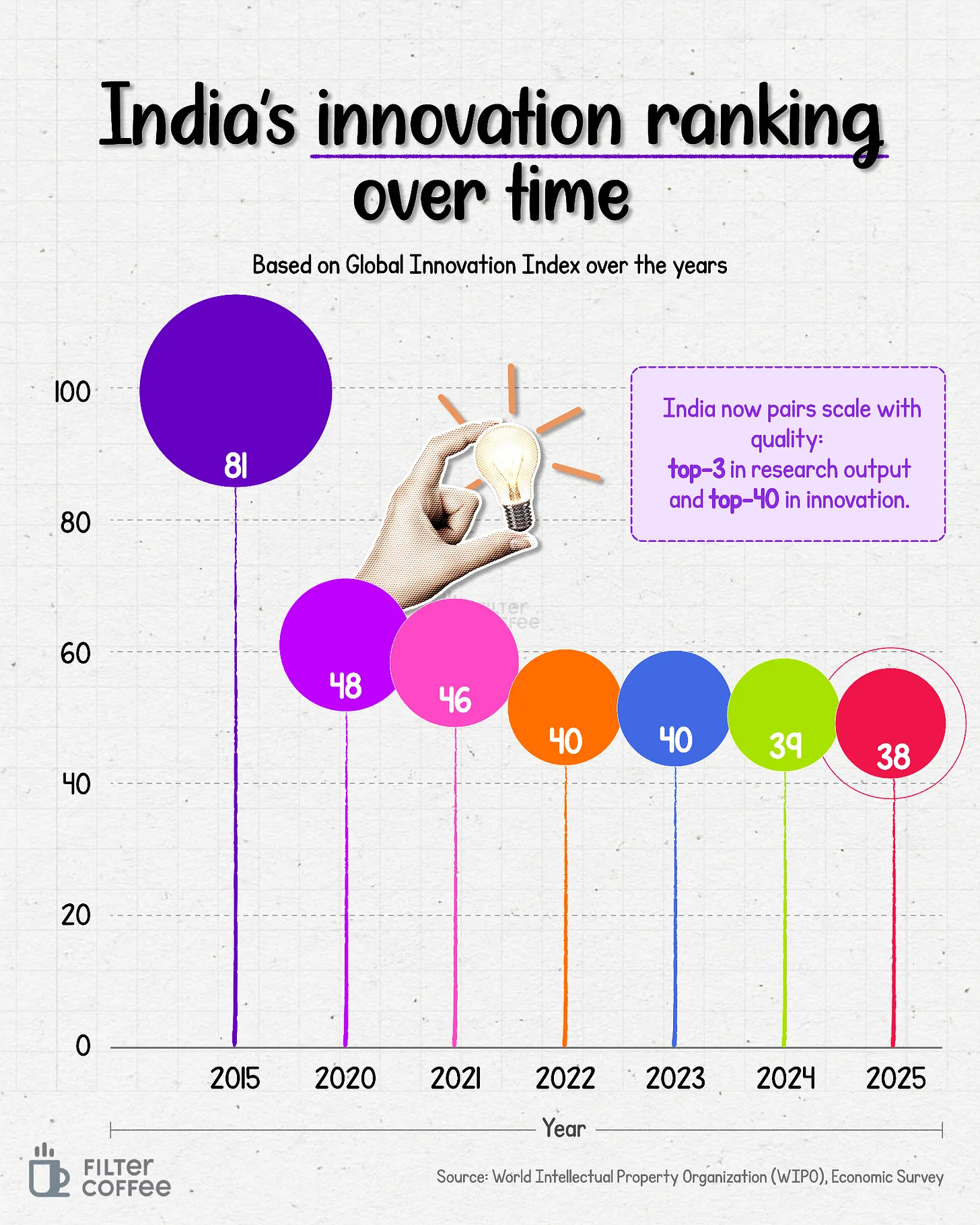
India just climbed to 38th place in the Global Innovation Index 2025. A decade ago, in 2015, we were at 81. That is not a small jump. That is a 43 rank improvement in ten years in a ranking that measures how well countries turn ideas into economic value.
The Global Innovation Index, or GII, is published every year by the World Intellectual Property Organization. It evaluates around 130 to 140 economies across nearly 80 indicators. These indicators cover everything from education quality, R&D spending, patent filings and startup activity to infrastructure, market sophistication and technology exports. In short, it checks whether a country is actually building, funding and scaling ideas or just talking about them.
India’s journey in this ranking has been gradual but steady.
In 2020, we were ranked 48th. In 2021, 46th. In 2022, we broke into the top 40 at rank 40. We held that position in 2023. In 2024, we moved to 39. And now in 2025, we sit at 38. This is not a one year spike. It is a consistent climb.
But what does 38 really mean? First, India remains the top ranked country in Central and Southern Asia. More importantly, among lower middle income economies, India is the innovation leader. That matters because the GII compares countries within income groups too. It tells you whether a country is punching above its economic weight. In that sense, India is.
The index breaks performance into two big buckets. Innovation inputs and innovation outputs. Inputs include things like institutions, infrastructure, education, R&D investment and business environment. Outputs measure results. Patents, research publications, high tech exports, creative goods and digital services.
Interestingly, India performs better on outputs than inputs. In simple words, we are extracting more innovation results than our enabling environment would normally suggest. That is both impressive and revealing. It means startups, researchers and companies are producing results despite gaps in infrastructure or institutional depth.
Take research output. India is now among the top three countries globally in terms of scientific publications. That is scale. On the startup side, India is home to one of the world’s largest startup ecosystems with over 100 unicorns. In ICT services exports, India is a global heavyweight. These feed directly into the output side of the index.
At the same time, input challenges remain. Gross expenditure on R&D as a percentage of GDP still hovers below 1%, much lower than countries like South Korea, Israel or even China. Infrastructure gaps, regulatory friction and uneven quality in higher education still show up in the scoring. Business sophistication and ease of translating research into commercial products remain areas where we lag developed economies.
Why is this rise happening now? Several structural shifts are at play. Over the last decade, India has rolled out Digital India, Startup India, production linked incentive schemes and major public digital infrastructure like UPI and Aadhaar.
The result is a tech enabled ecosystem where fintech, SaaS, deep tech and digital services can scale fast. Patent filings from India have increased significantly over the past few years. The number of recognized startups has crossed 1 lakh. Technology adoption across government services has accelerated.
But there is another layer. Innovation is no longer limited to labs. It is happening in small towns through digital platforms. It is happening in manufacturing through automation and design improvements. It is happening in services exports through AI and cloud capabilities. The GII captures this broad ecosystem, not just big tech companies.
Still, moving to the top 20 will be a different game. Countries in the top tier combine heavy R&D spending, deep capital markets, world class universities and strong intellectual property regimes. India will need sustained investment in research, stronger academia industry collaboration and smoother regulatory systems to make that leap.
The bigger story is this. Innovation is measurable. It is ranked. It is being compared globally. And for a country that once struggled to enter the top 50, sitting at 38 with top three research output and top 40 innovation status suggests something fundamental has shifted. The next decade will decide whether this climb becomes a plateau or turns into a sprint.