

 Newsletter
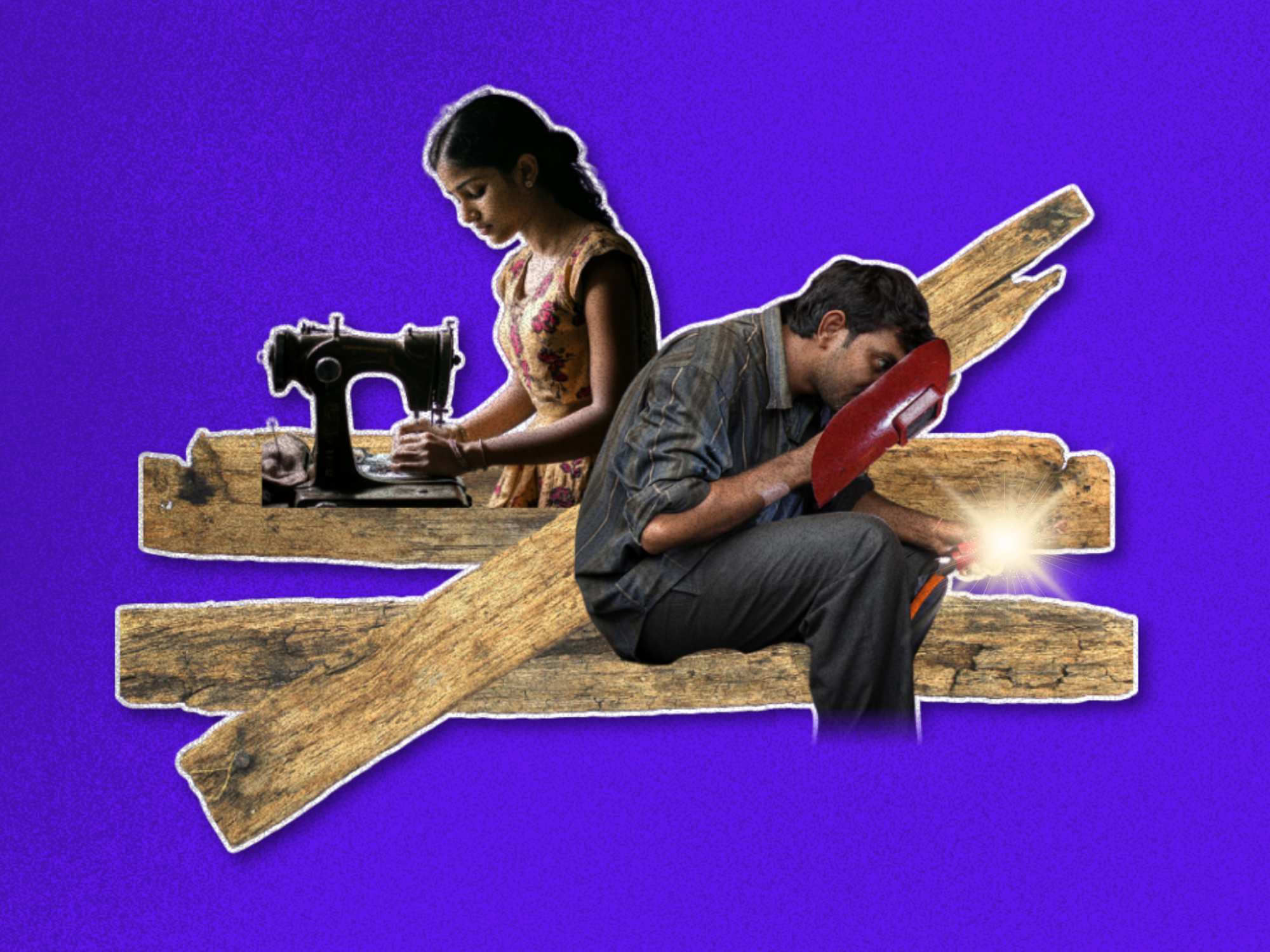
Before we get lost in numbers and charts, take a moment to see a factory floor, or a building or road construction site.
The constant hum of machines, the dust in the air, the sharp smell of paint and cement. Now look around and count how many women you spot. Not much, right?
That quick picture or snapshot probably tells you more about the reality of Indian manufacturing than most long policy speeches ever could.
India really wants to be a $5 trillion economy. And manufacturing is being cast as the hero of that story.
Every policy speech, every industry panel, every budget preview circles back to the same idea, factories will do the heavy lifting.
Today, manufacturing makes up about 17% of India’s GDP and the goal is to push that to 25%. That’s not a small jump. To get there, the plan is to scale up fast and compete globally, especially in new areas like electronics, semiconductors, and high-tech equipment.
But while everyone is busy talking about machines, supply chains, and exports, there’s a more human story unfolding on factory floors across the country. And it’s worth paying attention to, because India’s factories are not gender neutral.
Manufacturing employs about 68 million people in India. That’s bigger than the population of many countries. Out of these, nearly 23 million are women.
So no, women are not absent from manufacturing. In fact, more than one-third of all manufacturing workers today are women. That’s a big improvement from two decades ago, when fewer than one in four workers in manufacturing were women.
After years of falling participation in the 2000s and early 2010s, women have slowly been making their way back into the workforce, and manufacturing has reflected that comeback.
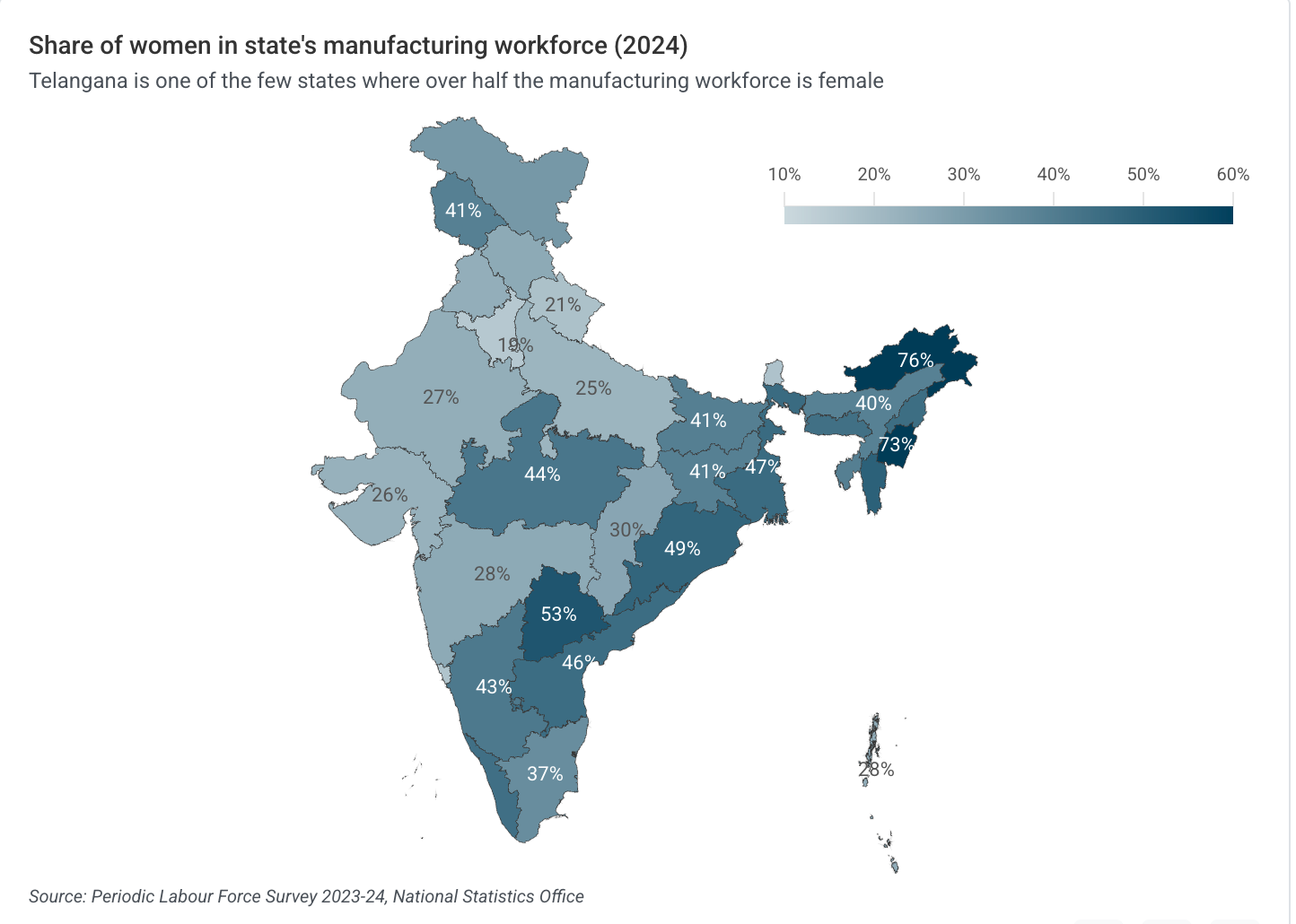
But here’s the catch. Compared to other countries in Southeast Asia, India is still lagging.
In places like Vietnam and Thailand, women make up nearly half of the manufacturing workforce. And when you look at India’s large factories, the gap gets wider. In 2023, factories employed about 7 million men and just 1.5 million women.
So what exactly are women doing in manufacturing? Short answer: a lot of the same few things.
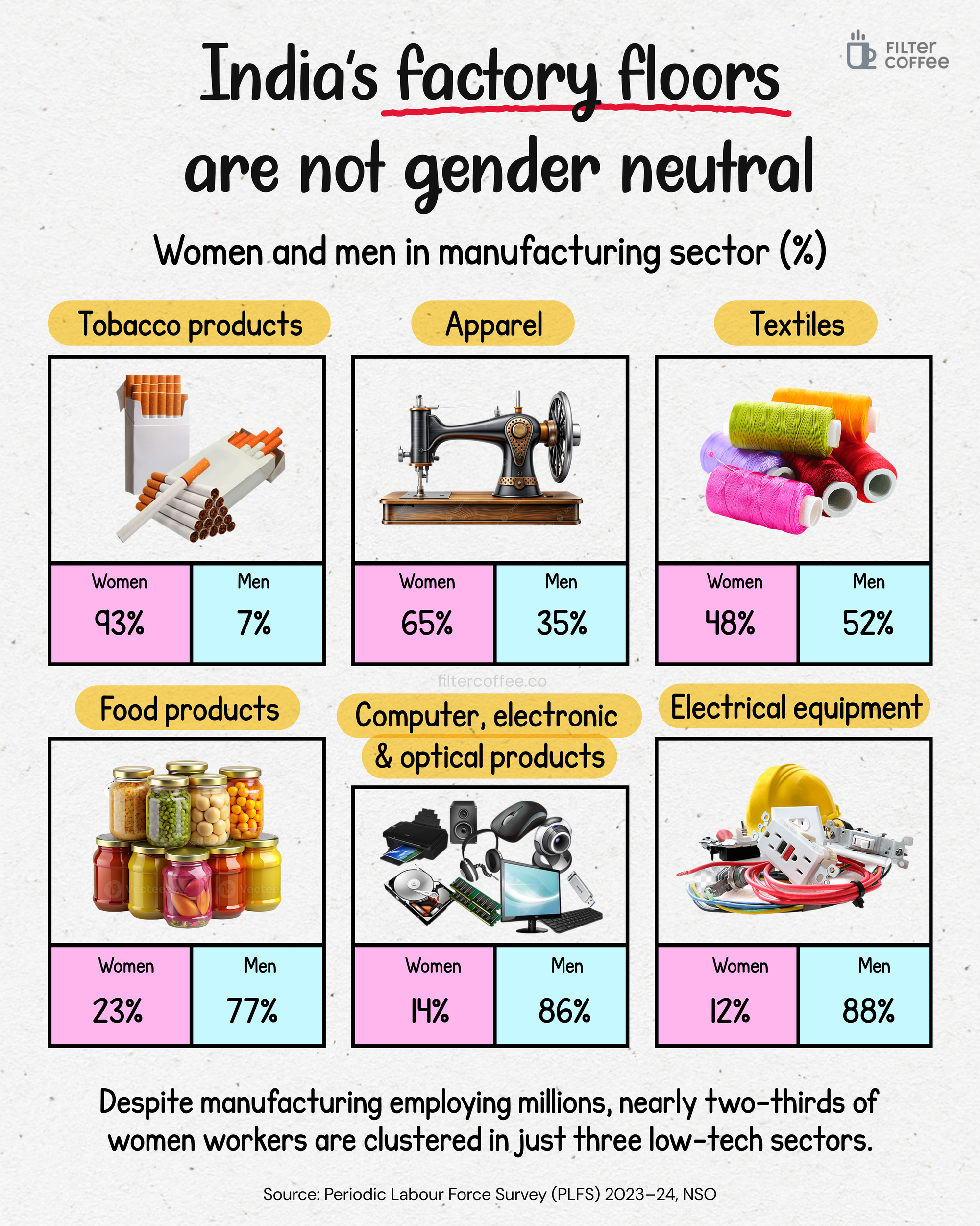
Nearly 78% of all women in manufacturing are packed into just four sectors, apparel, textiles, tobacco, and food products. And within these, the concentration gets even tighter.
More than half of all women in manufacturing are working in just two activities: stitching clothes and making bidis. Custom tailoring and bidi rolling still dominate women’s manufacturing jobs in India.
Let’s talk about clothes first.
Apparel and textiles have exploded over the last two decades. In 2000, apparel made up just 6% of manufacturing jobs. By 2024, it jumped to 22%.
The share of women in apparel manufacturing rose from under 25% to about 55%. Today, one in three women in manufacturing is a tailor.
Tobacco is an even starker example. In tobacco manufacturing, especially bidi making, women make up a staggering 93% of the workforce. Apparel follows at 65%, textiles at around half. Outside these sectors, women nearly disappear. In electronics and optical products, women account for just 14% of workers. In electrical equipment manufacturing, it drops to 12%. These are exactly the high-tech industries India wants to bet on for its global ambitions.
Now here’s the part that really changes how you see the numbers.
Most women in manufacturing are not salaried factory workers. Over three out of five women are self-employed. For men, it’s just one in four.
Over the years, men have seen steady growth in salaried manufacturing jobs. Women haven’t. Most of the increase in women’s participation has come through self-employment, home-based work, small units, informal setups. That usually means lower pay, less stability, and little social security.
So yes, women are working. But many are stuck at the lower end of the manufacturing ladder.
This becomes a problem when you think about where Indian manufacturing is headed. The future is being sold as high-tech, capital-intensive, and globally competitive. Electronics, semiconductors, precision equipment. But these are the sectors where women are least visible today. If nothing changes, manufacturing may grow, but women could be left watching from the sidelines.
And that would be a missed opportunity.
Women stitching garments or rolling bidis already know what production work looks like. They understand quality, deadlines, and repetition.
With the right training, safer workplaces, childcare support, and better transport, moving women into organised factories and newer industries isn’t some wild idea. Other countries have done it. India just hasn’t done it at scale yet.
Bottomline: now that Budget 2026 is behind us, companies are still talking about incentives and policy support to stay globally competitive. That’s fair. But real competitiveness isn’t built on machines and subsidies alone. It’s built on people, and how effectively they’re used. Right now, a large part of India’s manufacturing workforce is underutilised and locked into a handful of low-tech sectors.
India’s factories are busier than ever, but the growth isn’t evenly shared. If manufacturing is meant to drive the next phase of growth, the real question isn’t how much we make. It’s who gets to make it, and who gets left behind as machines get smarter.