
 Newsletter

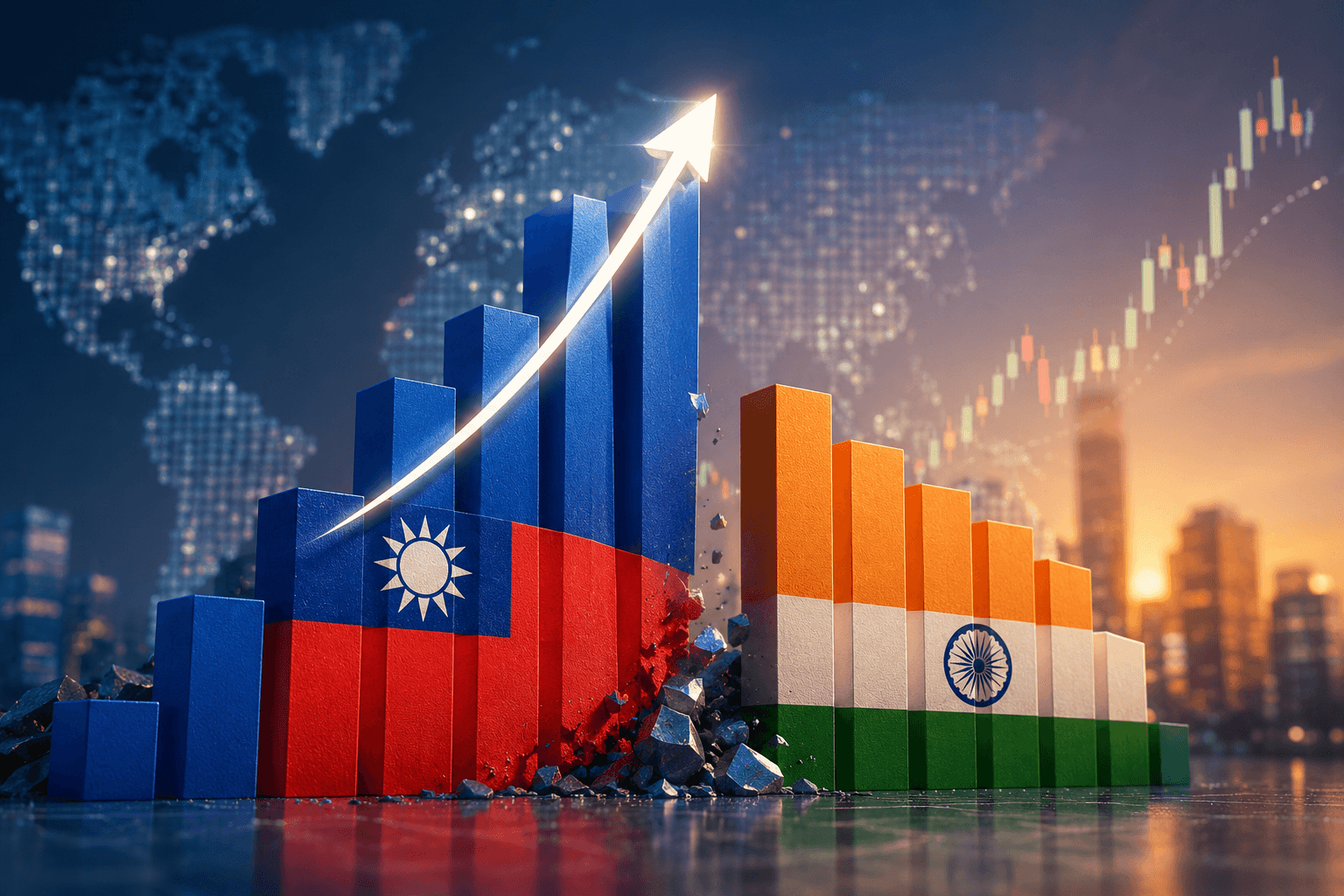
Taiwan just overtook India to become the world’s fifth-largest stock market.
And surprisingly, this story has very little to do with Taiwan becoming a larger economy than India.
India’s economy is still over four times bigger than Taiwan’s. India is still among the fastest-growing major economies in the world. Domestic investing is booming, SIP inflows are hitting record levels, and India’s long-term growth story remains intact.
But global markets right now are obsessed with one thing: artificial intelligence.
And Taiwan happens to sit right at the centre of it.
The country’s stock market value recently climbed to around $4.95 trillion, slightly ahead of India’s $4.92 trillion. The biggest reason behind that jump is a single company: Taiwan Semiconductor Manufacturing Company, or TSMC.

TSMC now makes up roughly 42% of Taiwan’s benchmark stock index. That level of concentration is honestly wild. Imagine one company becoming so important that it can pull an entire country’s stock market above another major economy.
Its stock has surged nearly 50% this year because the AI boom has turned advanced semiconductor manufacturers into some of the most valuable businesses on the planet.
Every major AI company today depends on chips. Nvidia, Apple, AMD, Qualcomm, Amazon, Google, Microsoft, Meta, all of them need increasingly powerful semiconductors to train and run AI systems. But designing chips is only half the story. Manufacturing them at the highest level is far more difficult.
And TSMC dominates that space globally.

The company controls more than 60% of the global foundry market and an even bigger share in advanced AI chips. Nvidia may be powering the AI revolution, but Nvidia itself relies heavily on TSMC to manufacture its chips.
Which means whenever AI demand rises, TSMC benefits almost automatically.
That’s why Taiwan’s market rally is really a reflection of something much bigger happening globally. Investors are no longer rewarding every growth market equally. They are aggressively chasing countries and companies sitting closest to the AI infrastructure cycle.
And right now, the AI boom is not just about chatbots or software tools anymore. It’s become a massive industrial buildout.
Microsoft, Amazon, Meta, and Google are expected to collectively spend hundreds of billions of dollars on AI infrastructure over the next few years. Data centres are expanding rapidly. Demand for GPUs is exploding. Advanced chip packaging capacity is running full. Some semiconductor equipment now has waiting periods stretching over a year.
TSMC sits at the centre of this entire ecosystem. That’s also why governments are treating semiconductors almost like national security assets.
Over 90% of the world’s leading-edge chips are manufactured in Taiwan. That concentration has become a huge geopolitical concern, especially for the United States, because Taiwan also sits at the centre of rising tensions with China.

So the US is trying to reduce its dependence.
Under the CHIPS Act, America is pouring billions into domestic semiconductor manufacturing. TSMC itself is massively expanding in Arizona. What started as a roughly $12 billion factory project has now evolved into plans for a much larger semiconductor ecosystem reportedly worth close to $165 billion across fabs, packaging facilities, and R&D infrastructure.
Europe and Japan are doing something similar too.
India is also trying to enter this race through semiconductor incentives and manufacturing schemes. But building advanced chipmaking capability is incredibly difficult.
A modern semiconductor fab can cost over $20 billion. It requires ultra-specialised machinery, highly skilled engineers, stable electricity, water infrastructure, chemical ecosystems, and precision manufacturing expertise built over decades.
This is not like setting up another assembly plant.
Some chipmaking tools contain over 100,000 components and are produced by only a handful of companies globally. In certain cases, there’s literally just one company in the world capable of manufacturing critical equipment.
That’s why replicating Taiwan’s ecosystem quickly is nearly impossible.
And this is where India’s current market position becomes important to understand.
India still has strong structural strengths. Consumption is rising. Financialisation is accelerating. Manufacturing ambitions are growing. The economy remains large and diversified.
But global investors right now are prioritising direct exposure to AI infrastructure.
India doesn’t yet have globally dominant AI chip companies, semiconductor foundries, or hyperscale AI infrastructure players comparable to TSMC. Most Indian listed giants are still tied to banking, telecom, IT services, energy, or domestic consumption.
That difference is shaping capital flows.
Foreign investors have reportedly sold nearly $24 billion worth of Indian equities this year while increasing exposure to Taiwan and South Korea. India’s weight in the MSCI Emerging Markets Index has also fallen sharply over the past year.
Meanwhile, Taiwan’s regulators are actively adapting to TSMC’s dominance. Recent rule changes now allow domestic funds to allocate larger portions of their portfolios into heavily weighted companies like TSMC, potentially unlocking billions more in inflows.
In many ways, markets are no longer treating TSMC like a regular company.
They’re treating it like infrastructure for the AI economy.
And that may be the biggest takeaway from this entire story.
For years, technology conversations focused mostly on apps, software, and platforms. But the AI era is increasingly becoming a story about physical infrastructure: chips, power, factories, cooling systems, supply chains, and manufacturing capacity.
The countries controlling those building blocks are suddenly becoming far more valuable in the eyes of global investors.
Taiwan mastered one extremely difficult industrial capability over decades, and today the entire world depends on it.
That dependence is now reshaping global markets.