
 Newsletter
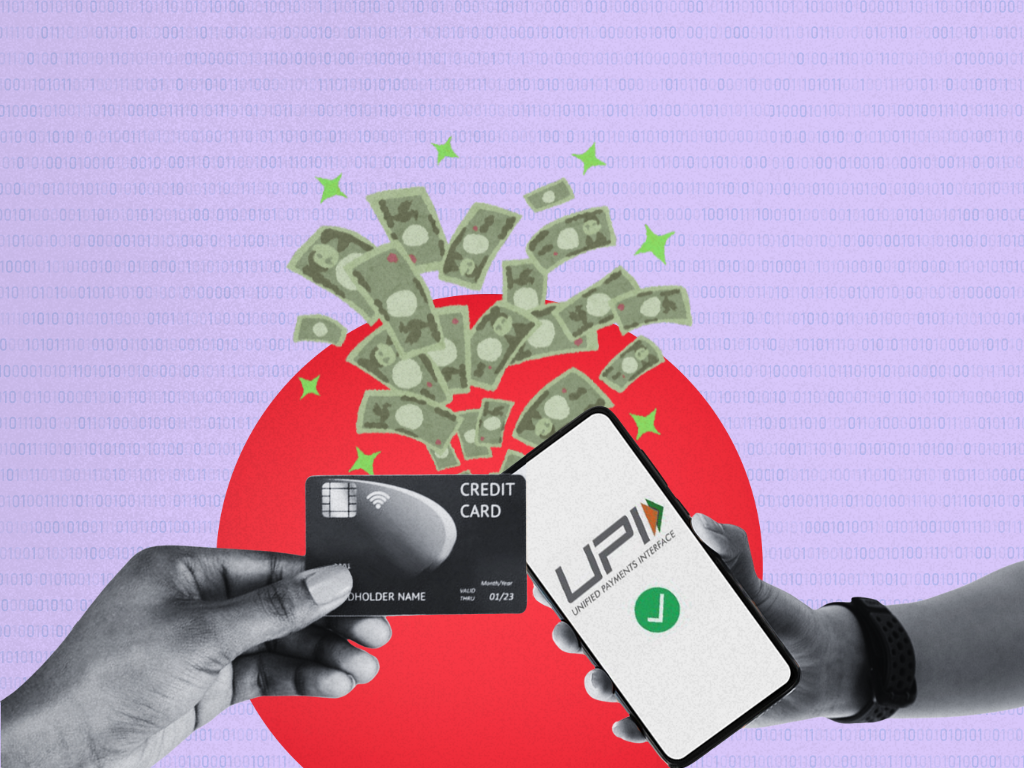
If you look at your last ten payments, chances are nine of them went through UPI. Not because you made a conscious choice. But because that is just how money moves in India now.
You scan, it beeps, you walk away. No wallet. No card. No second thought.
For years we thought the big digital payment war in India was UPI versus cards. QR versus swipe. PhonePe versus Visa. That war is basically over.
And the result is not that UPI killed cards. It did something sneakier. It absorbed them.
By early 2026, UPI is not just the biggest payment system in the country. It is the operating system for retail money itself. Everything else is now a plugin.
Look at the scale first.
In December 2025, UPI clocked over 21 billion transactions in a single month. Credit cards, in the same period, did under 500 million. On a daily basis, UPI is doing close to 700 million transactions. Credit cards do around 15 million. That is not a gap. That is a different universe.
Value-wise too, UPI is miles ahead.
Nearly ₹28 lakh crore in monthly value versus roughly ₹2.2 lakh crore on credit cards. And this was not a one-time thing. UPI is still growing at close to 30% year-on-year. Cards are growing too, but slower. The frequency game is completely done.
So what changed?
In 2025, credit cards stopped being just plastic money and became a part of UPI applications. RuPay credit cards linked to UPI exploded. Not because Indians suddenly fell in love with RuPay branding, but because RuPay was the only network that could live natively inside UPI.
In two years, RuPay’s share of the credit card market jumped from a rounding error to nearly 16%. Even more telling, about 40% of all credit card transactions by volume now happen through UPI QR codes.
People are using credit, but they are not swiping cards. They are scanning QRs like always. Credit became invisible.
This is what absorption looks like. UPI did not fight credit cards head-on. It just made them behave like UPI.
Merchants played a huge role in this shift. For a small business, accepting cards was always annoying. Machines cost money. Rentals, maintenance, paperwork, MDR. UPI removed all of that. A printed QR code and a bank account were enough.
Today, over 50 million merchants accept UPI. Compare that to roughly 12.12 million physical PoS terminals in the country. The math explains behaviour.
When a kirana store, a salon, and a street vendor all take UPI but not cards, consumers adapt. Muscle memory forms. Cards slowly fall out of daily life.
SoftPOS, where phones act as card machines, is trying to bring cards back into small merchant setups in 2026. But habits are sticky. Once scanning becomes the default, swiping feels oddly outdated.
Even after all this, the market has not collapsed into one messy blob. It has sorted itself out neatly.
UPI has become the daily utility layer. Chai. Groceries. Autos. Rent splits. Small online purchases. The average ticket size on UPI has actually fallen to around ₹1,300. That is not a sign of weakness. It is proof of deep penetration. When a system starts handling smaller and smaller payments, it means people trust it for everything.
Credit cards, meanwhile, have retreated to where they shine. Big purchases. Electronics. Travel. Online shopping. Anywhere rewards, EMIs, or chargeback protection matter. Cards still dominate these moments. They just no longer dominate the day.
The real loser in this story is not credit cards. It is debit cards.
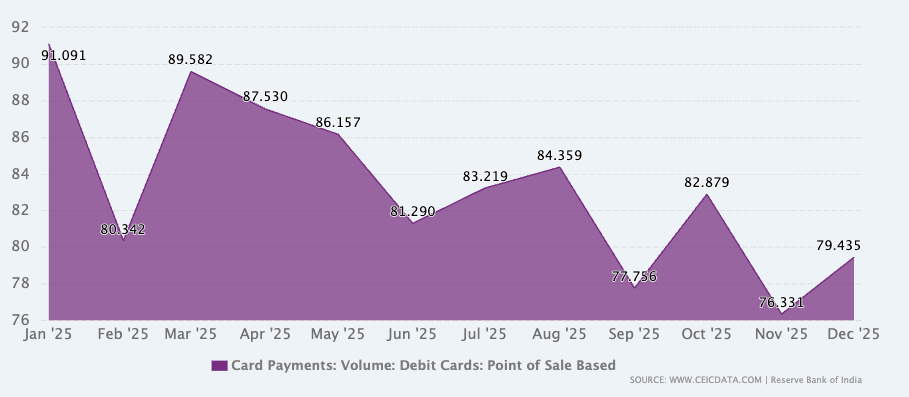
For years, debit cards were the bridge between cash and digital. Pay directly from your bank account, but digitally. UPI does the exact same thing, but faster, cheaper, and everywhere. Debit card usage at PoS terminals fell sharply through 2025. In 2026, debit cards are increasingly just ATM keys. Their payment role is fading fast.
Banks know this. That why the next push is credit lines on UPI. Not cards. Not wallets. Just a pre-approved borrowing limit that shows up when you scan a QR code. You tap. You pay. The loan happens in the background. For gig workers, small merchants, and thin-file users, this is massive. Credit without ceremony.
The Bigger Picture:
UPI is now flirting with Visa’s daily transaction volumes globally. On some days, it already beats it. And unlike Visa, which grew around credit-heavy Western economies, UPI is built for high-frequency, low-value, real-time payments. That is exactly how the Global South transacts.
UPI is already live or in pilot stages in multiple countries, including the UAE, Singapore, and France. It does not need to replace Visa everywhere to matter. It just needs to become the default rail for everyday payments wherever it goes.
One important caveat though. Volume is not revenue. Credit cards still make banks more money because MDR exists there. On UPI, especially small-ticket payments, fees are thin or non-existent. So banks will not kill cards. They will keep them alive as profit engines. Just hidden inside UPI flows.
Merchant Discount Rate or MDR is the fee a merchant pays to banks and payment companies every time a customer makes a digital payment. It is usually around 1 to 3% of the transaction value and covers costs like payment processing and network charges. This is why card payments cost merchants money, while most UPI payments do not.
UPI did not win by being better than cards at what cards do. It won by changing what payments feel like. Cards are now a backend choice. UPI is the interface.
FAQs
Why has UPI become the most used payment method in India?
UPI has become dominant because it is fast, widely accepted by merchants, and works directly from bank accounts. Its ease of use and low cost for merchants made it the default for everyday payments.
Has UPI completely replaced credit cards in India?
No. UPI dominates daily, small-ticket payments, but credit cards are still preferred for high-value purchases, EMIs, travel, and rewards-based spending.
How is UPI absorbing the credit card ecosystem?
UPI now lets users pay using credit through QR codes via RuPay-linked credit cards and bank-issued credit lines. This makes credit usable inside UPI apps without swiping a physical card.
What is Credit-on-UPI and why is it important?
Credit-on-UPI lets you pay at a UPI QR code using a credit source instead of your bank balance. It matters because it can expand access to instant credit for MSMEs and users who do not rely on cards.
Why are RuPay credit cards growing faster than Visa or Mastercard in India?
RuPay credit cards are growing faster because they can be linked to UPI for QR-based payments. This UPI integration makes RuPay more useful for everyday credit spends in India.
Why do small merchants prefer UPI over card payments?
UPI is easier and cheaper for small merchants because it works with a simple QR code and usually has no MDR on small payments. Card acceptance often needs PoS machines and comes with MDR costs.
What is happening to debit card usage in India?
Debit card usage for in-store payments is falling as people shift bank-to-bank payments to UPI. Debit cards are increasingly used mainly for ATM cash withdrawals.
Why is the average UPI transaction value decreasing?
The average UPI transaction value is decreasing because more people use UPI for tiny, daily purchases like food, groceries, and transport. It shows deeper adoption across everyday spending.
Does UPI generate the same revenue for banks as credit cards do?
No. Credit cards generate more revenue through MDR and interest, while most UPI transactions have low or zero fees, especially for small-ticket payments.
Is UPI expanding outside India?
Yes. UPI is live or in pilot stages in countries like the UAE, Singapore, and France. The broader goal is to expand UPI-style real-time payments for everyday transactions internationally.