

 Newsletter
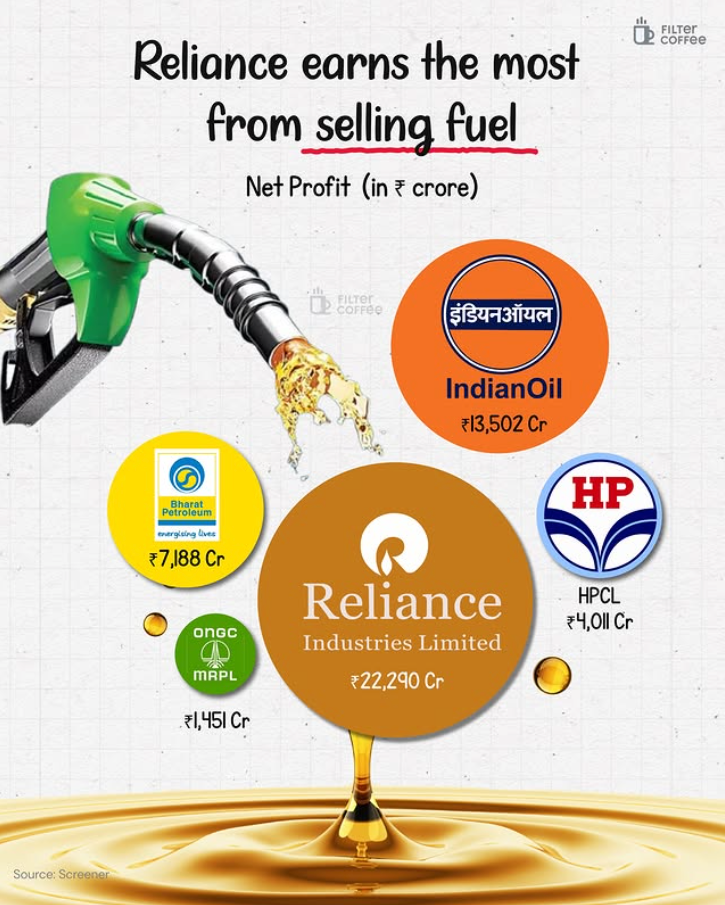
Reliance Industries recently reported a net profit of ₹22,290 crore for the December quarter. Around the same time, India’s biggest state-run oil companies also posted strong numbers. Indian Oil reported about ₹13,500 crore in profit, BPCL roughly ₹7,100 crore, and HPCL around ₹4,000 crore.
This may be one simple takeaway. Reliance seems to be making far more money than the rest of the oil marketing companies by selling fuel.
But the real story behind these numbers is far more interesting, and it says a lot about how India’s energy market is quietly changing.
India today is one of the fastest-growing fuel markets in the world. According to the Petroleum Planning and Analysis Cell (PPAC), the country’s petroleum product consumption is expected to reach roughly 252–253 million tonnes in FY26, growing about 4–5% annually.
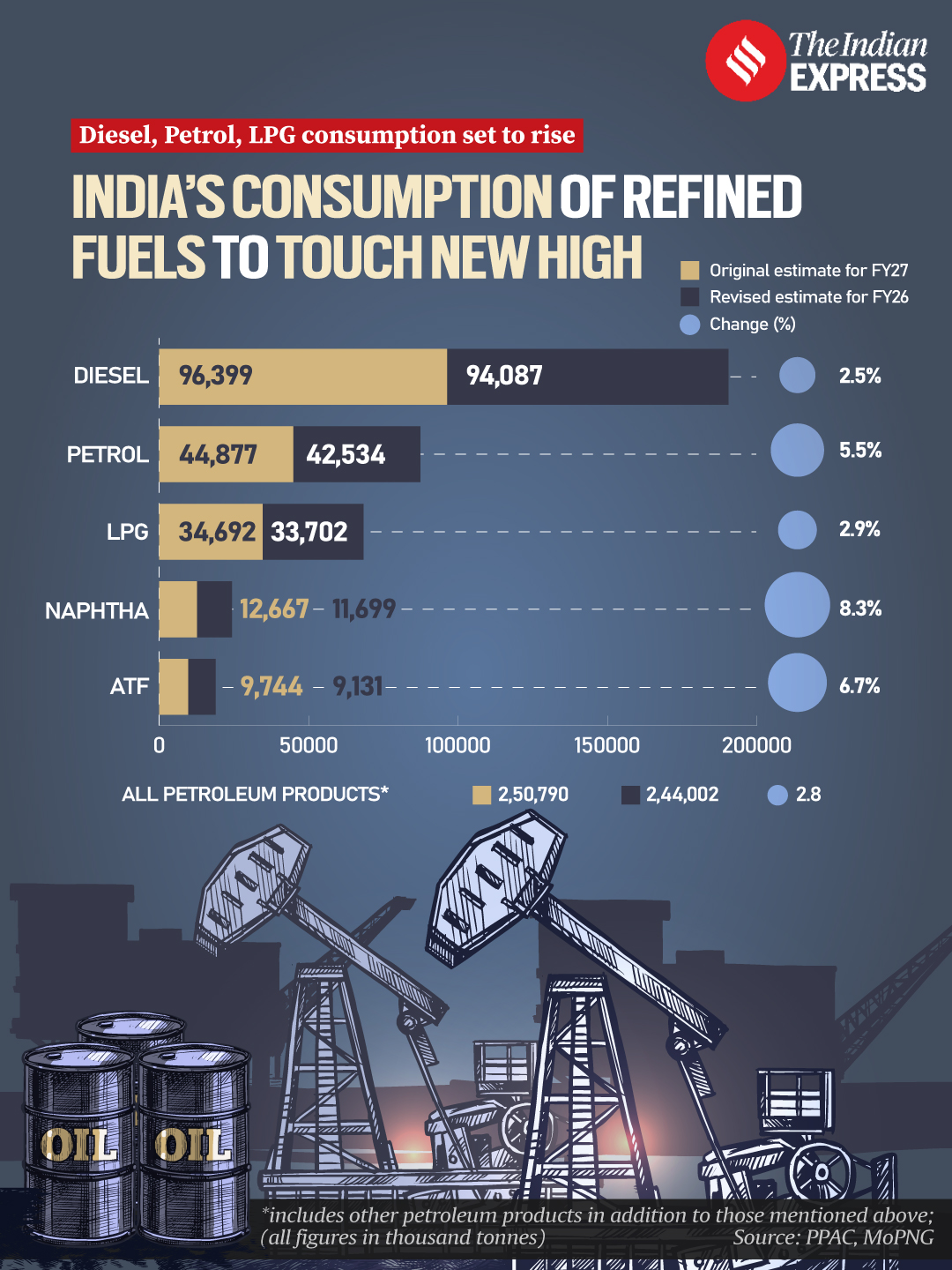
Petrol demand is rising because more people are buying cars and two-wheelers, while diesel continues to power trucks, buses and logistics networks across the country. Even aviation turbine fuel demand has been climbing as India’s airline sector expands.
This steady growth has turned fuel retailing into a massive cash-generating business. But not every company plays the same game.
For decades, the fuel retail market in India was dominated by government-owned oil marketing companies like Indian Oil, Bharat Petroleum and Hindustan Petroleum. Together, they still control the overwhelming majority of India’s petrol pumps. BPCL alone operates more than 23,000 retail outlets, and the combined network of the three PSU companies runs into tens of thousands of stations across the country.
Private players were largely absent for years because fuel prices were tightly regulated and margins were thin. That began to change after fuel pricing was gradually deregulated in the 2010s. Suddenly, private refiners saw an opportunity to enter a growing consumer market.
Reliance Industries stepped in aggressively.
Through its joint venture with BP called Jio-bp, Reliance has been expanding its fuel retail network rapidly. The company now operates more than 2,100 fuel stations across India and has been growing volumes quickly. In recent disclosures, Reliance said diesel sales at its pumps grew more than 20% year-on-year, with petrol volumes rising at a similar pace.
But there’s an important detail that most comparisons miss.
The ₹22,290 crore profit reported by Reliance does not come purely from petrol pumps. Reliance’s energy business is built on a giant integrated system that includes two of the world’s largest refining complexes in Jamnagar, massive petrochemical operations, fuel exports, and wholesale fuel marketing. Retail fuel is just one piece of that larger oil-to-chemicals ecosystem.
This scale gives Reliance a structural advantage. It can refine crude oil, sell products globally, supply its own retail network and optimise margins across the entire value chain. State-run oil companies, on the other hand, are far more dependent on domestic fuel sales and government pricing policies.
Another shift is also happening quietly. India’s petrol pump landscape itself is changing.
The country now has more than 100,000 fuel retail outlets, almost double the number a decade ago. Private companies like Reliance, Nayara Energy and Shell are gradually increasing their share, though public sector companies still dominate the network.
At the same time, petrol pumps are slowly transforming into multi-energy hubs. Thousands of outlets now offer CNG dispensing, while many are installing EV charging stations. Government data shows that nearly 29,000 fuel outlets already support EV charging, and over 7,700 locations provide CNG or bio-CNG fuel options.
Policy is also reshaping the sector. India’s ethanol blending program has accelerated rapidly, with petrol now blended with nearly 20% ethanol in many regions. This reduces oil imports while creating a new supply chain involving farmers, sugar mills and biofuel producers.
Also read: India’s ethanol gamble – will it backfire on the roads?
All of this means fuel retail is no longer just about selling petrol and diesel. It is gradually becoming a broader energy distribution business.
There are also new risks emerging. Global crude prices remain volatile because of geopolitical tensions, especially in West Asia. If crude prices rise sharply while domestic fuel prices remain stable, profit margins for oil companies can get squeezed. Ratings agencies have already warned that India’s state-run oil companies could face margin pressure if global oil prices surge.
Yet despite these risks, the underlying trend remains clear.
India is still adding millions of vehicles every year. Logistics demand continues to expand as e-commerce grows. Air travel is booming. Industrial activity is rising. All of this translates into higher fuel consumption.
Which means that behind every petrol pump nozzle is a far bigger story about India’s growth, its energy security and the evolving battle between state giants and private energy empires.
And for now, Reliance appears to be playing that game at a very different scale.
Also read: Why are restaurants suddenly running out of LPG?