

 Newsletter

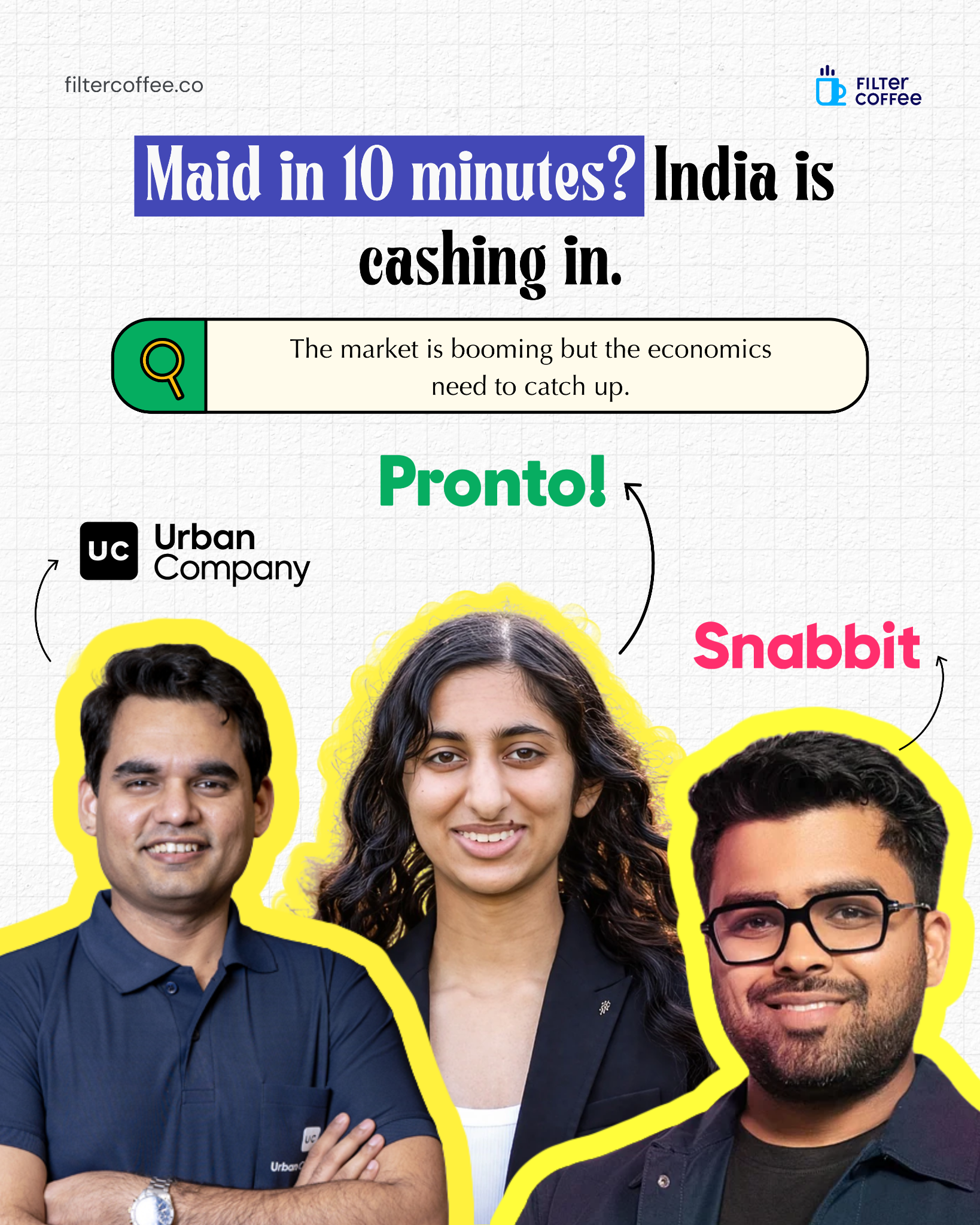
India have found its next quick commerce obsession and this time it is not groceries, medicines or smartphones. It is maids.
Over the last year, a strange new category has exploded across Indian cities.
Platforms like Urban Company’s InstaHelp, Pronto and Snabbit are promising something that would have sounded absurd just two years ago. A house help at your doorstep in 10 minutes.
Investors are putting money into it because they’ve seen something like this before.
This is essentially the Blinkit and Zepto model applied to domestic work, covering cleaners, cooks and home helpers. The approach is similar, to build dense supply in a neighbourhood, acquire users, reduce wait times and drive repeat usage.
Urban Company said InstaHelp crossed 50,000 daily bookings in less than a year of launch and touched 1 million monthly delivered bookings by March 2026.
Snabbit reportedly clocked over 830,000 monthly bookings in February 2026, up sharply from around 500,000 just a few months earlier. Pronto, the newest entrant, went from roughly 18,000 to 26,000 daily bookings within weeks according to reports.
Collectively, India’s instant house-help market is already processing more than 2 million monthly orders and the category barely existed a year ago.
Indian cities are changing faster than the systems supporting them. More dual income households now exist in metros than ever before. Millions of young professionals live away from families. Work hours have become unpredictable. Commutes are exhausting.
Apartments are getting smaller while expectations around cleanliness and convenience are rising. Traditional full-time domestic help models are breaking down because families no longer want fixed monthly arrangements. They want flexibility.
A cleaner for one hour. Dishes done after a party. Laundry folded on demand. Bathroom cleaning before guests arrive.
The platforms realised something important. Domestic work in India was already a massive informal economy. Nobody had productised it.
That is why investors suddenly see a huge opportunity.
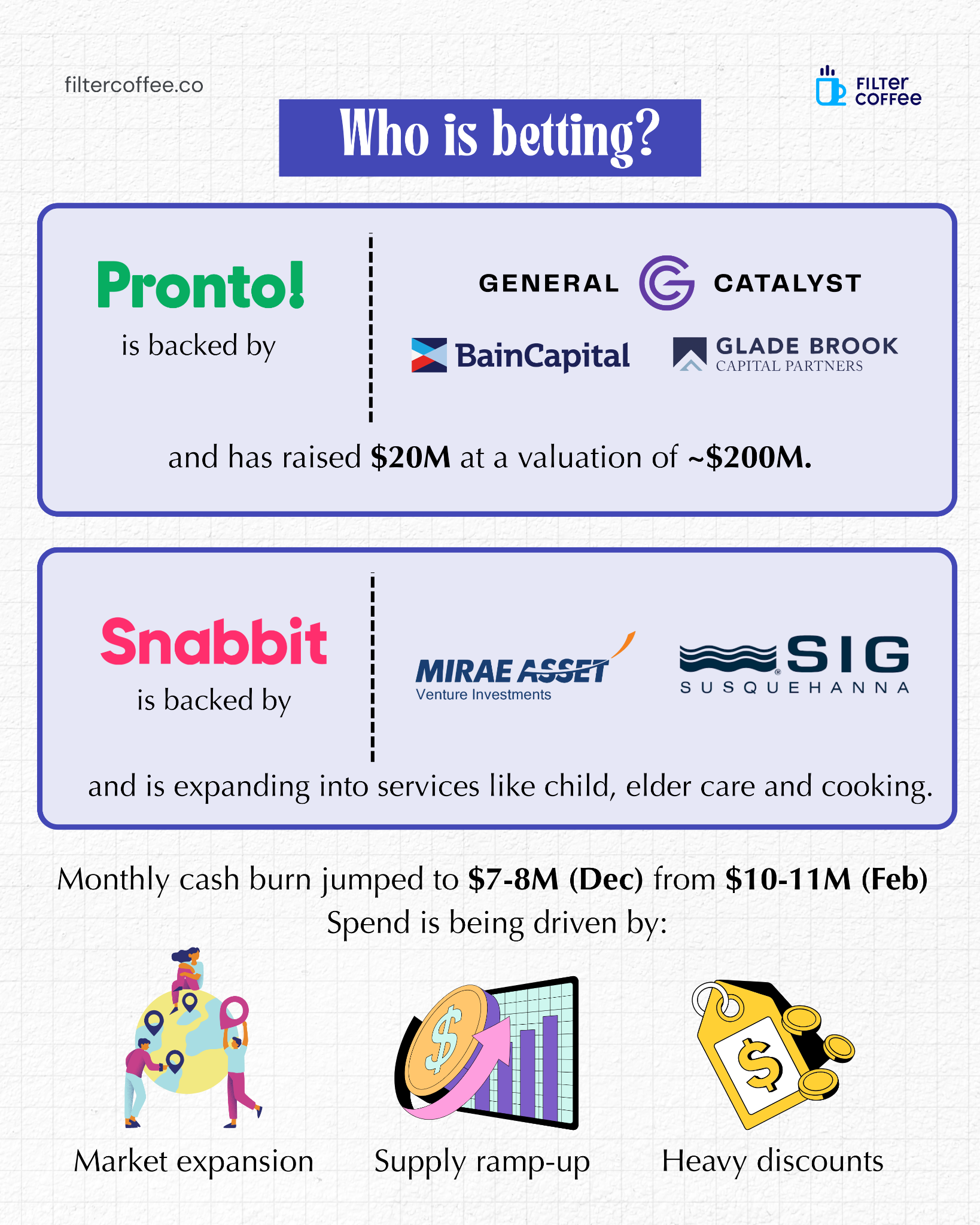
Pronto reportedly raised around $25 million at a $100 million valuation in early 2026 and within weeks was said to be in another funding round that doubled its valuation to nearly $200 million. Snabbit raised $56 million in a Series D round backed by investors like SIG and Mirae Asset. Urban Company already has the scale advantage and deep operational experience.
But beneath the excitement lies a messy reality as unlike groceries, humans are not inventory.
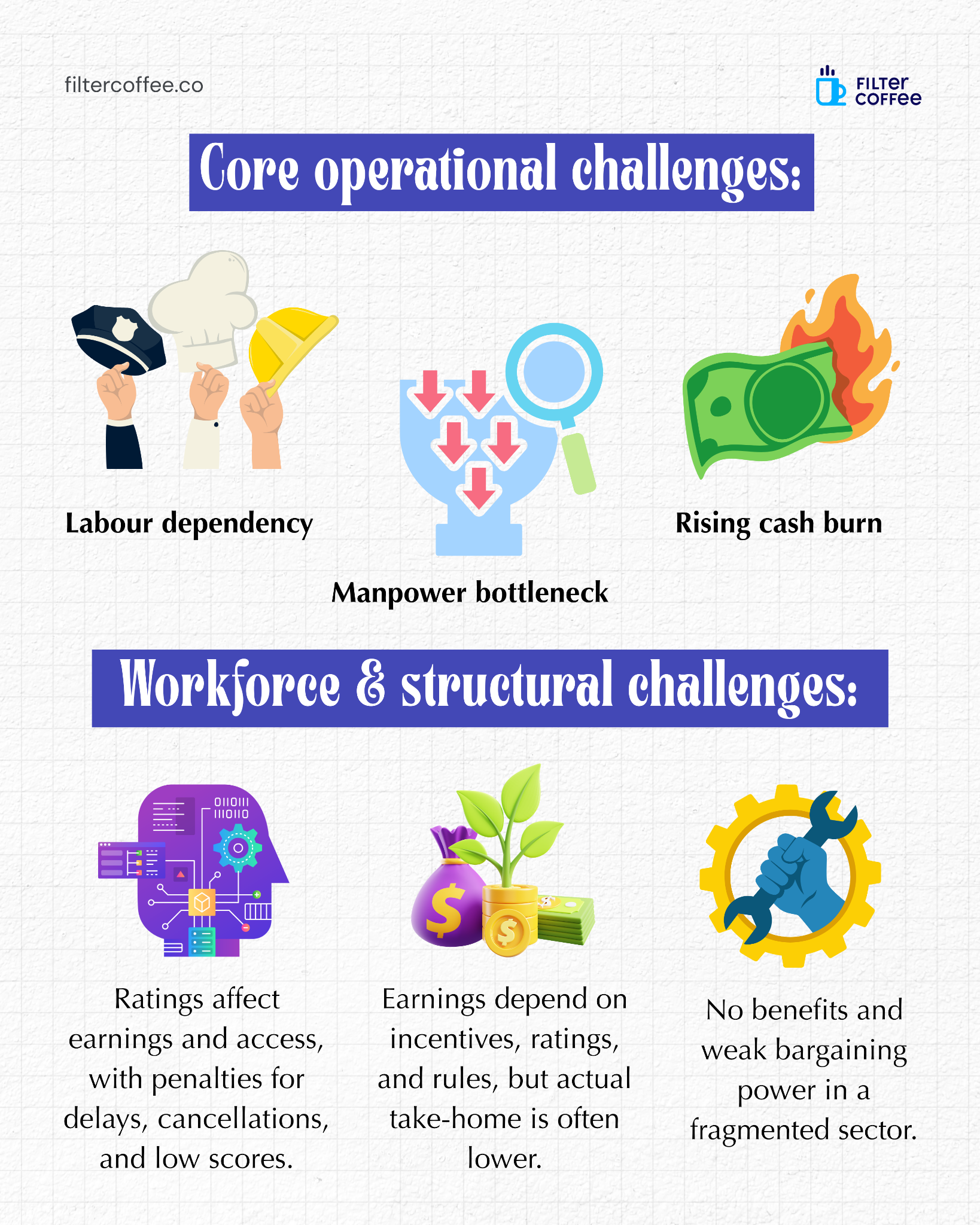
You cannot warehouse a cleaner in a dark store and dispatch them like detergent packets. The business depends entirely on labour density, reliability and trust.
Every cancelled booking, delayed arrival or poor rating affects future demand. Workers have to travel, climb buildings, interact with customers and perform physically exhausting work multiple times a day.
That makes unit economics brutal.
Reports suggest companies in the category are burning between $7 million and $11 million a month as they spend aggressively on discounts, worker incentives, onboarding and expansion.
Platforms need thousands of trained workers available within tiny geographic clusters to make the 10 minute promise work. One supply shortage in a neighbourhood can collapse the experience.
Then there’s the worker side.
This sits in the middle of India’s gig economy debate. Companies call them flexible “partners,” but many say the work is more like regular jobs without the same protections. Ratings affect how much work they get, incentives keep changing, and penalties for cancellations or delays can cut earnings.
Some states have already started responding. Rajasthan, Karnataka and Telangana have moved toward gig worker welfare frameworks involving registration, welfare boards and social security discussions.
Yet despite all the criticism, the demand keeps rising.
Because this category is tapping into monetising time anxiety.
Urban Indians are increasingly willing to outsource everyday chores because free time itself has become a luxury product.And that may be why investors believe this market could become far larger than people currently imagine.
India already has millions of domestic workers operating in an unorganised system. If platforms succeed in formalising even a fraction of that market, the category could eventually rival food delivery or quick commerce in scale.
The real question now is whether India can build a version of it that works for customers, workers and companies at the same time.