
 Newsletter
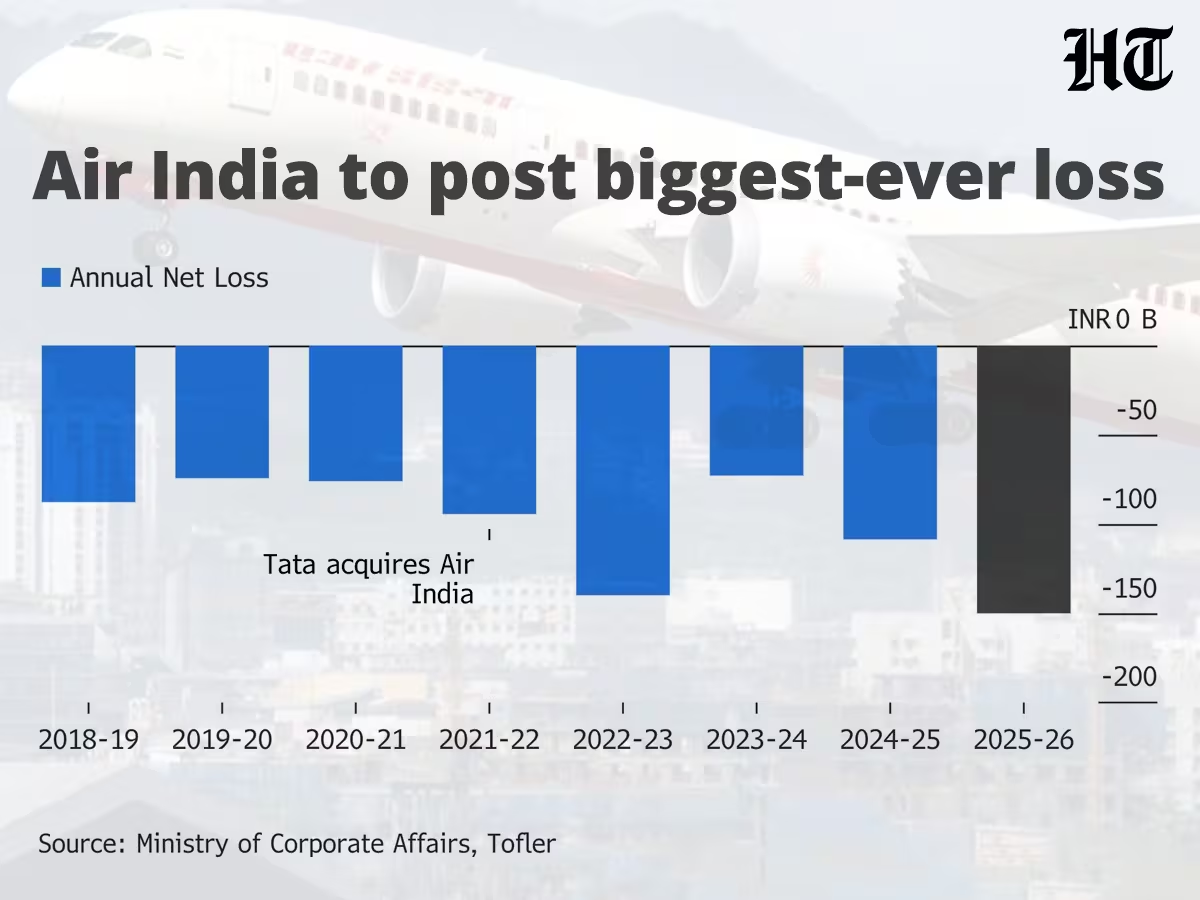
Air India is back in the headlines, but not for the reasons the Tata Group would have hoped. In April 2026, the airline reported a staggering loss of over $2.4 billion for the financial year, far worse than internal estimates, and is now in talks with Tata Group and Singapore Airlines for fresh capital infusion.
At the same time, CEO Campbell Wilson has announced his exit, safety audits have flagged serious lapses, and the airline continues to deal with the aftershocks of a deadly crash in Ahmedabad that killed more than 240 people last year. For an airline that was supposed to symbolise India’s aviation comeback story, this feels like hitting turbulence mid-flight with no clear view of when things will stabilise.
To understand how things got here, you have to rewind to January 2022, when the Tata Group bought Air India from the government. It was positioned as a full-circle moment.
The Tatas had founded the airline decades ago, and now they were reclaiming it with the ambition of turning it into a world-class global carrier. The plan was straightforward: Clean up operations, fix service quality, merge group airlines like Vistara and AirAsia India, modernise the fleet, and compete seriously on international routes where Indian carriers have historically underperformed.
But aviation is one of those businesses where everything has to go right at the same time. And for Air India, almost everything went wrong at once.
The airline actually started FY26 on a decent note, even posting operating profits in early April 2025. But that momentum didn’t last. Within weeks, geopolitical tensions started creeping into the business. Pakistan shut its airspace to Indian carriers, forcing flights to Europe and North America to take longer routes.
That directly increased fuel burn and operating costs. Then came the Middle East conflict, which disrupted a region that accounts for roughly 16% of Air India’s total capacity. Flights had to be rerouted, cancelled, or operated at higher costs, right when global jet fuel prices were already climbing.
And then came the biggest blow. In June 2025, a Boeing 787 Dreamliner operated by Air India crashed in Ahmedabad, killing more than 240 people. Beyond the human tragedy, the crash triggered operational disruptions, capacity cuts, and intense regulatory scrutiny.
The DGCA’s annual audit later flagged over 50 safety-related lapses at the airline, including serious issues that required immediate fixes. Suddenly, the conversation was no longer about brand revival or customer experience. It was about whether the airline could run safely and reliably.
All of this showed up brutally in the numbers. The airline ended FY26 with losses exceeding ₹220 billion. It is the kind of loss that forces shareholders to step in. Tata Group and Singapore Airlines, which owns about 25% after the Vistara merger, are now discussing how much capital they need to inject to keep the turnaround on track.
And even that may not be enough, which means Air India could eventually look at debt or other funding options, adding more pressure to its balance sheet.
But the financial stress is only one part of the story. Air India’s turnaround was always dependent on execution capability. Running a global airline requires deep operational expertise, especially in areas like maintenance, engineering, network planning, and safety management. And here, Air India seems to have had gaps.
One example is the decision during privatisation to leave out AIESL, the airline’s engineering and maintenance arm, which stayed with the government. That meant Air India had to rebuild or outsource critical technical capabilities at a time when it was already trying to fix everything else.
Even now, engineering and technical glitches continue to be pressure points. On top of that, the airline has relied heavily on Singapore Airlines for leadership and operational support, leading to questions about whether the strategy is truly aligned with building an independent global airline or indirectly feeding into SIA’s network strength.
Then there is the leadership churn. Campbell Wilson’s exit comes at a time when stability is most needed. Reports suggest that even Air India Express saw its MD step down earlier this year.
When top management keeps changing during a turnaround, it slows decision-making and execution. It also affects internal morale, especially when employees are already dealing with operational stress. Air India has tried to address this by rolling out performance-linked stock options for pilots, engineers, and senior staff, but retaining talent in a high-pressure environment is never easy.
And yet, it would be unfair to say nothing has improved. On certain routes, especially those operated by newer aircraft, customer experience has visibly improved. The airline has started retrofitting its older widebody fleet, with the first upgraded Boeing 787 already back in service. The broader plan is to modernise 26 such aircraft by 2027.
There have also been network expansions, loyalty programme revamps, and brand refresh efforts. In isolation, these are all positive signals. The problem is that they are being drowned out by larger operational and financial setbacks.
So where does this leave Air India now? The story has clearly shifted. This is no longer just a turnaround story. It is a stress test of whether a legacy airline, even with strong promoters, can fix deep-rooted structural issues while navigating external shocks. Aviation is a business where margins are thin, costs are volatile, and any disruption, whether geopolitical or operational, hits immediately.
The Tata Group still has the intent and the capital to support Air India. That part is not in doubt. But intent alone is not enough here. The airline now needs consistent execution across safety, operations, cost control, and customer experience, all at the same time. It also needs stable leadership and a clearer operating structure that does not depend too heavily on external partners.
The uncomfortable truth is that Air India’s biggest challenge today is not restarting the turnaround. It is regaining credibility while continuing it. Because in aviation, passengers can forgive delays and bad food, but they rarely forget safety concerns or repeated disruptions. And until those are fixed, no amount of rebranding or fleet upgrades will fully bring back trust.
That is why the real question around Air India has quietly changed. It is no longer about how fast the airline can turn around. It is about whether it can hold itself steady long enough to complete the turnaround at all.