

 Newsletter
India just had another big mango year.
Latest estimates peg production for 2024–25 at over 230 lakh tonnes, and if early signals hold, 2025–26 could be even better. But here’s the interesting bit — nearly half of all mangoes in India come from just two states: Uttar Pradesh and Andhra Pradesh. That’s not just a fun fact but the starting point of a much bigger story about how India grows, sells, and increasingly exports its favourite fruit.
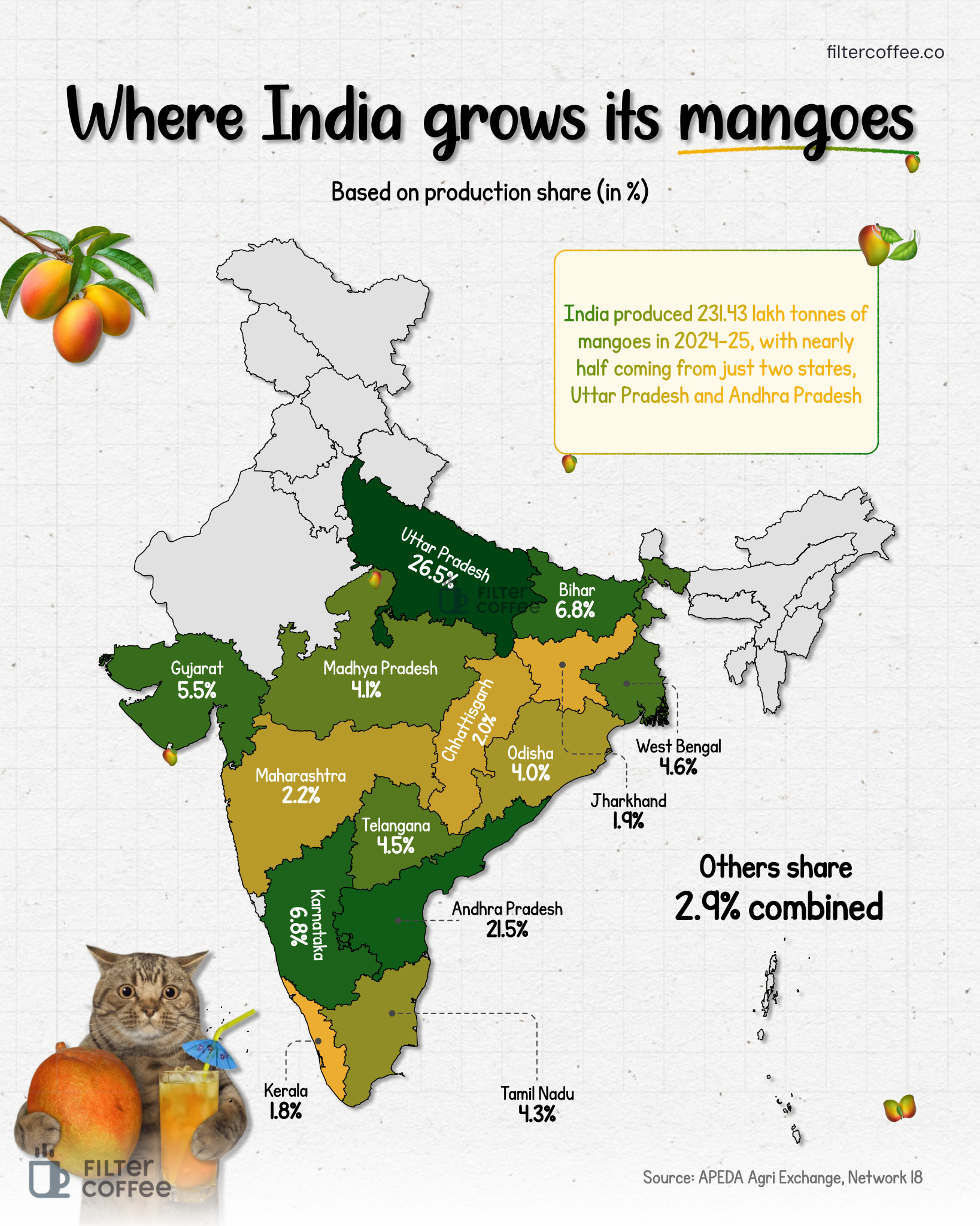
Let’s begin with the map. Uttar Pradesh alone contributes roughly 26–27% of India’s mango output, making it the undisputed king. Andhra Pradesh follows with about 21–22%, forming a powerful north-south duo.
After that, there’s a steep drop. States like Karnataka and Bihar contribute around 6–7% each, while Gujarat, West Bengal, Telangana, Tamil Nadu, Madhya Pradesh, Odisha and Chhattisgarh hover in the 4–5% range. The rest barely move the needle. In other words, India’s mango economy is highly concentrated — geographically and structurally.
But why does this matter? Because production concentration shapes everything, right from pricing power to export potential. Uttar Pradesh dominates traditional table varieties like Dasheri and Langda, while Andhra Pradesh and Karnataka are strong in Totapuri and Banganapalli, which are not just eaten fresh but also processed into pulp for juices and packaged foods. As demand grows globally, it’s not just about how many mangoes India grows, but what kind of mangoes it grows.
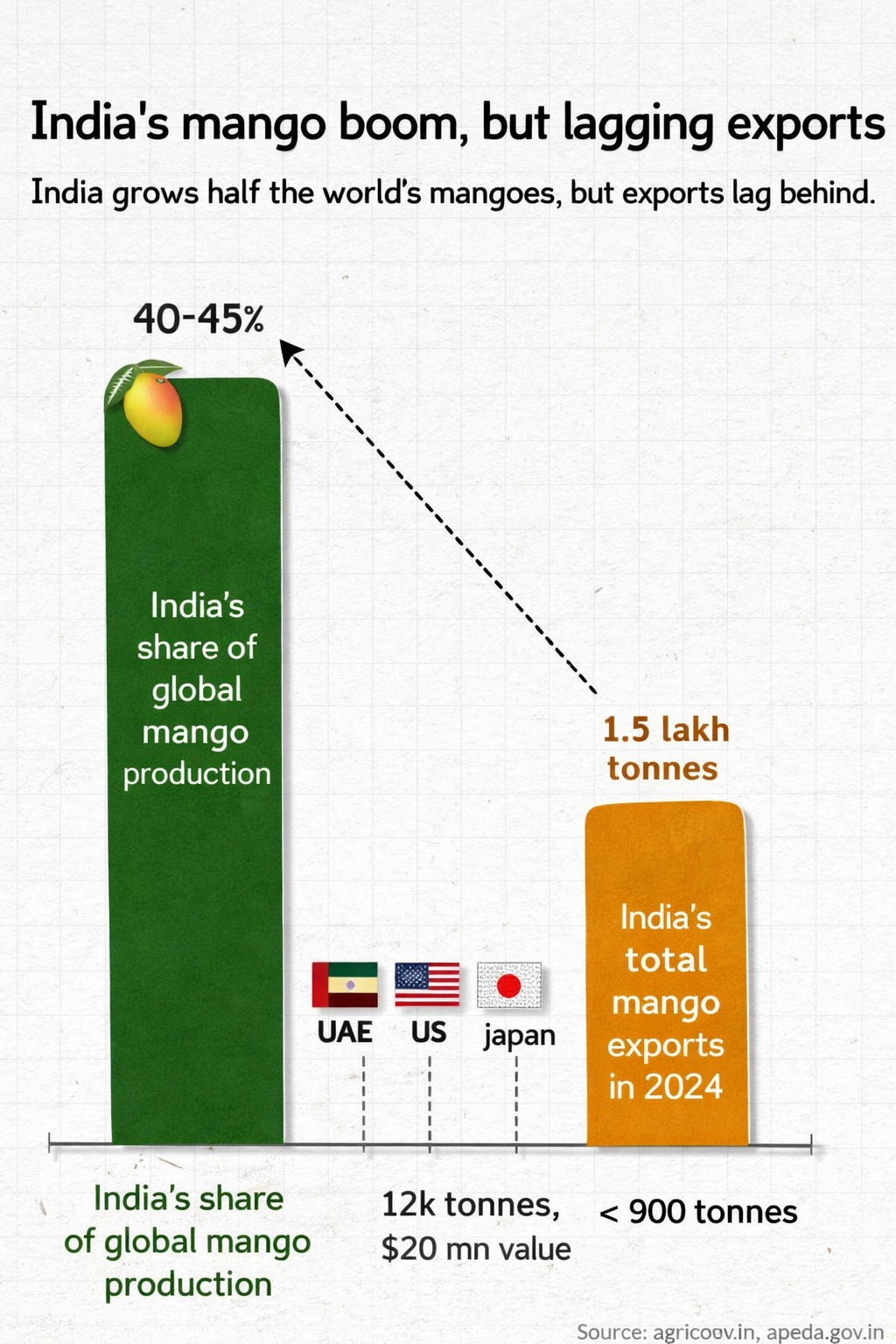
Now layer in the global angle. India is already the world’s largest mango producer, contributing roughly 40–45% of global output, but exports are surprisingly modest. For instance, the UAE alone imported over 12,000 tonnes worth about $20 million from India in 2024. That’s decent, but nowhere close to India’s production scale. So what’s holding India back?
The answer lies in something far less romantic than orchards — compliance and logistics. Exporting mangoes isn’t just about plucking and shipping. Countries like the US, Japan, and Australia require strict treatments like irradiation, vapour heat treatment, and hot water dips, along with tight traceability and residue checks. In fact, in 2025, Indian mango exports to the US briefly ran into trouble due to issues in irradiation documentation, leading to rejected consignments and losses for exporters. The problem wasn’t production, it was paperwork.
At the same time, India is trying to fix this. APEDA has been pushing infrastructure upgrades — setting up treatment facilities, digitising traceability, and promoting mango exports through campaigns like “Indian Mango Mania” in Abu Dhabi. The idea is simple: move from being just a volume giant to a premium mango brand. And this is where things get interesting.
Because not all mangoes are equal. India has a rich portfolio of GI-tagged varieties — Alphonso from Maharashtra, Kesar from Gujarat, Banarasi Langda from UP, Malda and Lakshman Bhog from the east — each with its own taste, texture, and export potential. The push now is to market these like luxury products, not commodities. Think of it as turning mangoes into something closer to wine — origin matters, branding matters, and storytelling matters.
Meanwhile, production patterns are also evolving.
Southern states like Andhra Pradesh and Karnataka are gaining importance not just because they produce a lot, but because they produce varieties suited for processing and exports, which are less perishable and easier to ship. That gives them an edge in the global market compared to highly delicate table varieties.
So, what looks like a simple map of mango production is actually a layered story. It’s about concentration of supply, diversity of varieties, gaps in export infrastructure, and a slow pivot from volume to value. India has already won the production game. The real question now is whether it can win the global mango market — not by growing more fruit, but by selling it smarter.


