
 Newsletter
India's AI race is creating some unexpected winners.
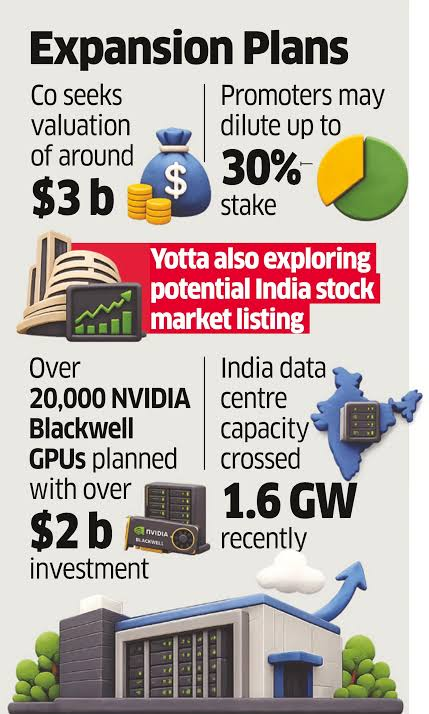
Yotta Data Services recently announced plans to invest more than $2 billion in over 20,700 NVIDIA Blackwell Ultra GPUs at its Greater Noida campus, with ambitions to build one of Asia's largest AI computing platforms. NVIDIA will also establish one of its largest DGX Cloud clusters in the Asia-Pacific region within Yotta's infrastructure. By FY27, Yotta expects to operate more than 80,000 GPUs, making it one of the biggest AI infrastructure providers in the region.
But here's the interesting part. Yotta isn't owned by a software company or a chipmaker. It is part of the Hiranandani Group, a name most Indians associate with luxury apartments, office parks and sprawling townships.
At first, that sounds like an odd combination. What does a real estate developer know about artificial intelligence? As it turns out, a lot more than you might expect. Building a hyperscale data centre has far more in common with building a city than building software.
To understand why, we first need to understand what a data centre really is. Every UPI payment, Netflix stream, cloud file and AI prompt eventually reaches a building filled with thousands of servers. These facilities require vast amounts of land, uninterrupted power, advanced cooling systems and years of planning before they become operational.
That sounds remarkably similar to building a commercial township. Both require land, power infrastructure, regulatory approvals, large-scale construction and decades of maintenance. The only difference is that instead of offices or apartments, the tenants are servers. Instead of collecting rent from businesses or residents, operators earn money by storing, processing and moving digital data.
The Hiranandani Group recognised this shift early. As India's digital economy expanded, data centres were beginning to look less like technology businesses and more like a new form of infrastructure. Every company moving to the cloud, every streaming platform adding users and every bank digitising its operations needed secure places to store and process data. Demand was rising rapidly, while supply remained limited.
What the group lacked was someone who understood how to build and operate these highly specialised facilities. That person was Sunil Gupta.
For nearly two decades, Gupta had been building data centres for other companies. He started his career at Reliance before spending more than a decade at Netmagic, one of India's earliest and largest data centre operators. During his tenure, Netmagic became part of Japan's NTT Group, where Gupta led the development and operation of more than twenty hyperscale data centres across India. Few executives had spent as much time solving the engineering, operational and commercial challenges of large-scale data centres.
In 2019, Gupta met Niranjan Hiranandani to discuss where the industry was headed. The conversations lasted only a few weeks before both sides decided to launch Yotta Data Services. The partnership made perfect sense.
Gupta brought decades of technical expertise and customer relationships, while the Hiranandani Group contributed land, capital, construction capabilities and experience in executing massive infrastructure projects. One knew how to run data centres. The other knew how to build the physical foundations on which they could scale.
When Yotta launched, India's digital economy was already expanding rapidly. Businesses were moving to the cloud, streaming platforms were growing and banks, telecom operators and government departments were generating more digital data than ever. Demand for modern data centres was rising much faster than supply.
Then artificial intelligence changed the economics of the industry.
Training large AI models requires thousands of specialised NVIDIA GPUs connected together inside purpose-built facilities. Instead of simply renting rack space, companies like Yotta now own these GPUs and rent computing power on demand. That transforms a data centre from a digital warehouse into an AI utility. Businesses no longer need to spend hundreds of crores buying AI hardware that could become outdated within a few years. They can simply rent the computing power whenever they need it.
That explains why Yotta has accelerated its investments over the last two years. It launched Shakti Cloud, became India's first cloud provider to join NVIDIA's Partner Network and was selected as one of the infrastructure providers under the IndiaAI Mission. The company is positioning itself as the platform where startups, enterprises, researchers and government organisations can access advanced AI computing infrastructure without building it from scratch.
Just as countries invest in roads, ports and power plants, they now want domestic computing capacity to support businesses, researchers and public institutions. If AI becomes the foundation of the next wave of economic growth, then the infrastructure powering it becomes just as important as the technology itself.
That is where the idea of sovereign AI comes into the picture. The goal is not to replace global cloud giants such as Amazon Web Services, Microsoft Azure or Google Cloud. Those companies will continue to dominate the broader cloud market. Instead, companies like Yotta want to ensure that businesses building AI products in India have access to high-performance computing infrastructure within the country, with lower latency, local data residency and infrastructure designed specifically for AI workloads.
Seen through that lens, Yotta is no longer just another data centre company. It is building digital infrastructure for India's AI economy. That also explains why the Hiranandani Group has gradually expanded beyond residential and commercial real estate into industrial parks, hyperscale data centres, cloud platforms and AI infrastructure. The common thread across these businesses is no longer property. It is long-term infrastructure designed for the next phase of economic growth.
Of course, this is not a risk-free bet. AI hardware becomes obsolete quickly, GPU demand could fluctuate and billions of dollars need to be invested years before returns become visible. Power availability remains another major challenge because AI clusters consume enormous amounts of electricity. Competition is also intensifying as global cloud providers, telecom operators and other Indian data centre companies race to build their own AI infrastructure.
Yet the broader direction seems difficult to ignore. The biggest opportunity in artificial intelligence may not belong only to companies building chatbots or writing AI models. It could also belong to those building the infrastructure that powers them. A decade ago, the Hiranandani Group was known for building cities. Today, it is betting that the next great infrastructure business will not just be real estate. It will be the computing backbone of India's AI economy.