

 Newsletter
India has just changed the way it measures industrial growth.
The Ministry of Statistics and Programme Implementation has revised the base year of the Index of Industrial Production from 2011-12 to 2022-23, and the first release under the new series showed industrial output growing 4.9% in April 2026.
Manufacturing grew 6.2%, electricity and gas supply grew 4.9%, water supply, sewerage and waste management grew 6.6%, while mining and quarrying contracted 5.1%.
Basically, the number says industry is growing, but the bigger story is that India has finally changed the ruler it uses to measure that growth.
To understand why this matters, think of the IIP as India’s monthly factory pulse check.
It tells us whether factories are producing more goods, mines are extracting more minerals, and power systems are generating more electricity. Economists track it because it comes out frequently and gives an early signal of what may be happening inside the real economy.
Investors track it because industrial production affects corporate earnings, demand, jobs, credit growth and interest rate expectations. Policymakers track it because if manufacturing slows, exports weaken, or power demand changes, the government needs to know before the problem becomes visible in GDP data.
The catch is that India was measuring today’s industrial economy using a base year from 2011-12. That was a very different India. UPI did not exist, electric vehicles were not a serious market, solar power was still not mainstream, India was not assembling iPhones at scale, semiconductors were not part of dinner-table policy discussions, and critical minerals were not being talked about like national security assets.
So when an index built around the industrial structure of 2011 keeps getting used in 2026, it slowly starts missing the plot. It may still measure production, but it does not fully capture what production now looks like.
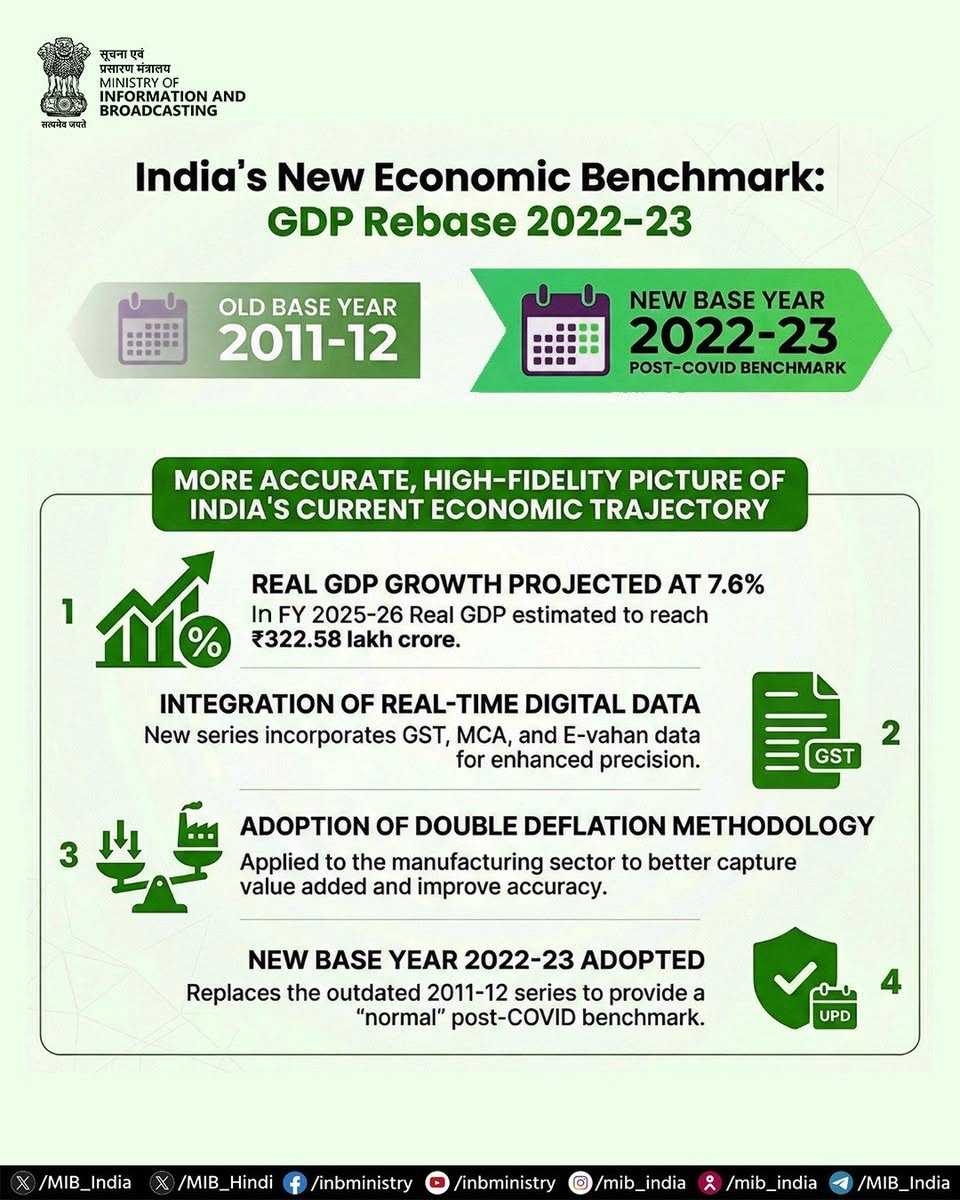
This is why base-year revisions happened. A base year is the reference point against which growth is measured. When the economy changes, the basket of goods and sectors being tracked has to change too. Otherwise, outdated products keep getting too much importance, new industries remain under-represented, and the final growth number becomes less useful.
It is like judging today’s entertainment industry by counting DVD sales and ignoring OTT platforms. Technically, you are still measuring entertainment. Practically, you are measuring a museum exhibit.
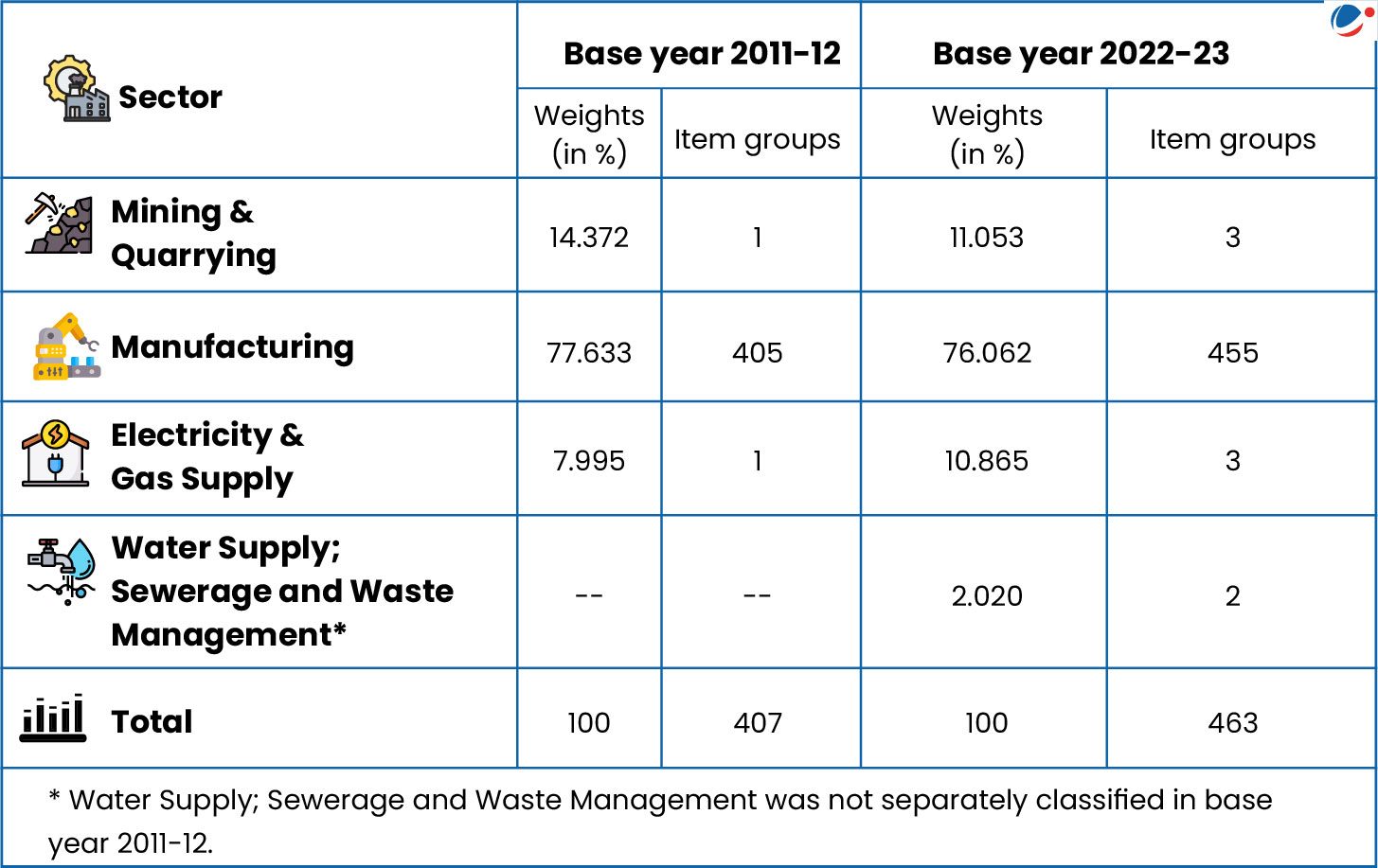
The new IIP series tries to fix this by expanding both coverage and granularity. The revised basket has 1,042 products mapped to 463 item groups, and reports say 120 new item groups have been added while several older categories have been dropped.
The index will now track areas such as rare-earth minerals, minor minerals, gas supply, water supply, sewerage and waste management. It will also give separate indices for renewable and non-renewable electricity generation, along with more detailed break-ups for fuel minerals, metallic minerals and non-metallic minerals.
Today, India is trying to build electronics supply chains, expand renewable energy, reduce dependence on imported critical minerals, manufacture defence equipment, build more urban infrastructure, and position itself as an alternative manufacturing base in a world looking beyond China. If your industrial index does not capture these shifts, your data will keep looking backwards while the economy moves ahead.
Rare-earth minerals are a good example. These are used in electronics, clean energy systems, electric vehicles, magnets and defence applications. For years, they were treated like a niche technical topic. Now they sit at the centre of global industrial strategy because countries do not want to depend too much on one supplier for materials that power future technologies. By adding rare-earth minerals to the IIP, India is not just improving a spreadsheet. It is acknowledging that the minerals economy has become strategically important.
Renewable energy is another big signal. Earlier, electricity generation was important, but the index did not reflect the clean-energy transition with enough detail. Now, by separately tracking renewable and non-renewable electricity, the government can better understand how India’s power mix is changing. This matters because India’s industrial future depends heavily on power availability, grid stability and energy costs. If solar, wind and other renewable sources become a bigger part of supply, that shift should show up clearly in national data, not hide inside one broad electricity number.
The inclusion of water supply, sewerage and waste management also says something important about urban India. Industrial production is not only about factories anymore. Cities need water systems, waste-processing infrastructure, sewage networks and environmental services to support growth. As India urbanises, these sectors become part of the economic backbone.
Reports say the new series includes products such as CCTV cameras, debit cards with magnetic strips, stents and vaccines, while dropping older categories such as kerosene, CFLs, tyre tubes and sewing machines. India moved from kerosene lamps and fluorescent lighting towards LED lighting, digital payments, medical manufacturing, surveillance equipment and modern electronics.
Policy-wise, India has spent the last decade pushing manufacturing through Make in India, PLI schemes, infrastructure spending and sector-specific incentives. But to know whether these efforts are working, policymakers need better data.
For businesses and investors, IIP is not just a government statistic. It feeds into expectations about GDP, corporate sales, credit demand, capacity utilisation and investment cycles.
This update also fits into a larger statistical clean-up. MoSPI had announced a broader exercise to revise the base years for major indicators including GDP, IIP and CPI, with 2022-23 proposed as the new base year for GDP and IIP, and 2024 for CPI.
Because major economic indicators should ideally speak the same language. If GDP uses one economic structure, inflation uses another, and industrial production uses a much older one, comparisons become messy.
Of course, this does not mean the new IIP is perfect. No index can capture a fast-changing economy completely. India’s services economy is huge, informal production is still difficult to measure, and new industries can emerge faster than statistical systems can update themselves. There is also the usual issue of data quality, response rates from production units, and delays in getting complete information. But a revised index is still better than an outdated one. The point is to reduce distortion.
The bigger lesson is that economic data is not neutral plumbing hidden under the floor. It shapes how a country understands itself. The new IIP does not guarantee that India will become a manufacturing powerhouse. But it gives the country a better dashboard to track whether it is actually getting there.


