
 Newsletter

India just slipped further down the global press freedom rankings.
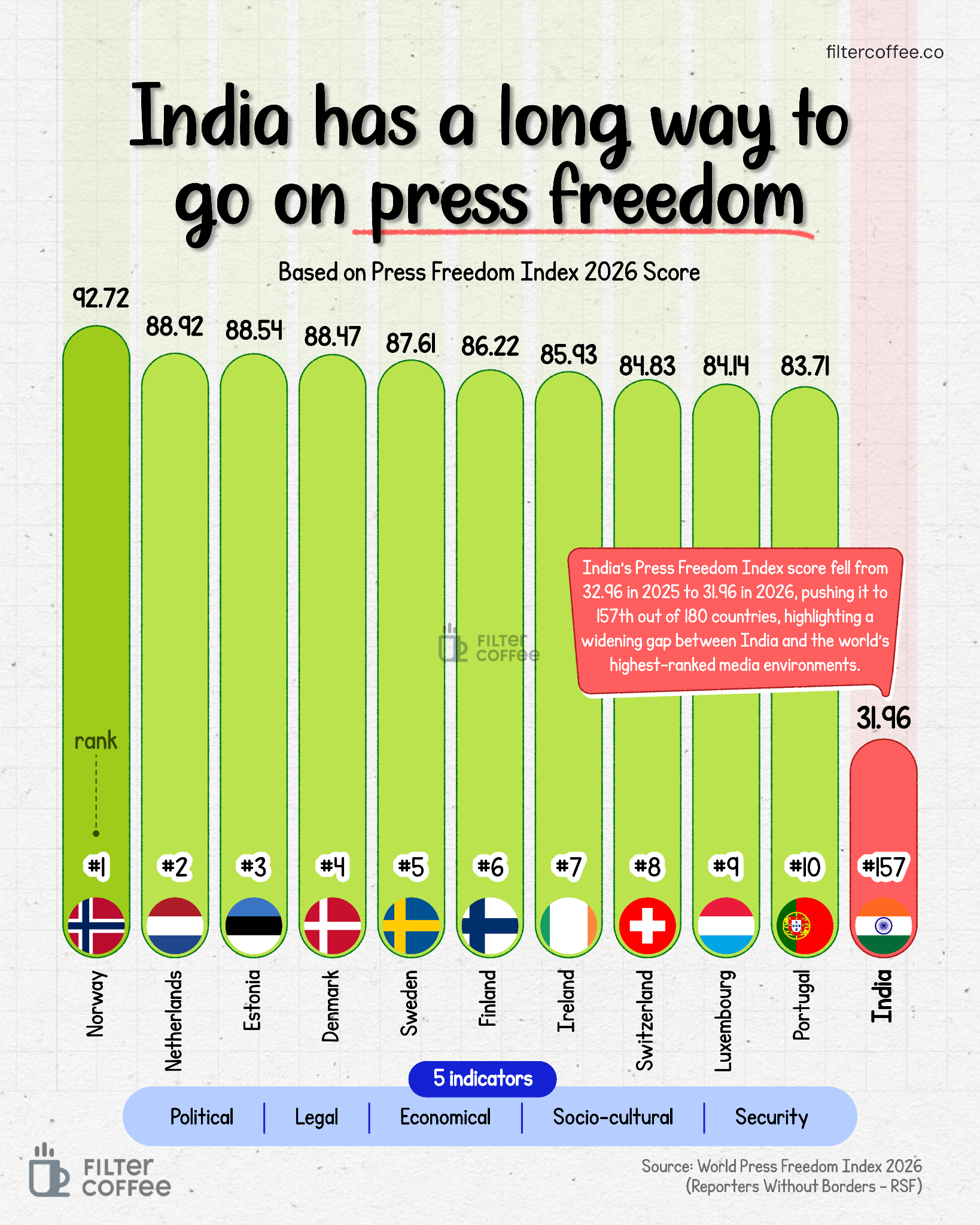
According to the 2026 World Press Freedom Index published by Reporters Without Borders (RSF), India ranked 157th out of 180 countries, down from 151st a year ago. Its score also fell from 32.96 to 31.96, placing it firmly in the "very serious" category.
And that matters more than ever.
India doesn't have a media shortage problem. In fact, it's the opposite. The country has one of the largest media ecosystems in the world, with hundreds of television channels, thousands of newspapers, countless digital publications, and a social media universe that produces more content every minute than most countries do in a day.
News has never been more abundant.
The question is whether it is becoming harder to produce independently.
To understand why India's ranking remains low, it helps to understand how the Press Freedom Index works. RSF doesn't simply count the number of journalists or newspapers in a country. Instead, it evaluates five broad indicators: political environment, legal framework, economic pressures, socio-cultural conditions, and journalist safety.
In other words, the ranking is asking whether the media can operate freely.
And increasingly, the pressure points are shifting.
A decade ago, concerns around press freedom were often centred on television channels, newspaper ownership, and political influence. Today, the battlefield has moved online. Independent journalists run YouTube channels. Investigative reporters publish on digital platforms. News breaks on X before it reaches television. Information spreads through WhatsApp groups faster than many newspapers can print it.
This shift has created both opportunities and tensions.
Governments around the world, including India's, are trying to figure out how to regulate a digital information ecosystem that can spread misinformation, deepfakes, propaganda and scams at unprecedented speed. The challenge is that the same regulations designed to control harmful content can also affect legitimate journalism.
That's why recent debates around India's Information Technology Rules have attracted attention from media organisations, legal experts and international watchdogs. Critics argue that some proposed changes could expand executive control over online content, while supporters argue stronger oversight is necessary in an era of viral misinformation and AI-generated content.
The result is a complicated balancing act. Every democracy today is trying to answer the same question: how do you regulate information without restricting it?
India is hardly alone in facing this dilemma.
But India's size makes the stakes much bigger.
Consider this. India has more internet users than the entire population of Europe. The country generates billions of digital interactions every day. Any policy change affecting information flows has consequences at a scale that few democracies have ever had to manage.
Then there's the economic side of the story.
Media independence isn't only affected by laws and regulations. It is also affected by business models.
Traditional newspapers are struggling globally as advertising shifts online. Digital publishers are competing against social media platforms for attention. Many news organisations are increasingly dependent on large advertisers, corporate sponsors or subscription revenue. In such an environment, economic pressure can become as influential as political pressure.
This is one reason why RSF increasingly evaluates economic indicators alongside legal and political ones. A newsroom that cannot financially survive cannot effectively hold power accountable either.
The irony is that India is simultaneously experiencing a media boom and a press freedom challenge.
More Indians are consuming news than ever before. Smartphone penetration continues to rise. Regional-language journalism is expanding rapidly. Independent creators are building audiences that rival traditional media houses. Podcasts, newsletters, YouTube channels and digital publications have opened entirely new pathways for storytelling.
Yet concerns around legal disputes, defamation cases, online harassment, journalist safety, platform regulation and content moderation continue to grow.
That tension sits at the heart of India's press freedom debate.
Because the future of journalism is no longer just about newspapers versus digital media. It is about trust. In a world flooded with content, reliable information becomes more valuable, not less.
And that's perhaps the biggest takeaway from India's latest ranking.
The countries that consistently top the Press Freedom Index, such as Norway, Denmark and Sweden, did not get there because they have more newspapers or bigger newsrooms. They got there because strong institutions, legal protections, transparency mechanisms and public trust evolved together over decades.
India's challenge is different. It is trying to build those safeguards while simultaneously managing a digital revolution, a booming creator economy, rising misinformation concerns and one of the most diverse media markets on the planet.
That is why the latest ranking matters.
Not because it tells us where India stands today.
But because it forces a bigger question: as India becomes a global economic and digital powerhouse, what kind of information ecosystem does it want to build for the future?