
 Newsletter

India’s inflation story just got a lot more complicated.
New data from the Ministry of Statistics and Programme Implementation shows that inflation between April FY25 and December FY26 is not moving in one neat national line. It is splintering across states.
Let us start with the outlier. Kerala at 8% is not just slightly higher than the rest. It is miles ahead. The next highest large state is Goa at 4%, and Karnataka at 3%. Lakshadweep at 6% also stands out sharply.
That means households in Kerala are facing price increases that are more than eight times what a household in Bihar is experiencing. If you are earning a fixed salary in Thiruvananthapuram, your real purchasing power is shrinking far faster than someone in Patna.
Now look at the Hindi heartland.
Uttar Pradesh, Rajasthan, Madhya Pradesh, Delhi are below 1%. Haryana at 1%. These are extremely low numbers by historical standards. In fact, anything near zero starts raising a different question. Is demand soft? Are food prices cooling sharply? Is there base effect playing tricks? Whatever the reason, the inflation pressure here is muted.
Eastern India also looks subdued. Bihar, Odisha, Assam, Tripura are also below 1%. West Bengal and Jharkhand are slightly above 1%. That suggests price stability or even weakness in some consumption baskets.
On the other hand, the Northeast is not one story. Nagaland and Mizoram stands at 2.5%. Sikkim and Meghalaya at 1.5%. That spread within one region shows how local supply chains, transport costs and consumption patterns matter.
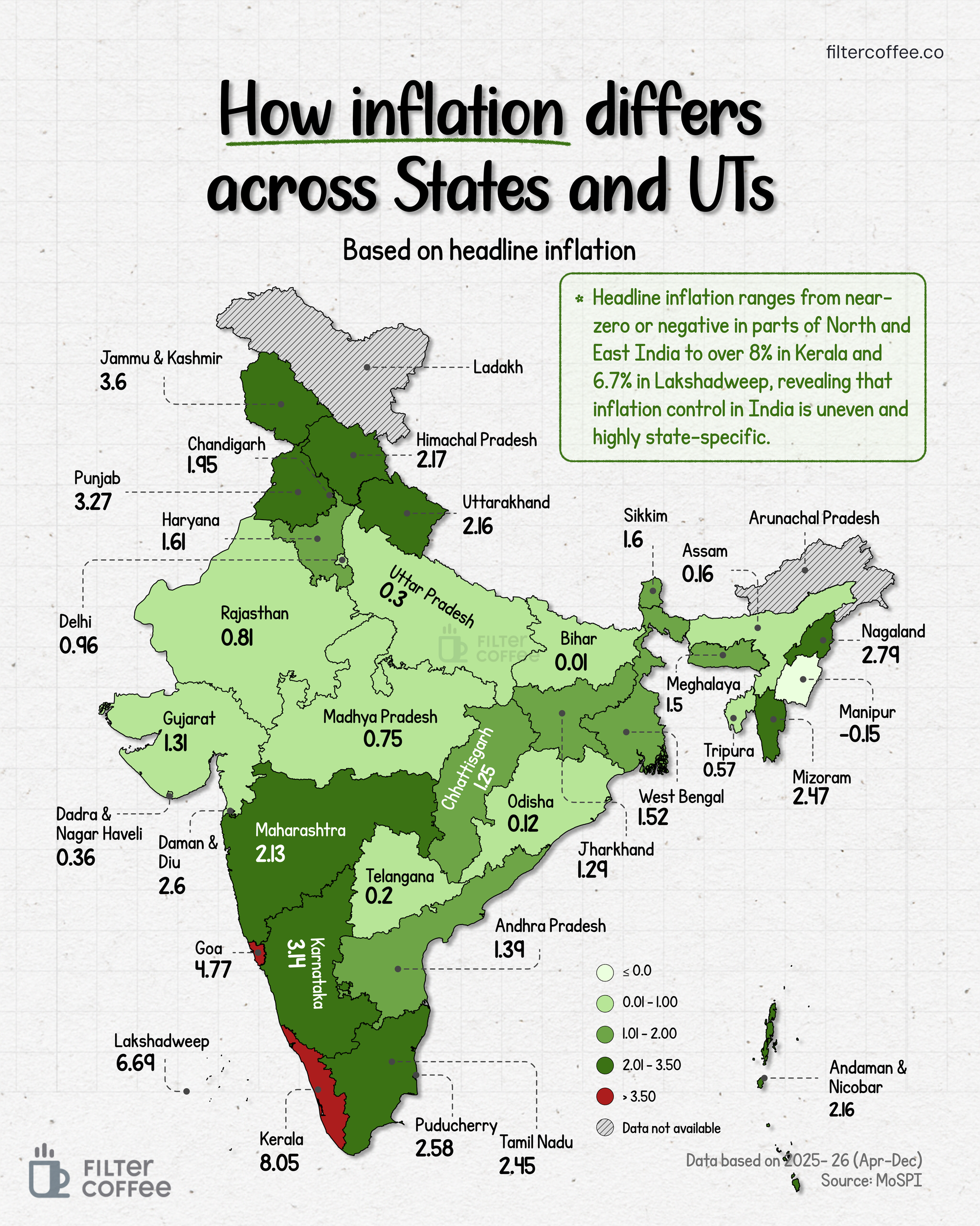
Western India sits somewhere in between. The numbers are not alarming but they are clearly not zero either. Southern India beyond Kerala also shows divergence. Even within the South, one state is overheating while another is barely seeing price growth.
So what explains this patchwork?
Inflation is built from state level price data across food, fuel, housing, clothing, transport and services. Food usually carries the biggest weight. If vegetable or cereal prices spike in one state due to local supply disruptions, that state’s CPI jumps even if national averages look calm.
Transport costs, rainfall patterns, storage capacity, local taxes and distribution margins can all vary sharply across regions. A coastal state with high logistics costs and stronger demand could see faster price growth than an agrarian state with better harvest output.
Policy-wise, the RBI sets one interest rate for the entire country. It targets national inflation, not state level inflation. But when Kerala is at 8% and Bihar is at 1%, a single rate decision will inevitably feel too tight for some and too loose for others. Monetary policy is blunt. Inflation is local.
The political economy layer is just as interesting. If voters in one state are facing sharp food inflation while another state is seeing price stability, the narrative around cost of living will differ dramatically. Welfare measures, subsidies and state level procurement policies can also influence local price movements.
India’s inflation management cannot be judged only by one national number flashing on television screens.
If anything, this data forces us to rethink how we talk about prices. When someone says inflation is under control, the real question should be, where exactly? Because for a family in Kerala, inflation right now feels very different from a family in Uttar Pradesh. And that gap is the real story hiding behind the number.