
 Newsletter
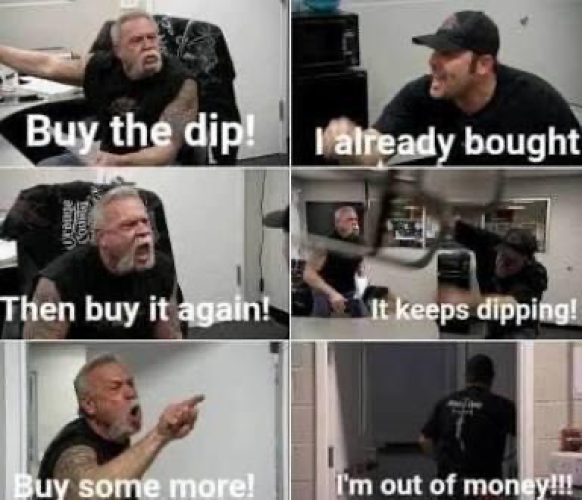
There is a reason buying the dip is so seductive.
A stock you liked yesterday is suddenly cheaper today. If the fall came from panic, a bad quarter or a temporary problem, buying while everyone else is selling can be a very good trade.
Turnaround investors have built entire strategies around this: find a business where the damage looks worse than it really is, buy before the recovery is visible and wait for the market to catch up.
There is a perfectly respectable academic case for this too. De Bondt and Thaler's famous 1985 paper found evidence that stocks that had performed badly over long periods could subsequently outperform, consistent with the idea that markets sometimes overreact to bad news.
Then there is the chart. After a strong move, traders often use Fibonacci retracements to judge how much of that move has been given back and where a reversal might develop.
The familiar 23.6%, 38.2%, 50% and 61.8% levels are essentially checkpoints: the deeper the retracement, the more of the original move has been erased. A trader isn't saying the stock must turn at 61.8%; they're looking for evidence that selling is losing control around a level.
Fibonacci retracements are a tool traders use to estimate where the price of a stock, crypto, index, etc. might temporarily stop or reverse after a significant move. Say a stock rises from ₹100 to ₹200. It probably won't keep going straight up. At some point, it may fall back, or retrace, part of that ₹100 rise before potentially moving higher again.
The evidence, however, isn’t very strong. One study of stocks in the Dow Jones, Nasdaq and DAX found that prices did often bounce around Fibonacci levels. But these levels didn’t work any better than regular support and resistance levels. So Fibonacci can give a trader a framework, but the numbers themselves aren't magic.
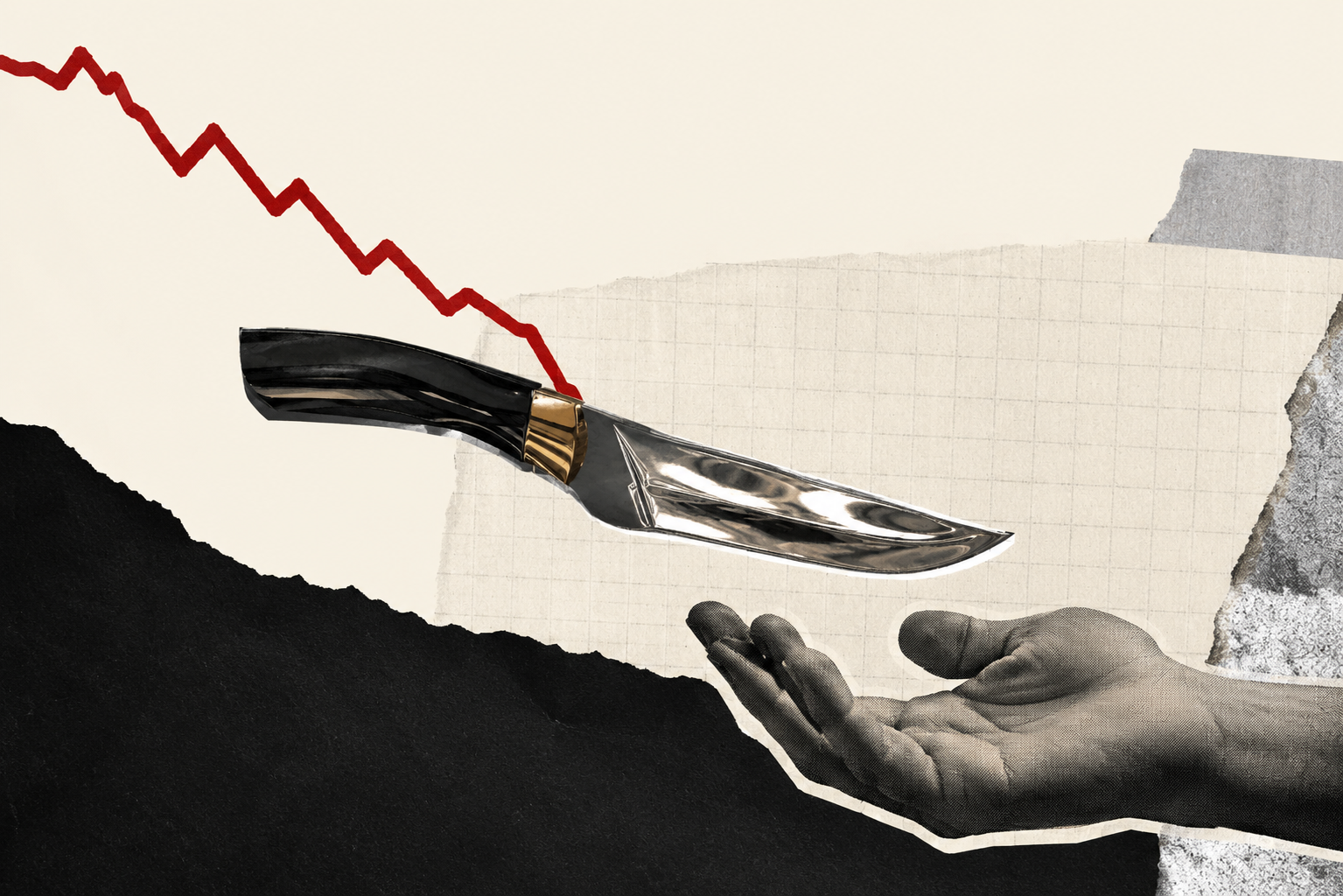
And then the knife turns downward.
The stock doesn't reverse. It keeps falling.
This is where the same logic that made buying the dip attractive can become the trap. The lower the stock goes, the more compelling the discount appears. Your original thesis is still sitting there, except now you have another problem: what if the market isn't panicking? What if it's right?
This is where another piece of market research complicates the picture. Jegadeesh and Titman's 1993 study found that stocks that had performed well tended to keep outperforming stocks that had performed poorly over the following 3–12 months.
In other words, sometimes the loser doesn't immediately mean-revert. It keeps losing.
That gives us the real tension behind the falling knife.
Markets can overreact, creating opportunities for contrarian investors. But markets can also have momentum, allowing a falling stock to keep falling long after it first looks “cheap.” The same decline can therefore be either a mispricing or the market slowly incorporating information.
And investors have a natural tendency to make that distinction harder. A 2026 paper by Xiao Yin and Dongchen Zou, using data covering about 80% of US retail trading, finds that retail buying increases significantly after stocks fall while staying roughly flat after gains. Their model also suggests that this behaviour can amplify volatility on the losing side.
That's why averaging down can be such a seductive strategy. You aren't just buying a cheaper stock anymore; you're trying to prove that your first decision was right. Your entry price becomes the reference point, even though the market has no idea where you bought.
The gutsy part of buying a falling stock is therefore not the act of buying it.
It is knowing what you're betting against.If you're betting that the market has overreacted to a temporary problem, you may have found a great opportunity. If you're simply betting that a stock can't fall much further because it has already fallen a lot, that's a very different trade.
And this is where the falling knife metaphor really works. Sometimes you reach out and catch the blunt end. The selling exhausts itself, the business recovers and you get to ride the stock back up. Other times, you grab the blade because the price looked irresistible, only to discover that the fall was the information.