
 Newsletter
If Mumbai were a company, it'd be one of the biggest businesses in India.
It has an annual budget of ₹80,953 crore, employs thousands of people, runs hospitals, schools, maintains roads, supplies water, manages waste and even helps keep public transport running.
But unlike a company, it doesn't sell a product. So where does all that money come from?
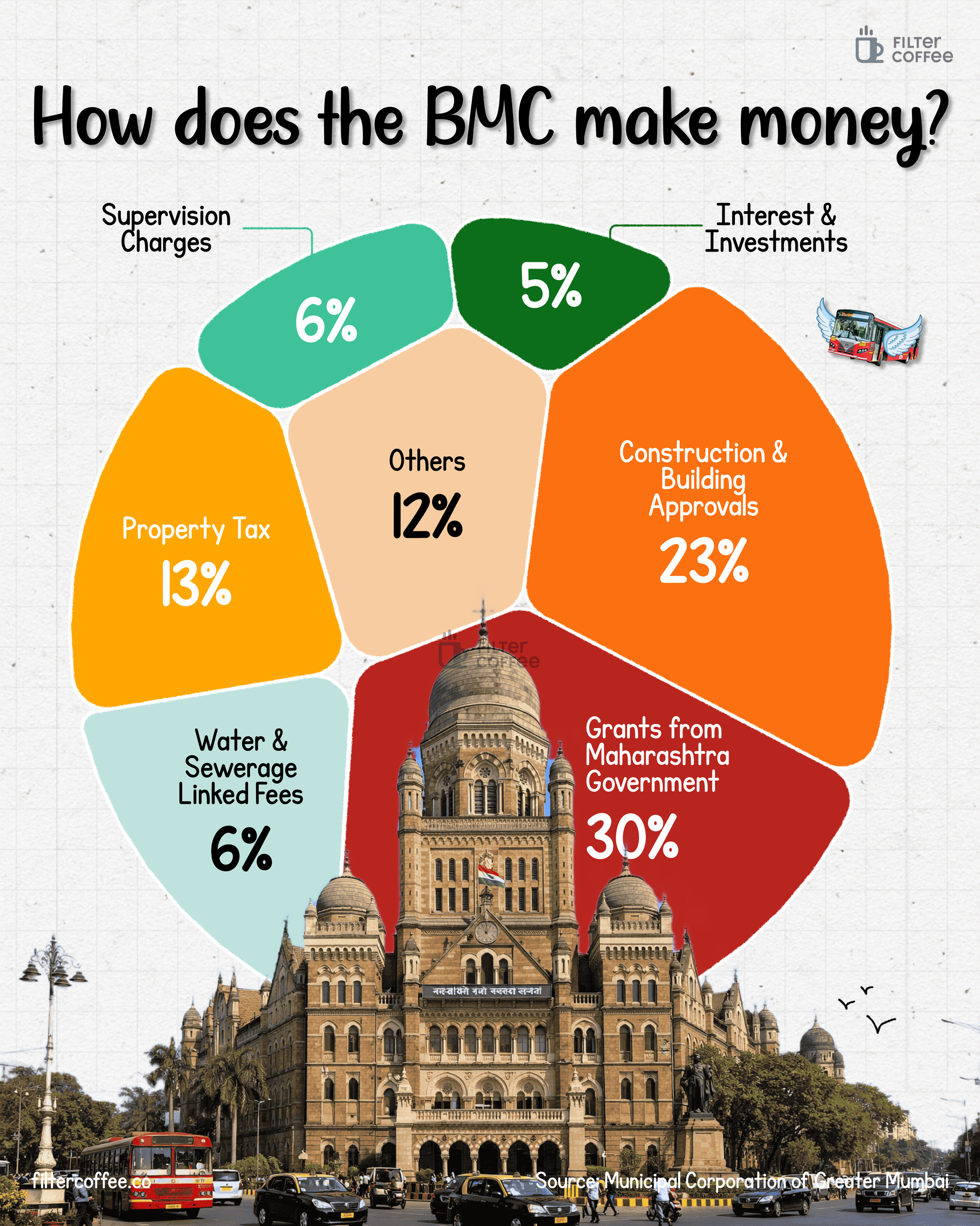
If your answer was property tax, you're not alone. It's probably the most visible payment Mumbaikars make to the BMC. But here's the surprising part, it accounts for only around 13% of the corporation's revenue.
That question has become even more interesting after the BMC unveiled its record ₹80,953 crore Budget for FY27, the largest ever by an Indian municipal corporation.
With nearly 60% of the budget earmarked for capital expenditure, Mumbai is doubling down on infrastructure, building roads, bridges, water pipelines, sewage networks and flood-control projects that the city desperately needs.
So, where does the money actually come from?
The biggest contributor isn't a tax paid by residents. It's grants from the Maharashtra government, which account for roughly 30% of the BMC's revenue. Close behind are construction and building approvals, contributing around 23%. Every redevelopment project, new commercial tower or housing society seeking additional floor space pays various premiums, approval charges and development fees to the civic body.
The remaining pie comes from several smaller but meaningful sources, property tax, water and sewerage charges, supervision fees, investment income and a host of other collections. And that's what makes Mumbai's finances so unique.
The more Mumbai redevelops aging buildings, builds new infrastructure and approves fresh projects, the stronger the civic body's finances become.
In fact, the FY27 budget also revised several development-related premiums and charges, signalling that the BMC wants to rely more on urban growth than simply increasing taxes. Of course, collecting money is only half the equation.
The record budget will be used to modernise Mumbai, from improving roads and hospitals to strengthening drainage systems that can better withstand monsoon flooding. The BMC also continues to provide significant financial support to BEST, ensuring the city's bus network keeps moving despite its financial challenges.
The next time you walk past a construction site, it might be worth looking at it differently.
Yes, it's another building coming up. But it's also another source of revenue helping fund the roads you drive on, the water that reaches your home and the civic services millions of Mumbaikars rely on every single day.
Turns out, Mumbai isn't just built by construction, it is, in many ways, funded by it.