
 Newsletter
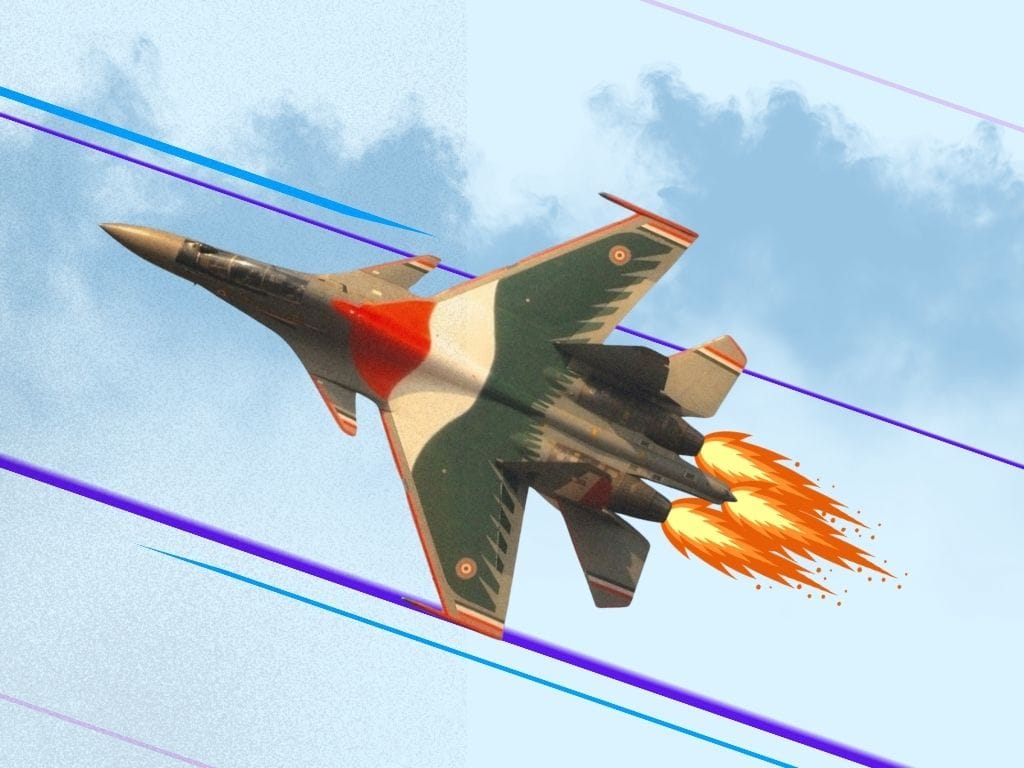
India has the world's fourth-largest military. It has nuclear weapons, aircraft carriers, ballistic missiles, fighter jets, and one of the largest standing armies on the planet.
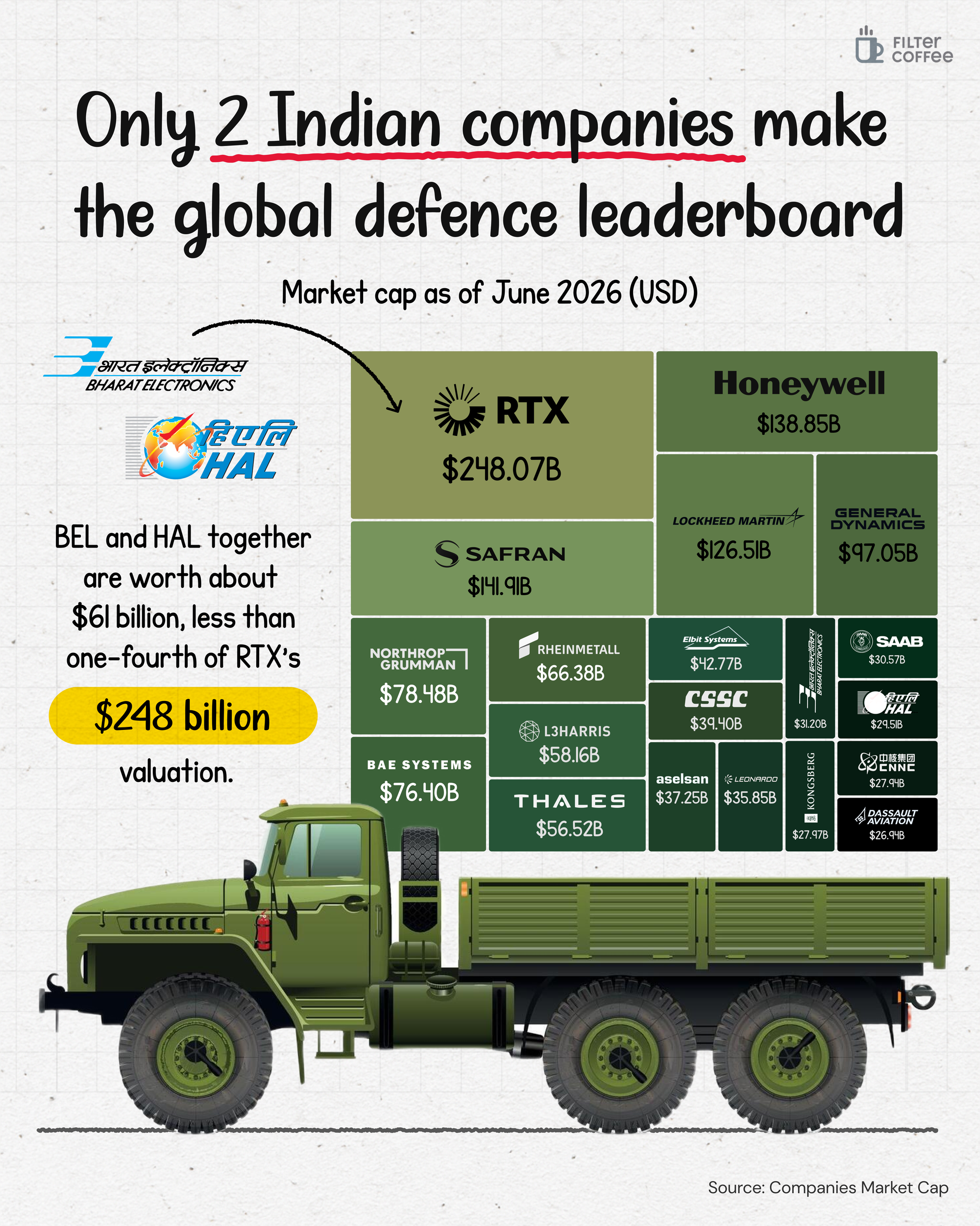
Yet when you look at the world's biggest defence companies, India barely shows up. Only two Indian firms, Bharat Electronics (BEL) and Hindustan Aeronautics (HAL), make the global defence leaderboard.
And that gap tells us something important about India's defence ambitions.
At first glance, the numbers look almost unfair. The world's largest defence company, RTX, is worth nearly $250 billion. That's more than three times the combined market value of BEL and HAL.
Even companies like Honeywell, Lockheed Martin, Northrop Grumman and General Dynamics tower over India's defence champions.
Which raises an obvious question. If India is one of the world's most powerful military nations, why doesn't it have defence companies that match its global stature? The answer lies in history.
For decades, India built military strength very differently from countries like the United States. While American defence giants spent decades designing, manufacturing and exporting weapons across the world, India largely relied on imports.
Russian fighter jets, French submarines, Israeli systems and American equipment became the backbone of India's military modernisation. The country was building military capability, but not necessarily building globally competitive defence companies.
That equation is finally beginning to change.
India's defence industry is currently experiencing its strongest growth phase in decades. Defence production crossed a record ₹1.78 lakh crore in FY26, more than doubling from levels seen five years ago.
Defence exports touched an all-time high of ₹38,424 crore, growing nearly 63% year-on-year and reaching more than 100 countries. Suddenly, India is no longer just one of the world's largest buyers of weapons. It is slowly becoming a seller too.
The biggest beneficiaries of this shift are companies like HAL and BEL.
HAL has transformed from a company known largely for assembling aircraft under licence into the backbone of India's aerospace ambitions.
Its order book has swelled to roughly ₹2.5 lakh crore, supported by Tejas fighter jets, Dhruv helicopters and a growing list of indigenous platforms.
BEL, meanwhile, has become the nerve centre of India's defence electronics ecosystem, supplying radars, communication systems, electronic warfare solutions and missile-related technologies. Its order pipeline now runs into tens of thousands of crores.
But the real story isn't just about these two companies. For the first time, India's defence growth is no longer being driven solely by public sector giants. A new generation of private players is entering the ecosystem. Companies are manufacturing drones, precision components, sensors, ammunition, electronics and aerospace systems.
And that's where the leaderboard can be misleading.
The global defence giants dominating today's rankings weren't built in a decade. Many of them have spent over half a century developing intellectual property, exporting weapons across continents and serving some of the world's largest military budgets.
Their size reflects decades of compounding technological expertise, acquisitions and global reach.
India is only at the beginning of that journey. The country's defence industry is moving from an import-dependent model to a design-and-manufacture model. Indigenous systems like Tejas, Akash, Pinaka, BrahMos and INS Vikrant demonstrate that India can increasingly build sophisticated platforms at home.
What remains to be seen is whether Indian companies can scale these capabilities into globally dominant businesses. So the most interesting takeaway isn't that India has only two companies on the global defence leaderboard.
It's that despite having just two names on the list today, India is building the foundations for many more tomorrow.