
 Newsletter

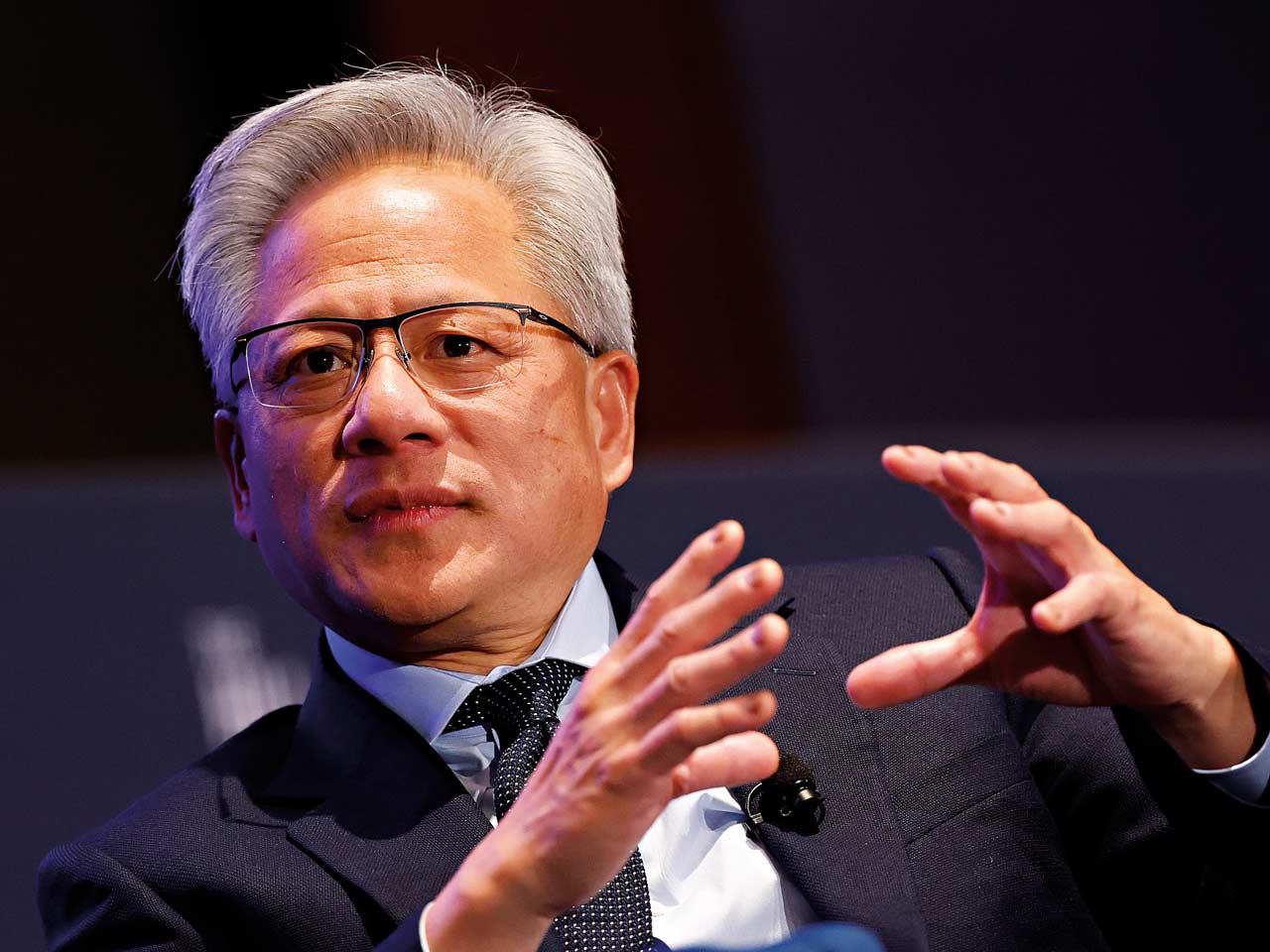
Nvidia is reportedly planning to oust Jensen Huang and we do not have to explain what a big update this is. The stock said plenty.
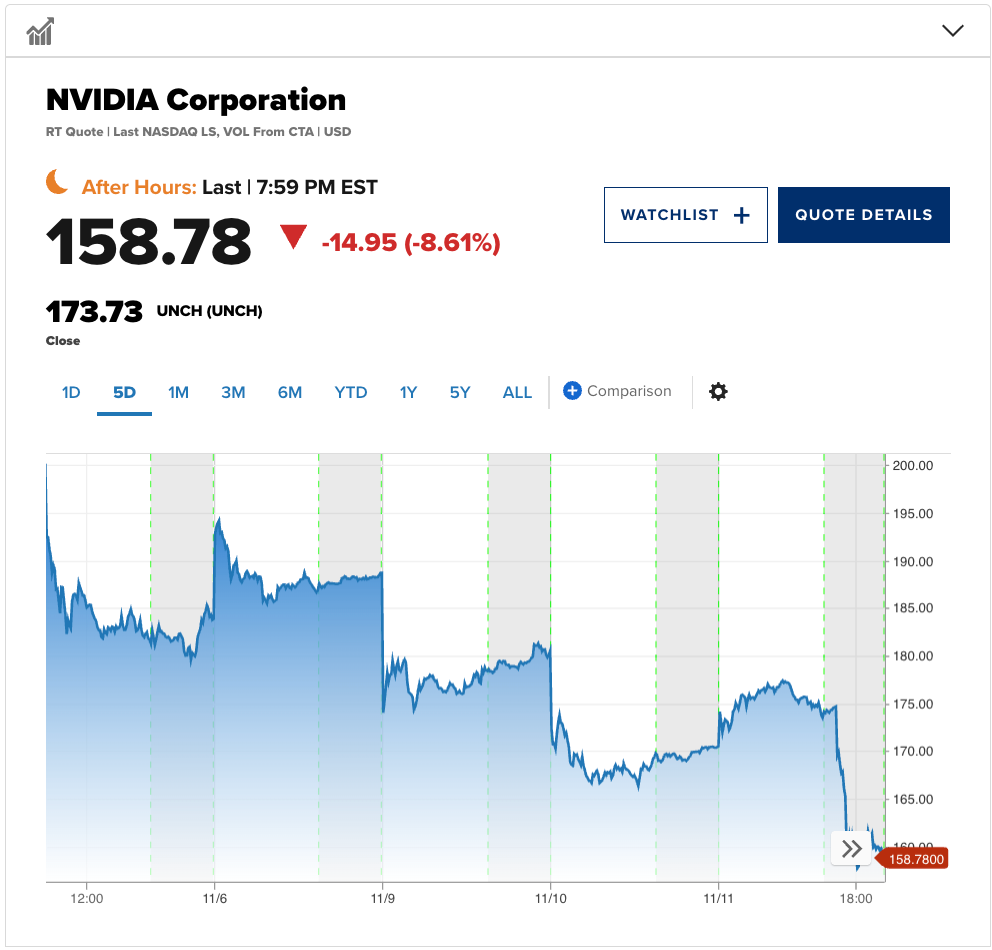
However, no removal has been officially announced. Huang remains Nvidia’s CEO at the time of writing.
First, the possible candidates: the company’s board has reportedly hired an outside firm to identify potential replacements.
Here are the names being discussed. None has been formally shortlisted.
Colette Kress: Nvidia’s chief financial officer is considered a possible interim CEO.
She has spent more than a decade at the company and understands its finances, investors and internal operations. However, Nvidia would still need a long-term leader capable of guiding its chip technology and AI strategy.
Ian Buck: Buck helped develop CUDA, the software platform that made Nvidia’s chips useful for artificial intelligence and other complex computing tasks.
He also oversees Nvidia’s data-centre business, which sits at the heart of the company’s AI boom. That combination makes him one of the strongest internal candidates.
Andrew Bell: Nvidia’s senior vice-president of hardware engineering has worked at the company for around 25 years.
He is not widely known outside the chip industry but has deep experience developing Nvidia’s hardware. He could be considered if the board wants a technical insider who already understands the company.
Chris Malachowsky: Nvidia’s co-founder remains an important technical figure inside the company.
He may not necessarily become CEO, but his knowledge and influence could make him an important part of any leadership transition.
Lisa Su: the AMD CEO has transformed Nvidia’s closest major chip rival and understands the semiconductor business extremely well.
However, leaving AMD to run its biggest competitor would be complicated. Her name is an interesting possibility not an obvious or confirmed choice.
René Haas: the Arm CEO understands chip design, data centres and the relationships between semiconductor companies and their customers.
Bret Taylor: Taylor has previously served as Salesforce’s co-CEO, Facebook’s technology chief and OpenAI’s board chairman.
He has experience managing large technology companies and difficult boardroom situations. But he does not have the same chip-design background as Nvidia’s internal candidates.
Eric Schmidt: the former Google CEO has experience in artificial intelligence, government policy and large technology businesses.
He could potentially act as a transition leader, although Nvidia would still require strong technical executives around him.
Google Cloud CEO Thomas Kurian and Amazon Web Services CEO Matt Garman have also appeared in media speculation. For now, Kress and Buck appear to be the most practical internal options. techcrunch.com
How did Nvidia get here: the controversy began with reports concerning Huang’s relationship with Alice Huang, a Chinese business executive who is not related to him.
Alice Huang was associated with Megaspeed, a Singapore-based AI infrastructure company that reportedly purchased billions of dollars’ worth of Nvidia chips. The company had already faced scrutiny over whether restricted processors were reaching China.
US intelligence officials reportedly suspected that Alice Huang was providing information to Chinese intelligence. China has rejected the allegations.
No public finding has established that Jensen Huang knowingly shared Nvidia’s secrets or sensitive US information. Nvidia’s board has also said it currently has no reason to believe national security or company secrets were compromised. Statement from NVIDIA Board of Directors
The matter became more serious because Nvidia’s most advanced AI chips are subject to US export restrictions.
October 29: reports revealed that Huang had developed a close personal relationship with Alice Huang while US authorities were examining her activities and associated businesses.
November 5: three Republican committee chairmen asked Huang to attend a closed-door briefing. They wanted to understand whether sensitive American technology or information could have been exposed.
November 8: Huang admitted in a message to employees that he had been unfaithful to his wife.
He apologised and accepted responsibility but did not identify the person involved.
Nvidia’s board launched an independent investigation on the same day. It said it had confidence in Huang and that he would cooperate with the review. investor.nvidia.com
November 9: Huang withdrew from several upcoming speaking engagements. US President Donald Trump also publicly supported him, describing him as a “fine person.”
November 10: Nvidia’s independent directors appointed former acting US attorney Joon Kim and law firm Wachtell Lipton to conduct the investigation. investor.nvidia.com
November 11: the New York Times reported that Huang had also had a relationship with Kimberly Powell, Nvidia’s vice-president of healthcare and an executive who reported directly to him.
Nvidia and Powell had not publicly confirmed that report at the time of writing.
The Wall Street Journal then reported that Nvidia’s board was preparing to determine whether Huang should remain CEO. Reuters separately reported that directors were meeting to discuss his future. www.investing.com
Elon enters the chat: amid the uncertainty, an X user asked Elon Musk to hire Huang.
Musk replied, “That would be an honor.”
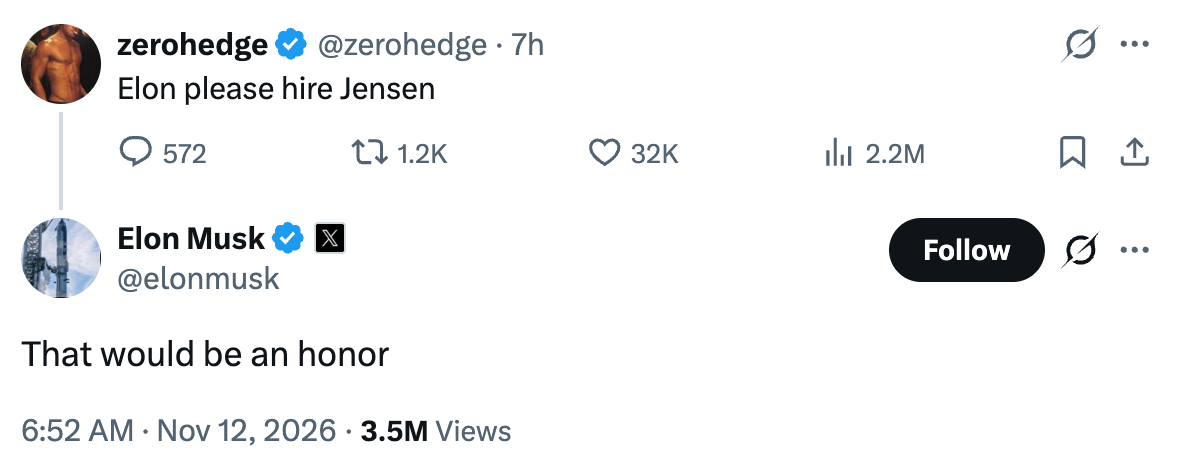
That is not a formal job offer. But it is notable because Musk’s companies require enormous computing capacity and are major users of Nvidia’s AI chips.
Tesla needs powerful processors to train its autonomous-driving systems and humanoid robots. SpaceX and xAI also require computing infrastructure for their AI ambitions.
If Huang became available, his experience in chips, data centres and AI infrastructure would be extremely valuable to Musk’s businesses. elonmuskarchive.org
Will Jensen actually leave Nvidia: losing the CEO title does not necessarily mean Huang would disappear from the company.
Nvidia’s board could remove him as CEO through a majority vote. Removing him from the board is a separate and more difficult process that would require shareholder involvement.
Huang is also Nvidia’s largest individual shareholder, owning roughly 3.6% of the company. He would therefore remain financially connected to its future even if he lost his management position. Trading Insights Daily
The board could keep him as a director or move him into an advisory position. Another possibility would be to create a chairman-like role that allows him to remain involved in technology and long-term strategy while another executive handles daily operations.
However, Nvidia currently has no board chairman, and no such arrangement has been announced.
A complete separation therefore appears less straightforward than simply replacing him as CEO.
Zoom out: even if Huang is removed as chief executive, Nvidia may not cut ties with him completely.
The directors he worked with during Nvidia’s enormous rise may prefer a controlled transition instead of an immediate break. Keeping him involved could reassure employees, customers and investors while giving a new CEO time to settle in.
But someone would still need to run the company. With no publicly named successor, Nvidia’s internal executives and particularly Huang’s many direct reports are likely to receive closer attention.
Until the board announces its decision, every name remains speculation.
The larger picture: the US and China are competing to control the development of the world’s most advanced AI technology.
Nvidia matters because its processors provide much of the computing power used to train and run modern AI systems. These chips can influence economic growth, scientific development and military capabilities.
As an American company, Nvidia must follow US restrictions on selling its most powerful processors to Chinese entities.
That is why this is no longer merely a story about Huang’s private conduct. The central question is whether his relationships created a conflict of interest, exposed sensitive information or affected Nvidia’s business decisions.
For Nvidia, both options carry risk.
Removing Huang could create an enormous leadership gap at one of the world’s most important technology companies. Keeping him could create governance and reputational problems if the investigation finds serious failures of judgment or company policy.
For now, Huang remains CEO. But Nvidia must prepare for something it has rarely had to imagine in its 33-year history: a future in which Jensen Huang is no longer the person running the company.