
 Newsletter

Sometimes, even money cannot solve a problem. Maharashtra, India’s wealthiest state, is finding that out.
The state’s listed wealth totals over ₹63 lakh crore, ahead of Delhi and Gujarat. It is home to 112 billionaires and 552 people on India’s rich list. But that wealth offers little protection against a weak monsoon.
The problem: the Maharashtra government has announced water supply cuts of at least 10% from October 16 across all urban and rural local bodies.
On September 26, the government declared drought in 265 of its 358 talukas, nearly 74% of the total. Each dam must also maintain an additional 10% emergency reserve. Drinking water needs will be protected until October 16, when the cuts begin.
The bigger picture: Maharashtra’s water shortage comes as India recorded its lowest monsoon rainfall since 2015, with El Niño dampening rainfall during the June-September season.
According to the India Meteorological Department (IMD), the country received 759.4 mm of rainfall, against a long-period average (LPA) of 868.6 mm.
That is about 87% of the average, making 2026 the fourth-lowest monsoon rainfall year since 2001 and the 13th lowest since 1901.
But a weak monsoon is more than a water problem. It can ripple through the entire economy.
Why India is vulnerable: India is one of the world’s largest agricultural producers and a leading exporter of rice and sugar. Its farms help feed nearly 1.5 billion people, keep food inflation in check and support 46.1% of the workforce. Farm incomes also drive spending across the rural economy.
When rainfall falls short, the effects can travel from fields to food prices, household budgets and businesses.
What is El Niño?
El Niño is a climate pattern that typically occurs every two to seven years, when surface waters in the central and eastern equatorial Pacific become unusually warm.
This changes how heat moves between the ocean and the atmosphere, shifting weather patterns around the world.
It can weaken India’s monsoon and push global temperatures higher. Forecasters say 2026 could come close to becoming the hottest year on record, with temperature records very likely to fall in 2027.
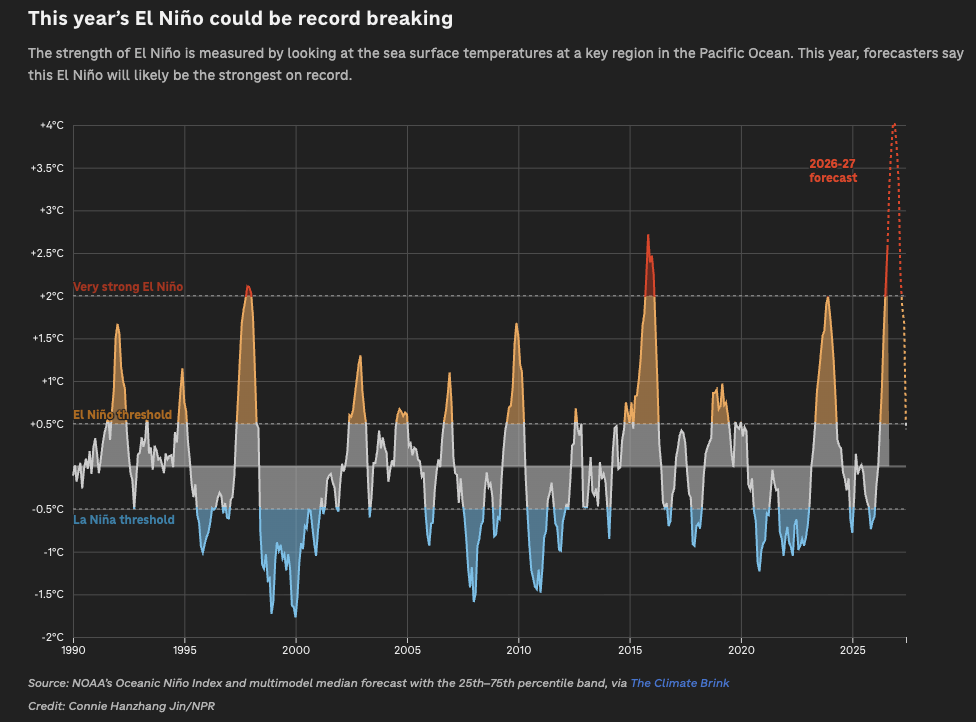
The economic impact: Hanna Luchnikava-Schorsch, head of Asia-Pacific economics at S&P Global Market Intelligence, expects India’s rural economy to slow ‘materially’ in 2026 and 2027 as drought, below-normal monsoon rainfall and depleted reservoirs reduce crop yields and farm incomes.
Experts consider India one of the major Asian economies most exposed to a super El Niño. While some expect government measures and existing buffers to cushion the fallout, others warn that the strain could fuel unrest.
For Maharashtra, the immediate challenge is conserving water. For India, it is keeping a poor monsoon from turning into a wider economic slowdown.