
 Newsletter
For most children, the start of a new school year means new books, fresh uniforms, and a brand-new backpack.
For businesses, it marks the beginning of one of India's biggest annual consumption cycles. From school bags and stationery to uniforms, footwear, and EdTech devices, the back-to-school season fuels billions of dollars in spending every year.
Yet behind every purchase lies an environmental cost that rarely makes it onto the shopping list.
India's back-to-school market was valued at around $15.7 billion in 2024 and is expected to grow to $23.3 billion by 2030.
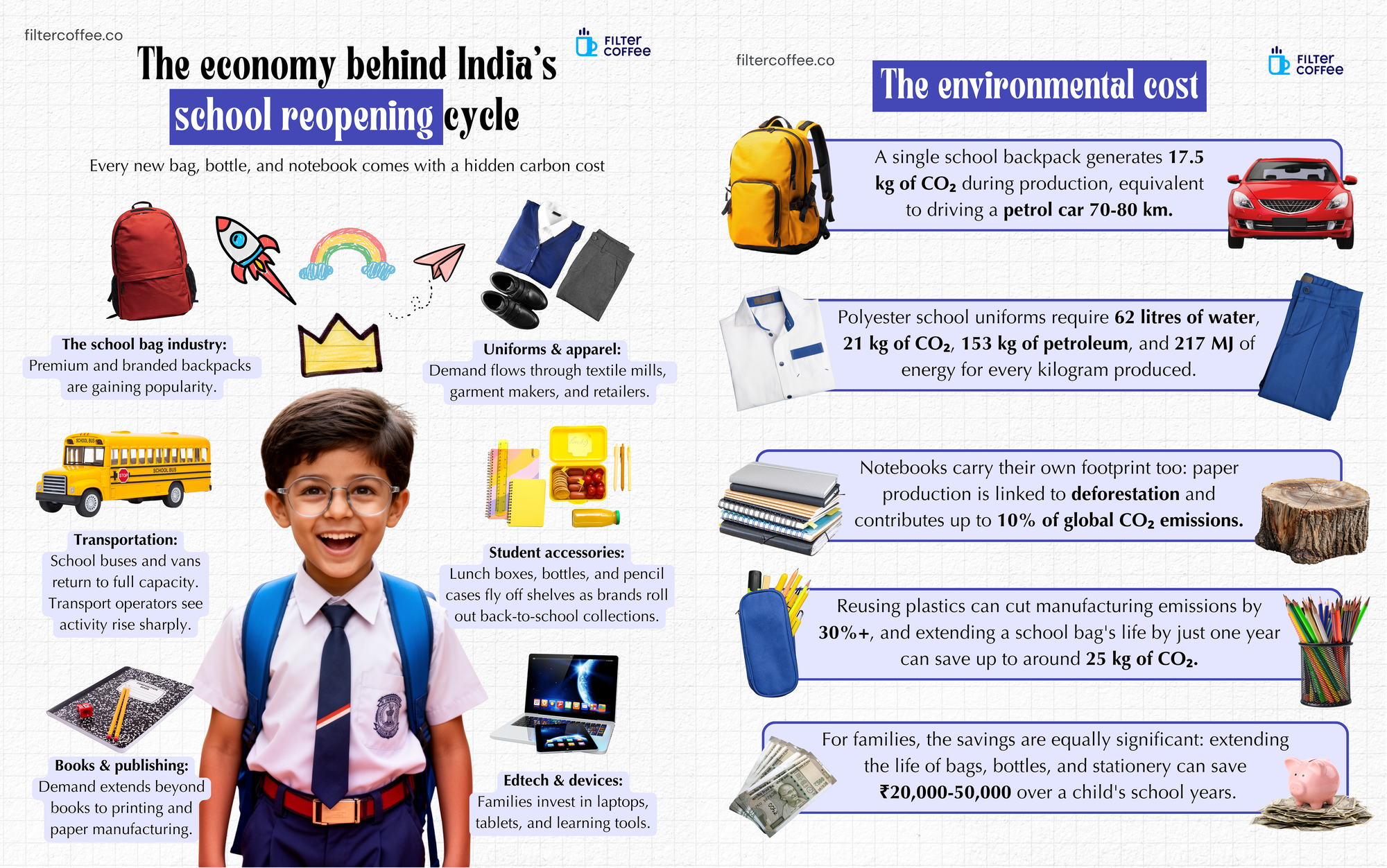
Every academic year, millions of families spend on uniforms, notebooks, school bags, lunch boxes, water bottles, transportation, and increasingly, digital learning tools. The ripple effect extends far beyond classrooms, driving demand across textile mills, paper manufacturers, publishers, retailers, transport operators, and consumer brands.
But the environmental footprint of this annual shopping cycle is substantial.
Take school bags, for instance.
Producing a single backpack can generate roughly 17.5 kilograms of CO₂ emissions, equivalent to driving a petrol car for nearly 70-80 kilometres. Multiply that by millions of students across the country and the numbers quickly become staggering. If even 10 million families replace usable school bags every year, the resulting emissions could exceed 175 million kilograms of CO₂ from backpacks alone.
The impact doesn't stop there. School uniforms, particularly those made from polyester blends, are resource-intensive products. Every kilogram of polyester fabric requires significant amounts of water, energy, and petroleum-based inputs during manufacturing.
Notebooks carry their own environmental burden as well. Paper production remains closely linked to deforestation, energy consumption, and industrial emissions, while plastic bottles, lunch boxes, and stationery contribute to a growing waste challenge once they are discarded.
This matters because India's back-to-school economy is only getting larger.
Rising incomes, growing aspirations, and the popularity of branded school products are encouraging families to upgrade supplies more frequently.
Premium backpacks, character-themed accessories, and technology-enabled learning tools are becoming increasingly common purchases.
At the same time, sustainability is beginning to enter the conversation. Manufacturers are experimenting with recycled materials, eco-friendly stationery, and longer-lasting products. Some brands are introducing school bags made from recycled plastics, while others are focusing on refillable stationery and reusable accessories. For families, the simplest solution may also be the most effective: extending the life of products already in use.
A school bag reused for just one additional year can prevent significant emissions while reducing household expenses. Across a child's school journey, reusing bags, bottles, and accessories can save families thousands of rupees while reducing waste.
As India's back-to-school market continues to expand, the challenge is no longer just about meeting demand.
It is about ensuring that growth does not come at an unnecessary environmental cost. Because sometimes, the most sustainable school supply isn't the newest one on the shelf—it's the one already waiting at home.