

 Newsletter
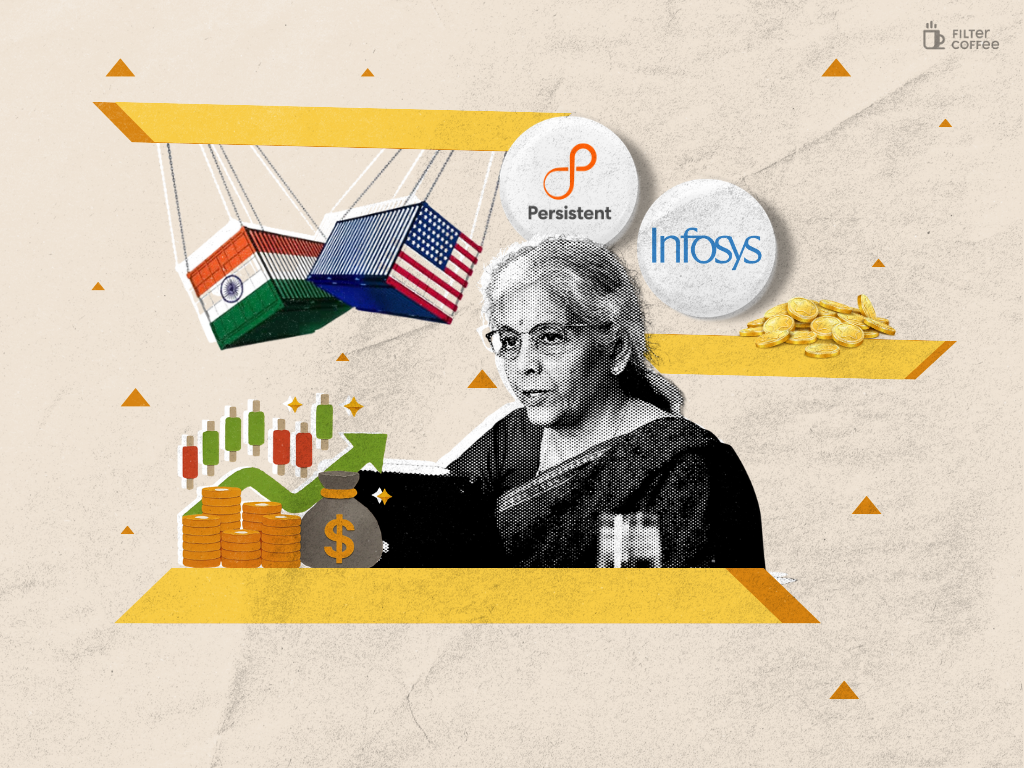
IT stocks in party mode, Market closing gets an update, and Trade deal falters for now.
🗓️ Morning, folks! ☀️
Let’s start today’s newsletter with something that will alter your brain chemistry! Quite literally.
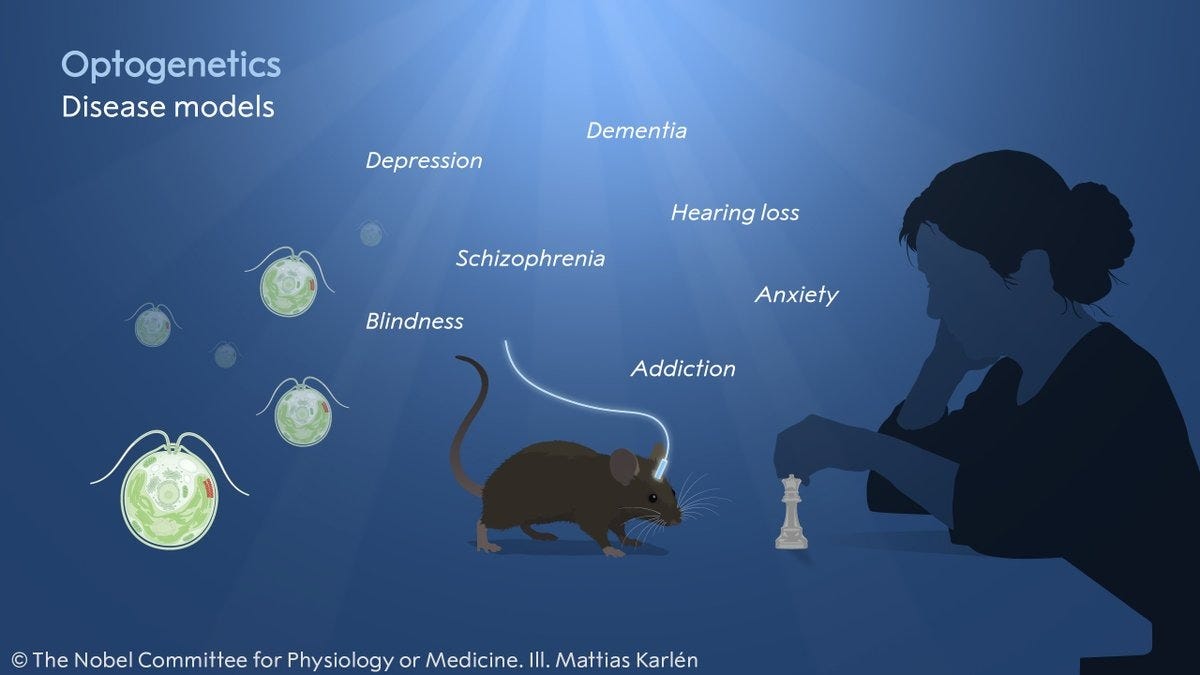
This year’s Nobel Prize in Medicine has gone to three scientists Karl Deisseroth, Peter Hegemann and Georg Nagel for their work on optogenetics.
So, what exactly is optogenetics? Think of it as putting a tiny light switch inside a brain cell. The scientists found a protein in algae that reacts to blue light and figured out how to put the gene for that protein into nerve cells.
Now, shine light on those cells and researchers can make them turn on or off. Instead of guessing what a particular brain cell does, they can flick its switch and watch what happens.
The technique is still largely a research tool, but it could eventually help scientists better understand conditions such as Parkinson’s, epilepsy and depression, and identify the specific brain circuits that need to be targeted.
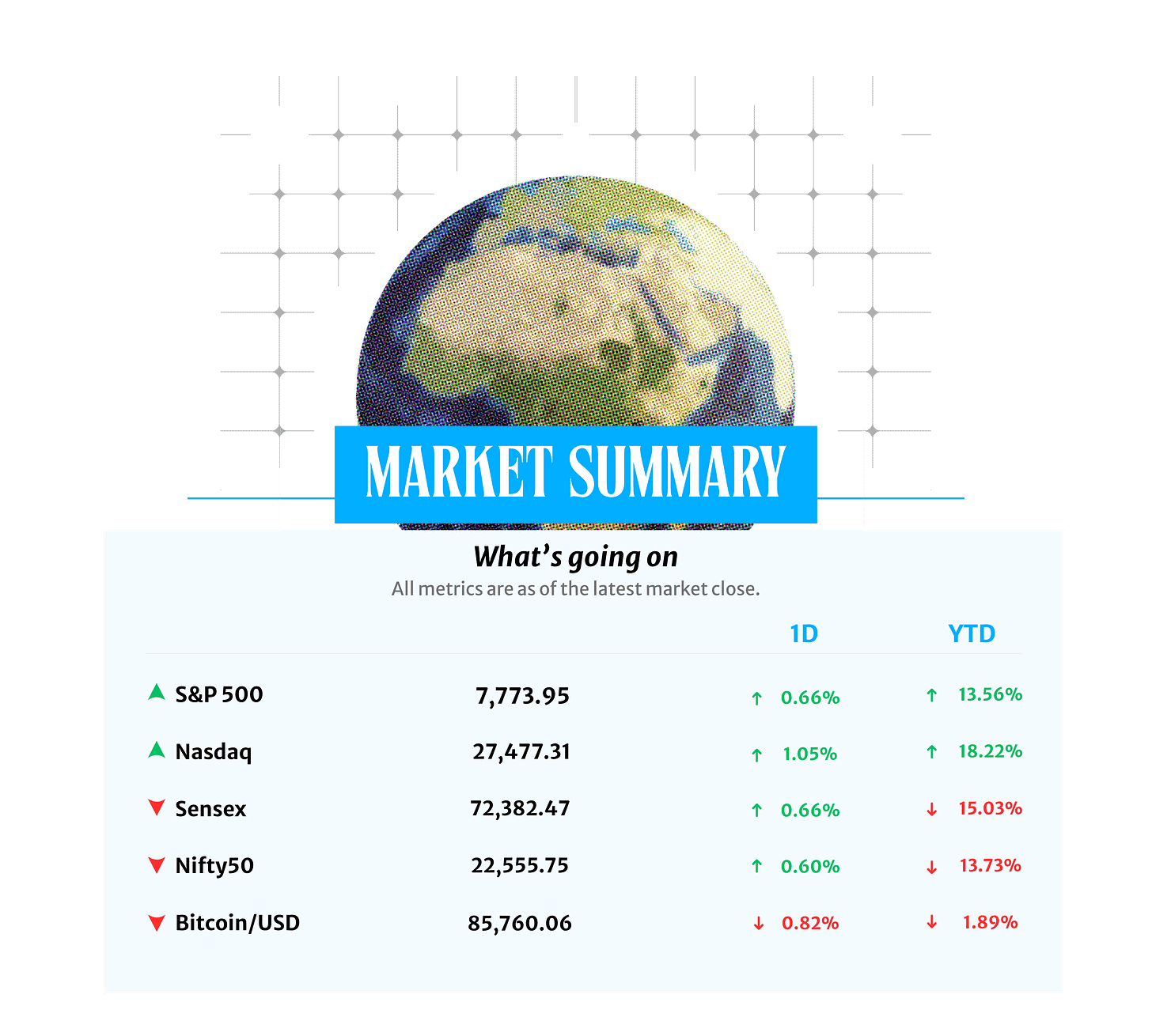
Back to business, Monday brought some relief to the market.
Nifty and Sensex both ended 0.6% higher, with Reliance Industries, ICICI Bank and ITC contributing the most to Nifty’s gains.
Global cues also improved as crude oil prices eased from recent highs. Brent hovered around $102 a barrel, offering some relief from inflation concerns.
FMCG, energy and banking stocks led the recovery, with positive quarterly business updates helping lift select stocks
💡 Spotlight: Accenture gave IT stocks some hope 💻
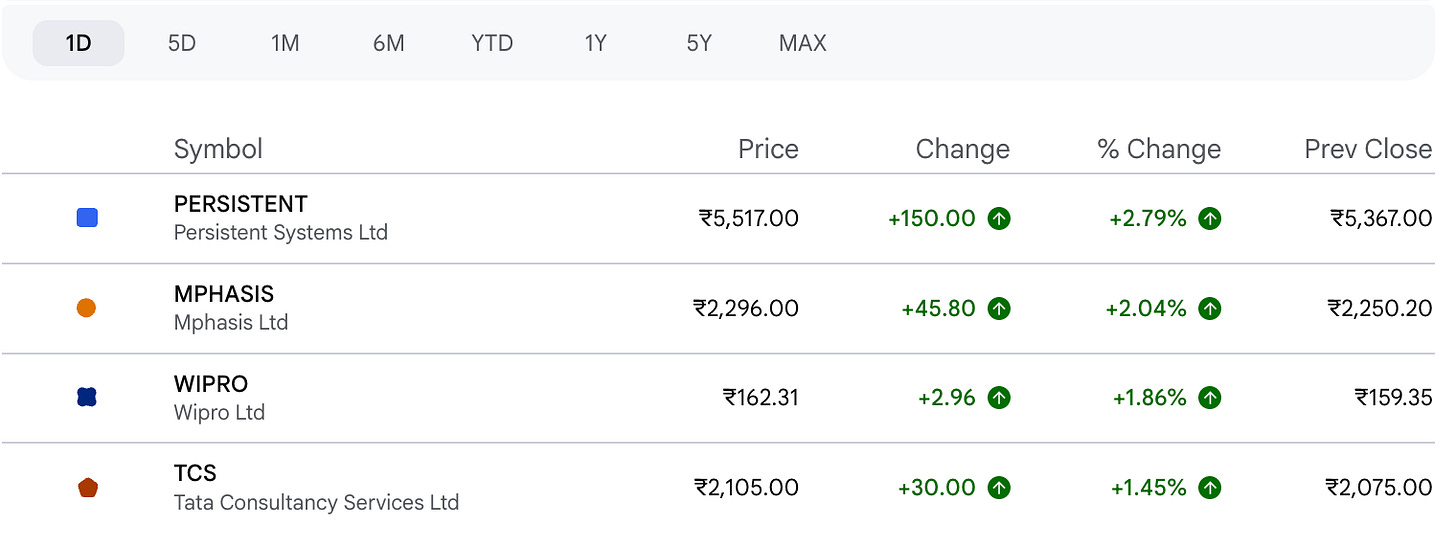
Indian IT stocks including Persistent Systems, Mphasis, Wipro and TCS gained up to 3% on Monday after Accenture reported strong Q4 results in the US.
The biggest takeaway from the company’s results was that AI is creating more business opportunities than it is taking away.
Accenture said companies are using AI not just to cut costs, but also to do more things, creating new work for IT firms.
Expectations from Indian IT earnings: TCS will kick off the Q2 earnings season on October 8, followed by HCLTech on October 12 and Infosys on October 23.
Analysts broadly expect another muted quarter for large IT companies, as clients remain careful about spending on projects that aren’t essential.
We also broke this down on video, watch here 🚀
Let’s hit it! 💪🏻
1 Big Thing: SEBI may rethink its closing auction rules 📊
SEBI is likely to partly reverse its new closing price system after feedback from market participants, according to sources cited by Reuters.
The biggest expected change: derivatives may go back to their old settlement method for at least another year.
But before we get into more details, let’s first understand what CAS is.
Closing Auction Session is a short auction held at the end of the trading day to decide a stock’s final closing price.
Instead of simply using trades from the last 30 minutes, buy and sell orders are collected during this auction to arrive at a closing price. Similar systems are used in markets such as the US and Hong Kong.
The problem: SEBI introduced CAS last month for stocks that have futures and options linked to them. But the new system led to sharp movements in derivatives prices, particularly on expiry days.
SEBI then asked the market what needed fixing and received around 20,000 comments and suggestions.
A major concern was using CAS prices to settle futures and options. Traders argued that this could make the final settlement price harder to predict and create a mismatch between their derivatives and the stocks they use to hedge them.
What might change: the biggest change could be a return to the old system for derivatives.
For at least a year, their settlement price could once again be calculated using the average traded price during the final 30 minutes of regular trading, instead of including the closing auction.
CAS itself isn’t going away. It could continue to determine the closing price of underlying stocks, particularly in the less-liquid cash market.
SEBI is also expected to broadly retain the existing timings. Regular trading could continue until 3:30 pm, followed by CAS, while derivatives trading could remain open until 3:45 pm.
Another proposal was to stop showing where the index was moving during CAS. But traders said this would make the process less clear, so SEBI is now likely to keep showing it, while reminding investors that the final index value is decided only after CAS ends.
2. India-US struggle to seal trade deal 👎
India-US trade talks appear to have hit another roadblock. Twenty months after negotiations began, the deal has stalled for a third time.
What’s going on: speaking at an event in New Delhi, Finance Minister Nirmala Sitharaman said the talks had reached a ‘plateau.’ Put simply, both sides have reached a point where making further concessions would be “very, very difficult”.
She said the US wants to recover what it believes it has lost in trade over the years. That leaves less room for compromise.
Sitharaman also questioned the growing use of tariffs to tackle trade imbalances, saying countries had traditionally resolved such differences through negotiations.
Her comments came days after US Trade Representative Jamieson Greer said the deal was in its final stages, but an agreement was not imminent.
Greer also said President Donald Trump and Prime Minister Narendra Modi could speak again soon to review progress.
A quick refresher: in February this year, India and the US announced an interim framework for a trade pact. It outlined plans to lower tariffs, strengthen energy ties and deepen economic cooperation.
But negotiations have faced repeated setbacks. In August 2025, US negotiators cancelled a round of talks in New Delhi as tariffs on Indian goods climbed towards 50%. In February 2026, Indian negotiators postponed a planned US visit amid uncertainty over tariff rules.
3. How long has India’s SIP money been invested? 💸
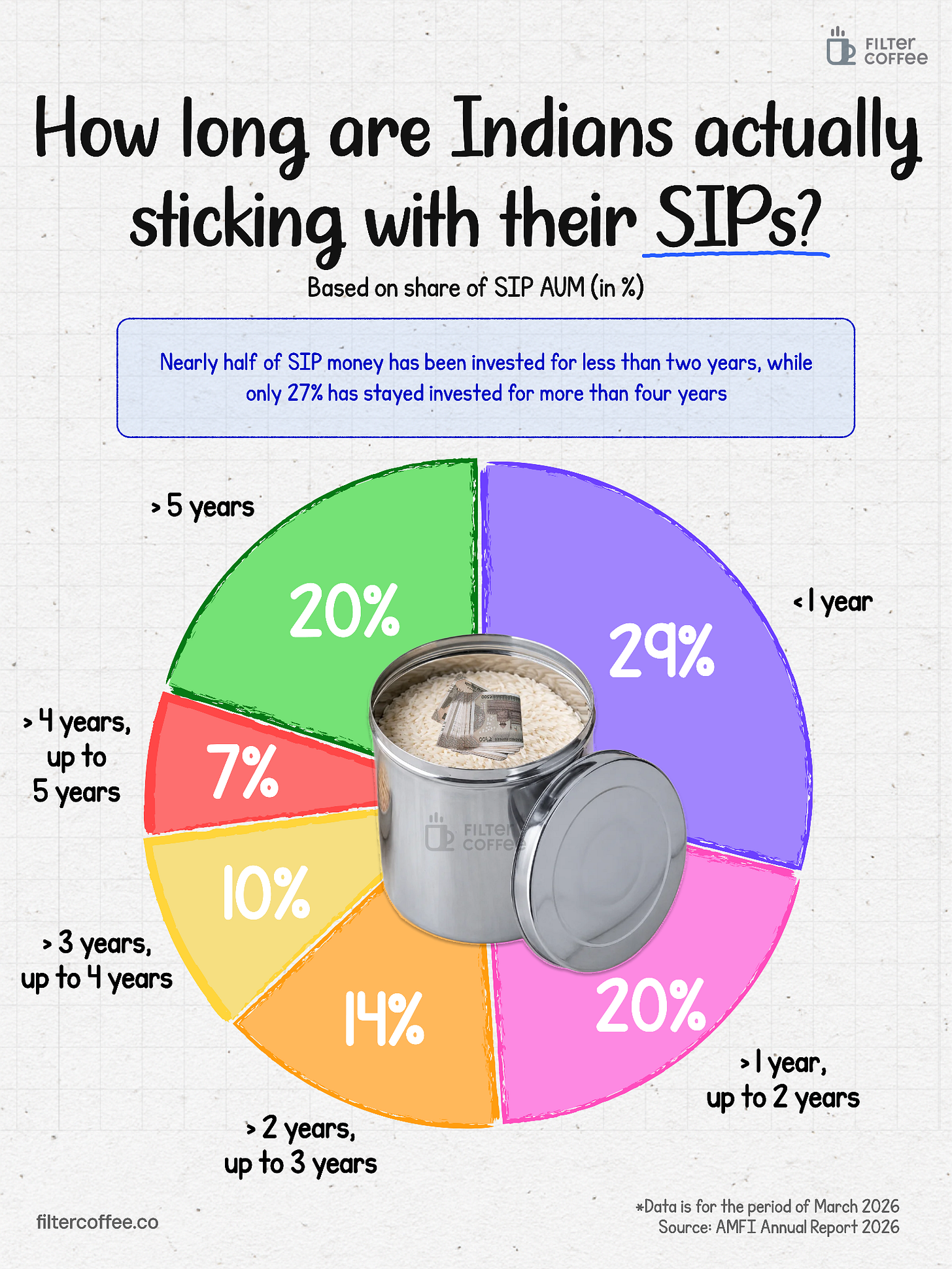
Starting an SIP is easy. Surviving a few market cycles is apparently harder.
Nearly half of India’s SIP money is less than two years old, while just 27% has stayed invested beyond four years.
For an investment strategy sold on the power of long-term compounding, the numbers reveal the real challenge: India has built the SIP habit faster than it has built the staying-invested habit.
4. Stocks that kept us interested 🚀
What went up ⬆️
🎓 Physicswallah jumped more than 9% after the company announced plans to restructure the lending strategy of its non-banking financial company segment and move away from direct lending.
🏦 PNB, Bank of Baroda, AU Small Finance Bank and Bajaj Finance gained up to 4% after reporting September quarter updates. Raymond Realty surged nearly 7%.
💄 Nykaa ended more than 4% higher after its September quarter update showed that the total value of products sold grew around 30%.
📺 LG Electronics India rose 3% after brokerages remained positive on its Q2 growth outlook.
⚡ Transformers & Rectifiers gained nearly 2% after securing orders valued between ₹100 crore and ₹500 crore.
🚆 GPT Infra gained more than 1% after its subsidiary Alcon Builders emerged as the lowest bidder for a project worth ₹149.5 cr from Western Railway.
🥥 Marico rose more than 1% as the firm said it expects double-digit revenue growth in Q2.
What went down ⬇️
🛍️ V2 Retail crashed 15% after its same-store sales growth came in at just 0.5% on a festive-normalised basis, despite strong overall revenue growth.
🛒 Avenue Supermarts (DMart) slipped more than 6% despite reporting an improvement in Q2 revenue growth, as investors remained focused on customer growth and margins.
What else are we snackin’ 🍿
⚠️ Investor warning: SEBI cautioned investors against finfluencers, anonymous tips and high-return claims, urging them to stick to regulated products and verified sources.
✈️ Fares rise: IndiGo will raise domestic and international airfares from October 6 as higher aviation fuel costs put pressure on expenses.
⚡ Mega orders: L&T secured orders worth up to ₹15,000 crore across India, Saudi Arabia and the UAE for its power transmission and distribution business.
That’s a wrap! Don’t let the weekday blues get to you.

And if you’d like to place your brand on this newsletter, let us know.
Hit that 💚 if you liked this issue.
Disclaimer: this newsletter is for informational and research purposes only. Nothing here should be considered financial, investment, legal, or professional advice.