
 Newsletter

Trading has a new audience, Pesticides go global, and EPFO limit increased.
🗓️ Morning, folks! ☀️
Today’s internet scrolling made us realise there is no zen without some ka-ching.
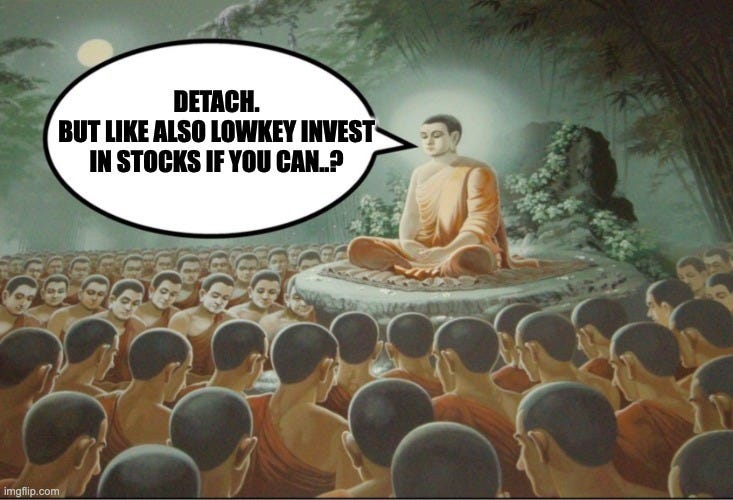
Japanese Buddhist temples are turning to an unlikely source to pay their bills: the stock market.
As donations and funeral income shrink, some temples are investing money already given by followers to cover rising maintenance costs.
One Hokkaido priest invested in bonds, REITs and stocks, earning 10%+ annually and helping fund ¥25 million ($162,000) in repairs.
The shift comes as Japan’s Buddhist community shrinks and centuries-old temples get more expensive to maintain.
And investing comes with a religious dilemma: Buddhism traditionally teaches detachment from profit, but some priests argue that doing nothing could mean losing the temple altogether.
Speaking of investing 💰,
Markets snapped a three-day losing streak with Sensex & Nifty rising nearly 0.5% each.
The recovery was led by financial and FMCG stocks, while IT continued to drag. Insurance stocks also saw some bargain hunting, with HDFC Life and SBI Life gaining around 3% each.

The broader market, however, remained muted.
Globally, the US Federal Reserve raised interest rates by 25 basis points to 3.75-4%, its first hike since 2023, as policymakers focused on stubborn inflation.
The Fed also raised its inflation forecasts, with headline PCE, which tracks changes in prices paid by American consumers, expected at 3.7% and core PCE at 3.4% this year.
For India and other emerging markets, higher US rates can affect capital flows, strengthen the dollar and increase global borrowing costs. ☹️
💡 Spotlight: Kiwis come closer 🥝
New Zealand’s Parliament has approved its Free Trade Agreement (FTA) with India, with lawmakers voting 93-29 in favour. The deal, signed in April, is now one step closer to taking effect, with India aiming to make it operational as early as October.
The FTA means all Indian exports to New Zealand will get duty-free access, while about 95% of New Zealand’s exports to India will see tariffs removed or reduced.
India has kept sensitive products such as dairy and sugar outside the deal. New Zealand has also committed $20 billion in investment in India over 15 years.
For people, the deal creates a Temporary Employment Entry visa route for up to 5,000 skilled Indians, allowing them to work in New Zealand for up to three years. It also includes a working holiday visa for 1,000 young Indians a year and new provisions for students and post-study work.
Let’s hit it! 💪🏻
1 Big Thing: Rise and shine ☀️
Vikram Solar has signed a ₹1,250 crore domestic solar cell supply agreement with Avaada Electro to procure 1 gigawatt (GW) of ALMM-compliant N-Type G12R TOPCon solar cells.
Avaada Electro, the manufacturing arm of Avaada Group, is an Indian solar manufacturer specialising in high-efficiency N-Type TOPCon solar products.
What the hell does that mean: these are high-efficiency solar cells used to make powerful solar panels for large solar farms and commercial projects.
Avaada Electro will supply these domestically manufactured cells for Vikram Solar’s module manufacturing operations.
Zoom out: India’s shift from being a buyer to a builder of solar equipment has been rapid, at least on paper.
But there’s a gap: India’s solar module manufacturing capacity has surged to 173 GW, while solar cell capacity stands at around 30 GW. “That mismatch is creating strong demand for locally made cells.
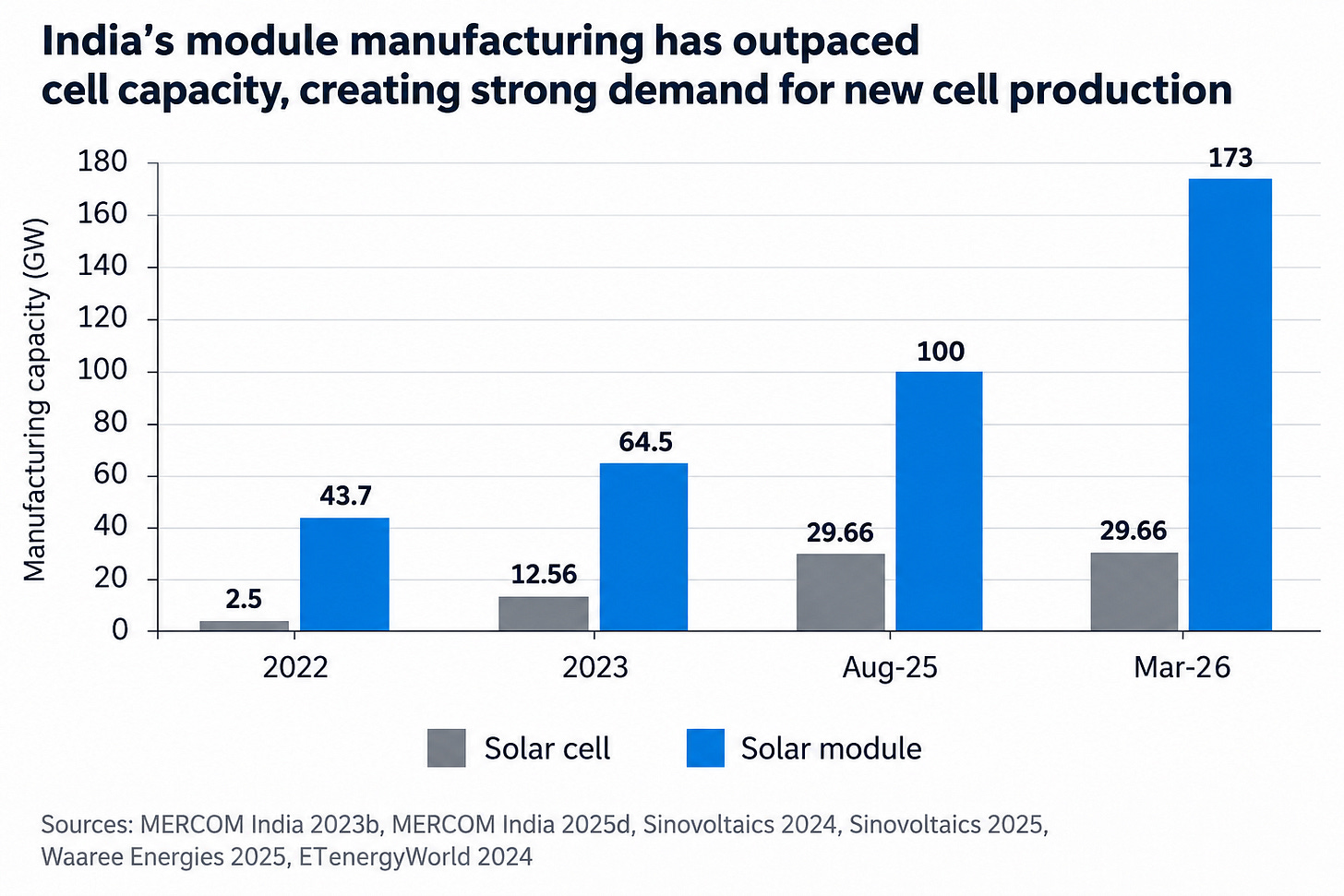
Five years ago, nearly all solar modules installed in India were imported from China. Today, modules are largely manufactured domestically, while about 50% of the solar cells consumed in India are made locally.
But there’s still a major missing piece: wafers. Roughly 99% of the world’s photovoltaic wafers are still made in China, making them a critical bottleneck in India’s push to build a domestic solar supply chain.
India may now be making more solar cells and modules at home, but the ingredients and equipment needed to make them still have a China connection.
2. India Pesticides gets its passport stamped 🌍
India Pesticides shares ended nearly 4% higher on Wednesday, after jumping as much as 15% during the day, as the company secured regulatory approvals for its products in the UK and Argentina.
The deets: the company received a technical equivalence approval for one of its insecticide products in the UK.
In simple words, UK regulators checked the insecticide and approved it as meeting their required standards.
The company also received registration for one of its herbicide products in Argentina, allowing the product to enter another international market.
Why it matters: agrochemical companies cannot simply start selling pesticides in a new country. Their products first need to clear local regulatory requirements. So, every new approval potentially opens another market for the company.
India Pesticides said the latest approvals strengthen its presence in the global agrochemical market and could help grow its export business.
While we are on approvals, in July, the company received technical equivalence approval in the European Union for one of its fungicide products.
3. It’s not all about the iPhone 🤭
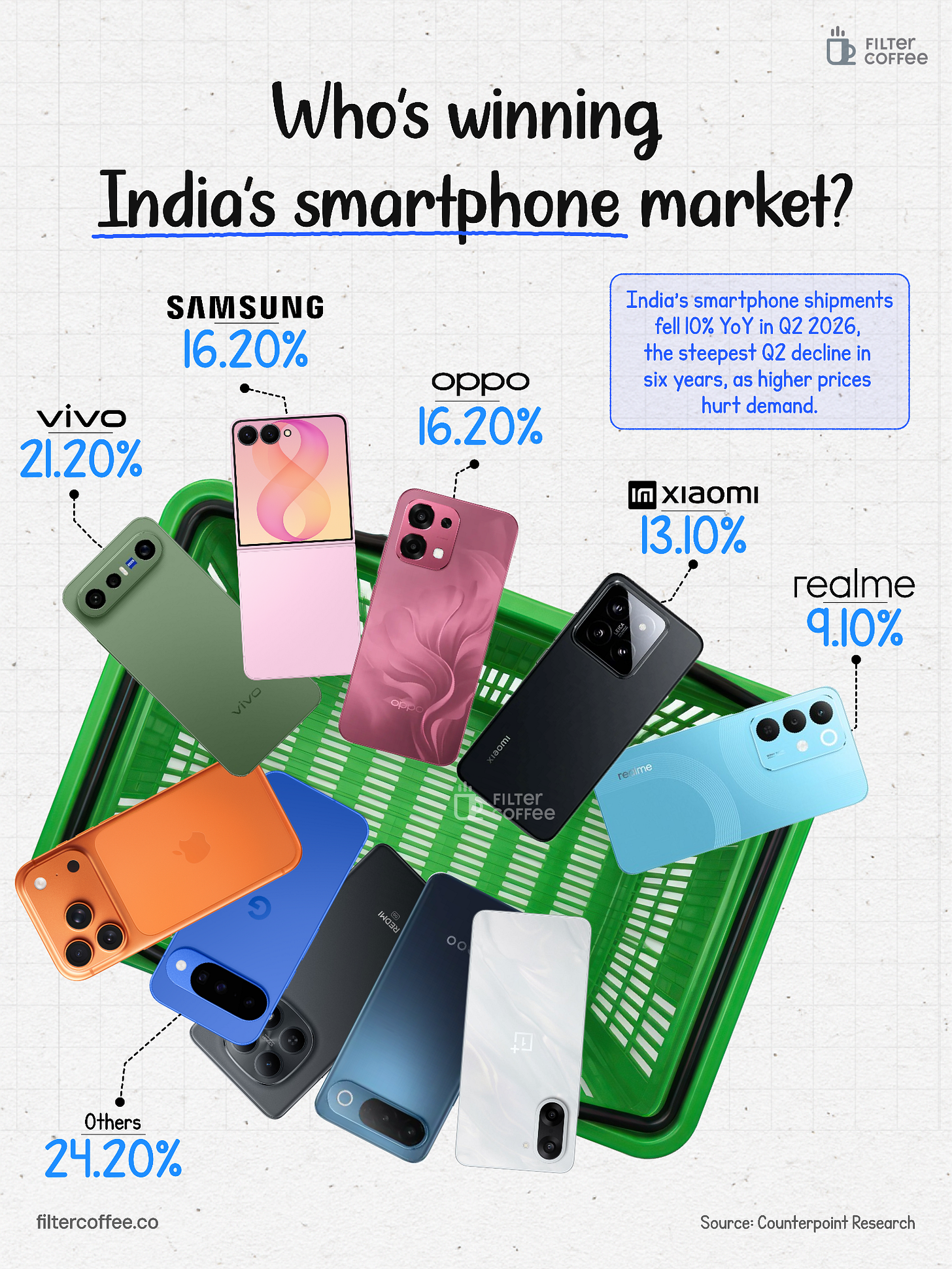
India’s smartphone market is getting tougher, especially at the affordable end.
Rising memory costs are pushing up prices, while consumers are increasingly turning to EMIs and refurbished phones.
Meanwhile, the five biggest brands still control roughly three-quarters of shipments. The next smartphone battle may be less about volumes and more about who can convince Indians to upgrade.
4. Stocks that kept us interested 🚀
What went up ⬆️
⚡Saatvik Green Energy jumped over 6%, snapping a three-day losing streak after the company secured a ₹1,041.6 crore order.
💪 Godavari Biorefineries surged 4% after it secured a Chinese patent for compounds used in medicines aimed at treating viral infections.
🤑 YES Bank ended in the green after MDR was introduced on select UPI merchant transactions, creating a new revenue stream for banks.
What went down ⬇️
💰Groww parent Billionbrains Garage Ventures fell nearly 4% after 10.4 crore shares worth ₹1,999 crore changed hands via block deals.
🔻ESDS Software Solution hit the 5% lower circuit amid profit booking, but remained 128% above its listing price.
👎 Jewellery stocks including Kalyan Jewellers and PC Jeweller fell 2-3% after BIS raised hallmarking fees by 67% to ₹75 per article.
What else are we snackin’ 🍿
👷 EPF expansion: the government raised the EPF wage ceiling to ₹25,000 from ₹15,000, at an estimated cost of ₹11,339 crore.
📈 IPO approval: Fibe received SEBI approval for its IPO, comprising a ₹750 crore fresh issue and an OFS of up to 4.01 crore shares.
🚆 Rail JV: BHEL and Titagarh Rail Systems formed a 50:50 joint venture to maintain Vande Bharat sleeper trains for 35 years.
☁️ AWS partnership: Sonata Software signed a five-year deal with AWS to accelerate cloud and AI adoption in India across major industries.
👍🏻 Deal done: Fortis Healthcare signed agreements to operate a 400-plus-bed super-speciality hospital in New Delhi, with operations expected to begin within 3-4 years.
That’s a wrap! Don’t let the weekday blues get to you.

And if you’d like to place your brand on this newsletter, let us know.
Hit that 💚 if you liked this issue.
Disclaimer: This newsletter is for informational and research purposes only. Nothing here should be considered financial, investment, legal, or professional advice.