
 Newsletter
Elon gets shady, GST meet outcomes, and Nobel for Literature goes to…
🗓️ Morning, folks and Happyy Fridayyyy!
You know taste is taking an apocalyptic turn when 600 data-centre enthusiasts throw a party. Enter Data After Dark, a very real, very pro-AI bash in Washington DC late last month.
There were “Loudoun County Iced Tea” cocktails, AI photo booths, a “Virginia Is for Servers” poster and Charli XCX on the dance floor.
The largely young tech and policy crowd came to celebrate data centres and argue that America needs more compute. Protesters crashed the party, too.
Because behind the cocktails is a bigger fight. 61% of Americans oppose new data centres, rising to 78% among 18-29-year-olds, citing electricity bills, water use, local disruption and AI’s threat to jobs. Supporters see them as engines for tax revenue, jobs and innovation.
Many say this is techno-optimism in action: the belief that technology will solve more problems than it creates. One side is betting on the AI-powered future; the other is asking who gets stuck with the bill.

Moving on, a tough Thursday for the markets. The Sensex fell 1.4% and the Nifty slipped 1.6%, extending their losses.
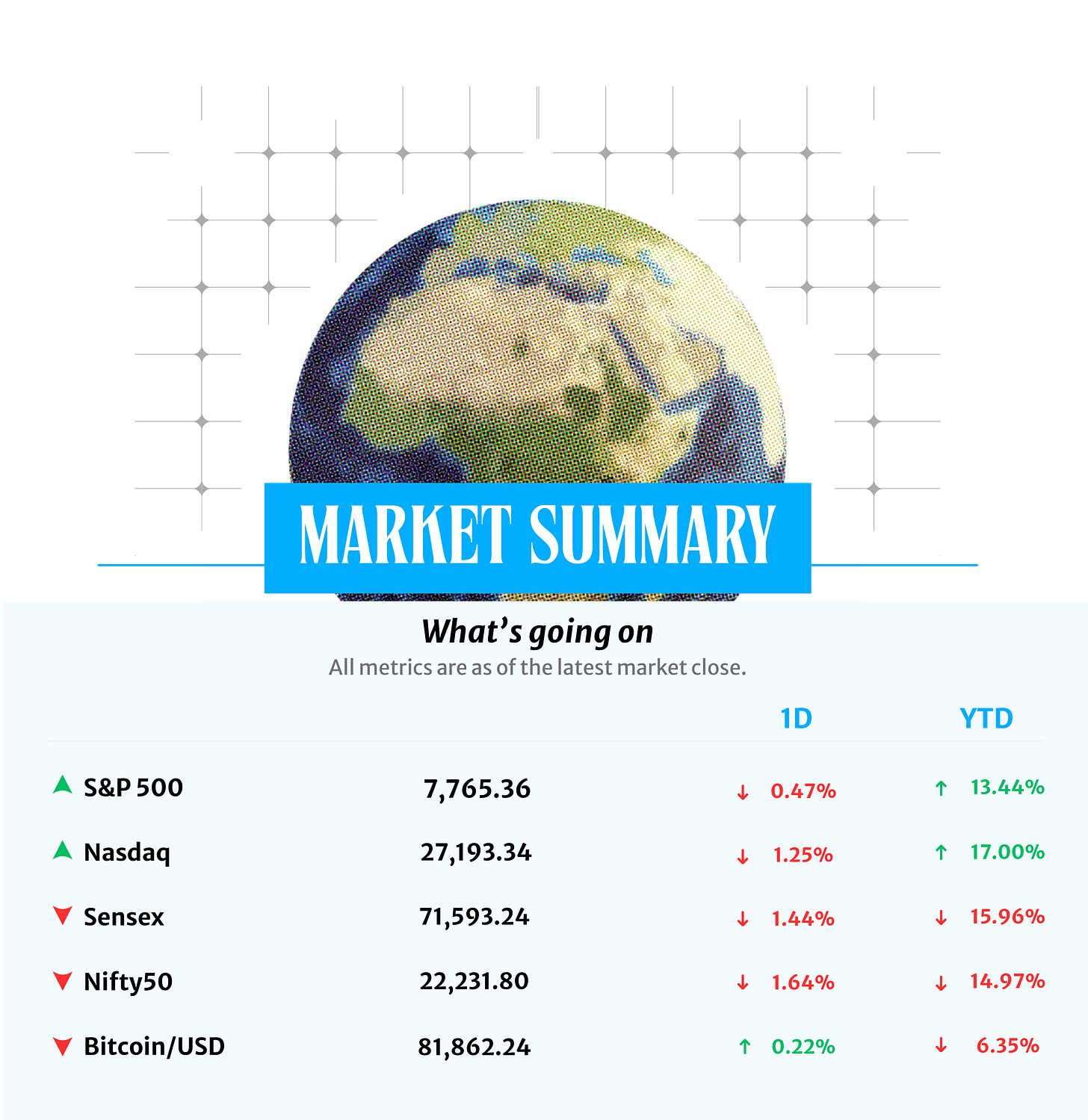
Nearly ₹13 lakh crore was wiped off BSE-listed companies’ market value over two sessions.
Selling was broad-based, with metal, realty and energy leading the losses, while IT showed relative resilience.
The RBI’s rate hike and shift towards calibrated tightening weighed on sentiment. Brent crude at $102-103 a barrel amid geopolitical tensions and supply concerns added to the pressure.
💡 Spotlight: India rejects Elon Musk’s Starlink monopoly claims ❌
India has rejected Elon Musk’s allegations that powerful business groups are blocking Starlink’s entry into the country to protect their own businesses.
As per the Ministry of Communications, the country follows a fair and equal approval process for all satellite internet companies, including Starlink.
The clarification came after Musk posted on X, alleging that certain powerful businesspeople were preventing Starlink from entering India to maintain their control.
He claimed that these businesses were trying to protect their existing dominance at the expense of Indian consumers. However, Musk did not name any companies or individuals.
Let’s hit it! 💪🏻
1 Big Thing: TCS kicks off Q2 earnings 🎉
TCS kicked off the IT earnings season with Q2 results in line with market expectations.
By the numbers:
- Net profit: up 4% QoQ to ₹13,884 cr vs ₹13,349 cr
- Revenue: up 1.3% QoQ to ₹73,188 cr vs ₹72,275 cr
- $ Revenue: up 0.2% QoQ to $7.64 billion from $7.62 billion
- EBIT Margin: at 24% vs 24% QoQ
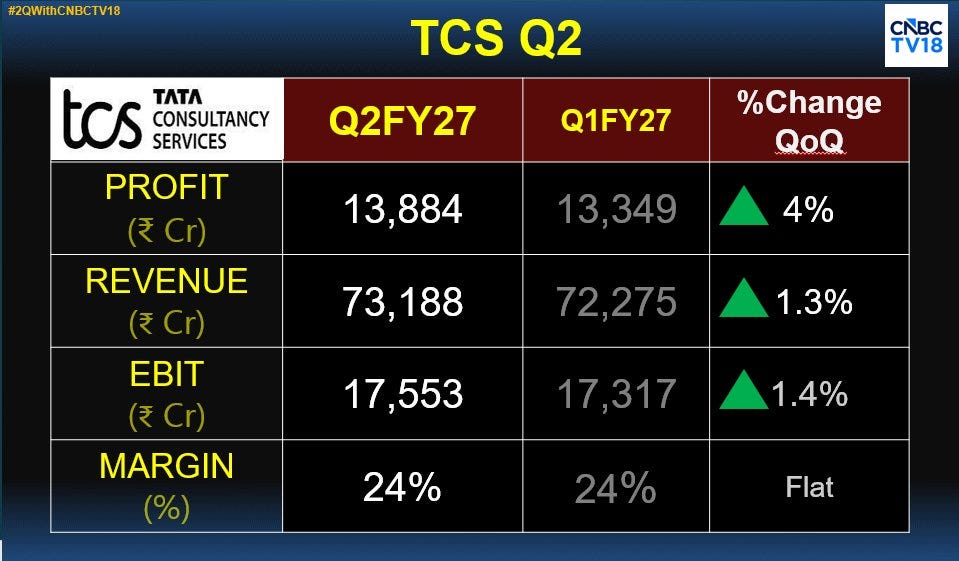
Breaking it down: last quarter’s profit was pulled down by a one-time legal settlement cost. Without that cost, profit would have been ₹13,849 crore, almost the same as this quarter’s ₹13,884 crore.
TCS’ annualised AI revenue crossed $3 billion, up from $2.6 billion in the previous quarter.
Why margins stayed flat: margins usually improve in the September quarter as the initial impact of June-quarter salary hikes eases. This time, TCS invested part of those savings in AI and data centre capabilities, limiting the improvement.
Deal wins during the quarter stood at $9.6 billion, within analysts’ projected range of $9 billion to $10 billion.
The headcount numbers: TCS added 4,258 employees on a net basis in the September quarter, taking its total workforce to 598,056 at the end of Q2 FY27.
For shareholders: TCS also declared a second interim dividend of ₹12 per share for FY27. Eligible shareholders will receive ₹12 for every share they hold, or ₹1,200 before tax for 100 shares.
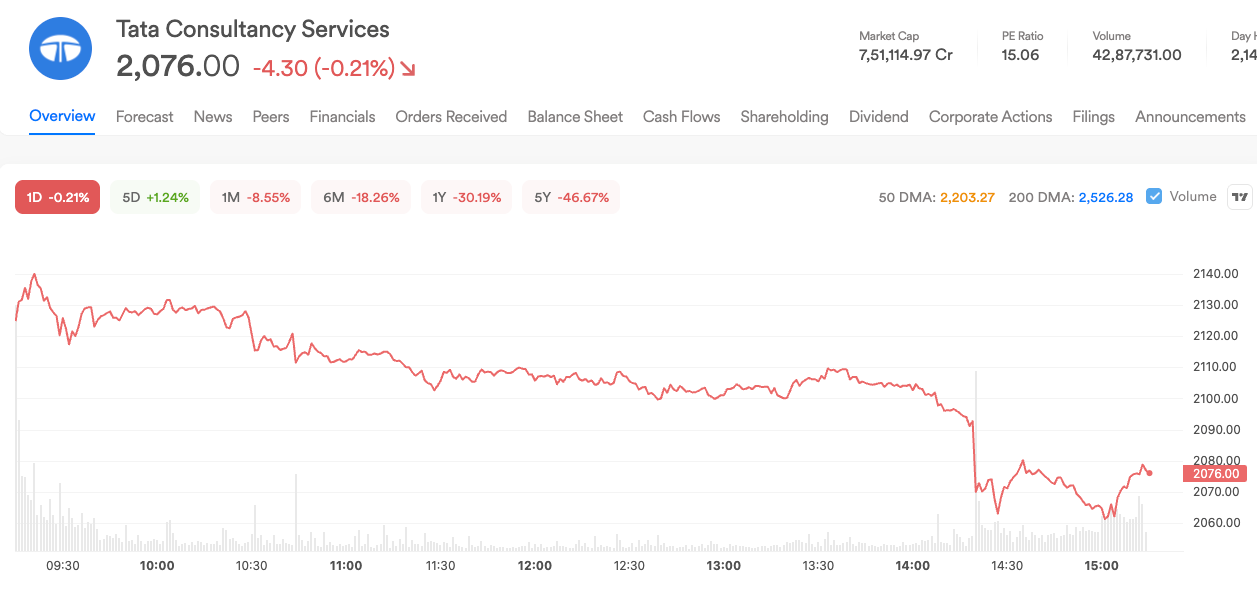
Stock action: TCS will be in focus today after its Q2 results and the US decision to suspend it from the PERM programme, which allows employers to sponsor foreign workers for green cards.
2. GST got a little less taxing 👀
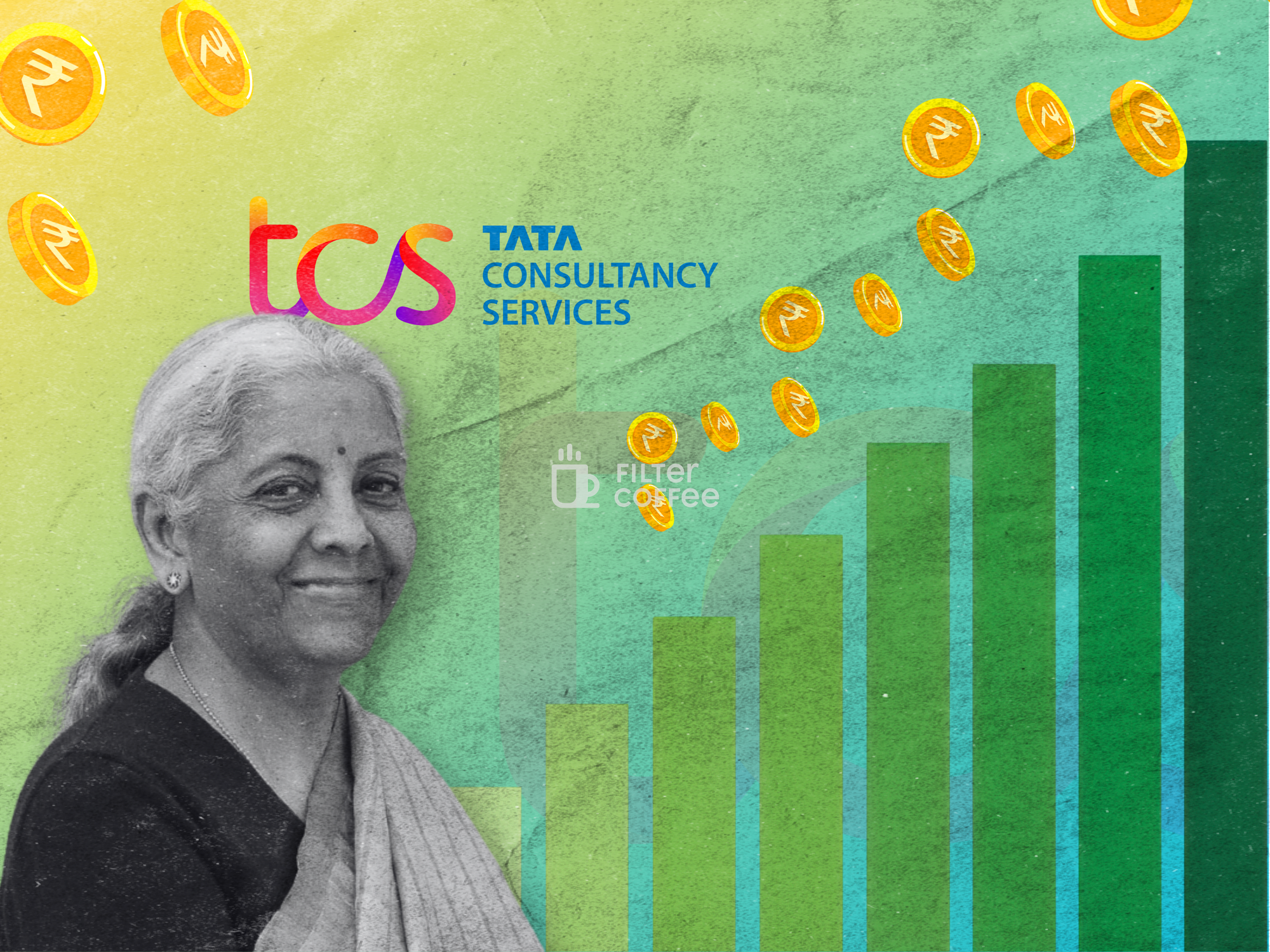
India’s 57th GST Council has approved several changes to make tax registration, refunds and compliance easier for businesses, while also announcing changes to arrest and prosecution provisions.
The deets: businesses will now be able to receive 90% of their eligible GST refunds within 13 days, under the new process. Currently, tax authorities have 15 days to acknowledge a refund application. That will be reduced to 10 days.
If officials don’t acknowledge the application or flag missing information within that period, it will automatically be considered acknowledged.
The Council has also expanded the types of business expenses eligible for refunds under the inverted duty structure.
Imagine a company pays 18% GST on materials used to manufacture a product, but the finished product attracts only 5% GST. The company has paid more tax on its purchases than it collects on sales. This creates unused tax credit, which it may be eligible to claim back.
Until now, certain expenses, such as services used by the business, were excluded from these refunds.
Arrests under GST: the Council has agreed to remove arrest powers under GST laws and raise the threshold for criminal prosecution.
Under existing GST provisions, tax officials can authorise arrests in certain cases involving serious violations, such as fake invoices, fraudulent tax credit claims and tax evasion.
Proposals still under discussion:
- Allowing businesses to claim Input Tax Credit (ITC) even if their suppliers fail to deposit GST.
- Reducing GST on Merchant Discount Rate (MDR) from 18% to 5% or removing it entirely.
- Allowing wider tax credits on vehicles purchased for business use.
3. Solar panels on water? 👀
Tata Power has partnered with Norway’s Ocean Sun to bring its innovative floating solar technology to India.
What’s happening: Tata Power will test Ocean Sun’s floating solar technology at its Mulshi reservoir in Maharashtra.
The 300 kWp pilot project will assess how well the technology works in Indian conditions, including its power generation, cost, reliability, and ease of installation and maintenance.
Unlike conventional floating solar panels, which sit on large floating platforms, Ocean Sun’s panels rest on a thin, flexible membrane that floats directly on the water.
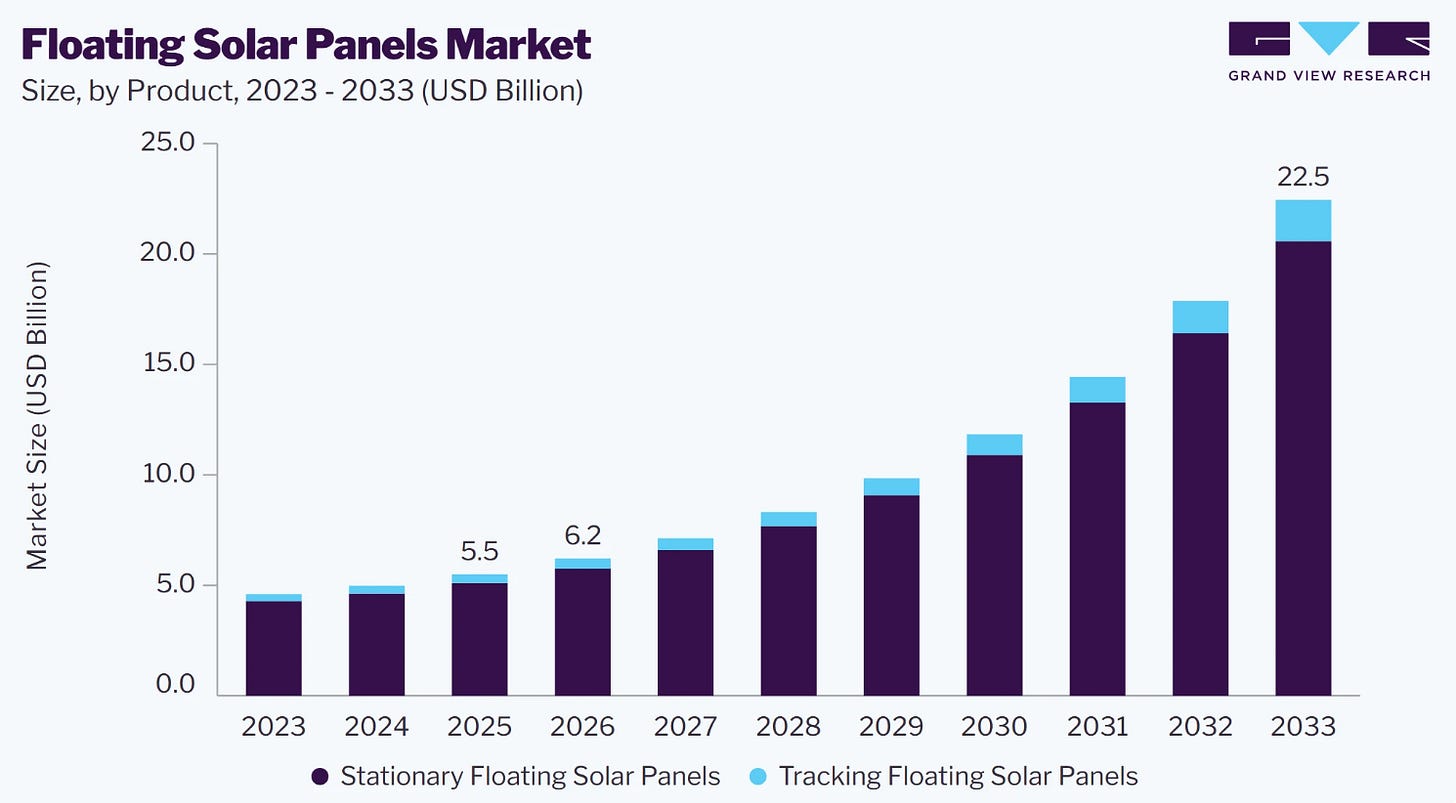
Larger picture: India has a huge opportunity for floating solar.
Estimates suggest the country could support more than 102 GW of floating solar capacity, using reservoirs and other water bodies to generate clean power without taking up large amounts of land.
4. Startup funding health check 📊
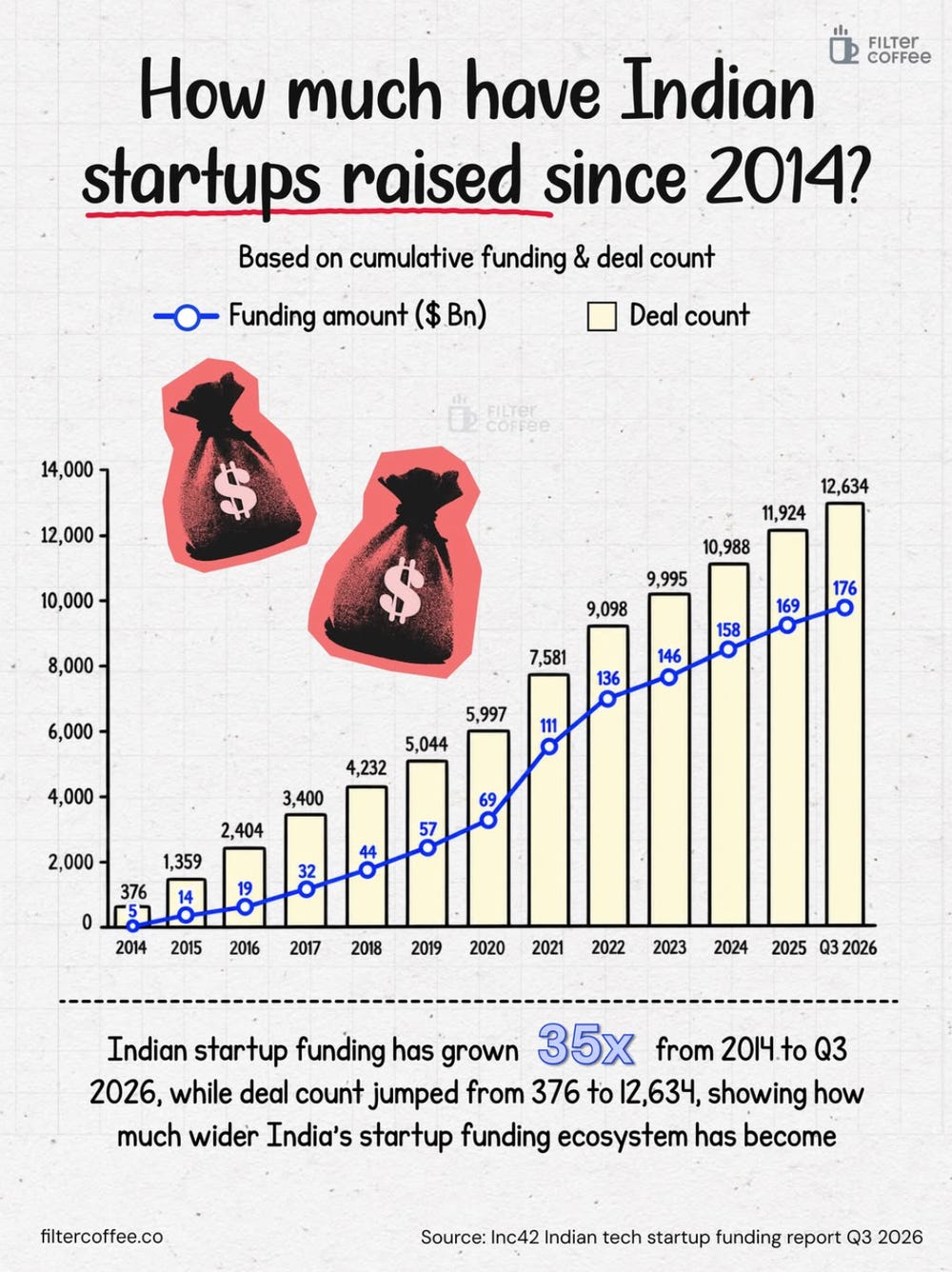
Indian startups have collectively raised $176 billion across 12,600+ deals since 2014. In 2014 alone, they raised $5 billion across 376 deals.
The funding boom accelerated that growth, with around $67 billion raised between 2020 and 2022.
Over the past decade, India hasn’t just built more startups. It has built a much bigger market for funding them.
5. Stocks that kept us interested 🚀
What went up ⬆️
😮💨 Fino Payments Bank surged 13% after its September business update showed a sharp 223% jump in loan referrals.
⚡️Mastek rose over 1% after Staffordshire County Council selected the company to lead AI-enabled Oracle Cloud transformation.
What went down ⬇️
☹️ ITC fell 4% after a ₹9,437 crore block deal involving 36.6 crore shares, or 2.9% of the company, at ₹257 each.
👎🏻 Adani Enterprises slipped over 5% in morning trade, while other group stocks also declined sharply as the market rout intensified.
❌ Paytm and Mobikwik crashed up to 10% intraday amid reports that UPI MDR implementation may be deferred to January 2027.
🛵 Ola Electric tumbled nearly 5% after the company announced a rights issue priced at ₹27 per share for existing shareholders.
What else are we snackin’ 🍿
📚 Literature nobel: Canadian poet and author Anne Carson won the 2026 Nobel Prize in Literature for her innovative writing that blends classical literature with modern poetry and prose.
🛡️ Insurance growth: Life insurers saw mixed growth in September, with HDFC Life and ICICI Prudential Life reporting strong premium increases, while retail APE growth remained subdued.
❌ Visa crackdown: the US suspended Microsoft, Infosys, Wipro, Cognizant, HCLTech and Capgemini from a green card programme, citing alleged worker visa abuse.
😐 Costly dreams: the US government has proposed at least $70,000 in training fees for international students seeking to work in the country.
And that’s a wrap. Pour yourself an extra one this weekend. 🥂

We’ll be back like clockwork on Monday!
Hit that 💚 if you liked this issue.
Disclaimer: this newsletter is for informational and research purposes only. Nothing here should be considered financial, investment, legal, or professional advice.