
 Newsletter
India gets Yen love, Satellite internet rivalry, and Hexaware-Anthropic deal.
🗓️ Morning, folks, and Happy Mondayyy! ☀️
Before we begin, the latest episode of This Is Business is now live!
This time, Tanvi Dessai visited HackerFab at IIT Bombay, India’s first-of-its-kind student-run semiconductor fabrication lab, to meet Aryamman Bhatia and Abhineet Avhad.
The episode explores how a small group of students is trying to make chipmaking more accessible, and what that could mean for India’s growing semiconductor ambitions.
Full story here 👇
Last week’s news cycle felt like one long uphill battle for women’s rights, but here’s a reason to celebrate.
South African judge of Indian Tamil origin, Navanethem “Navi” Pillay, has won the 2026 Nobel Peace Prize for her decades-long fight for human rights and justice.
At 85, Pillay has spent her life holding power accountable, from defending anti-apartheid activists in South Africa to helping prosecute crimes committed during the Rwandan genocide. She also led a UN inquiry about Gaza.
The Nobel Committee honoured her for defending international law and bringing justice to victims of violence and conflict.

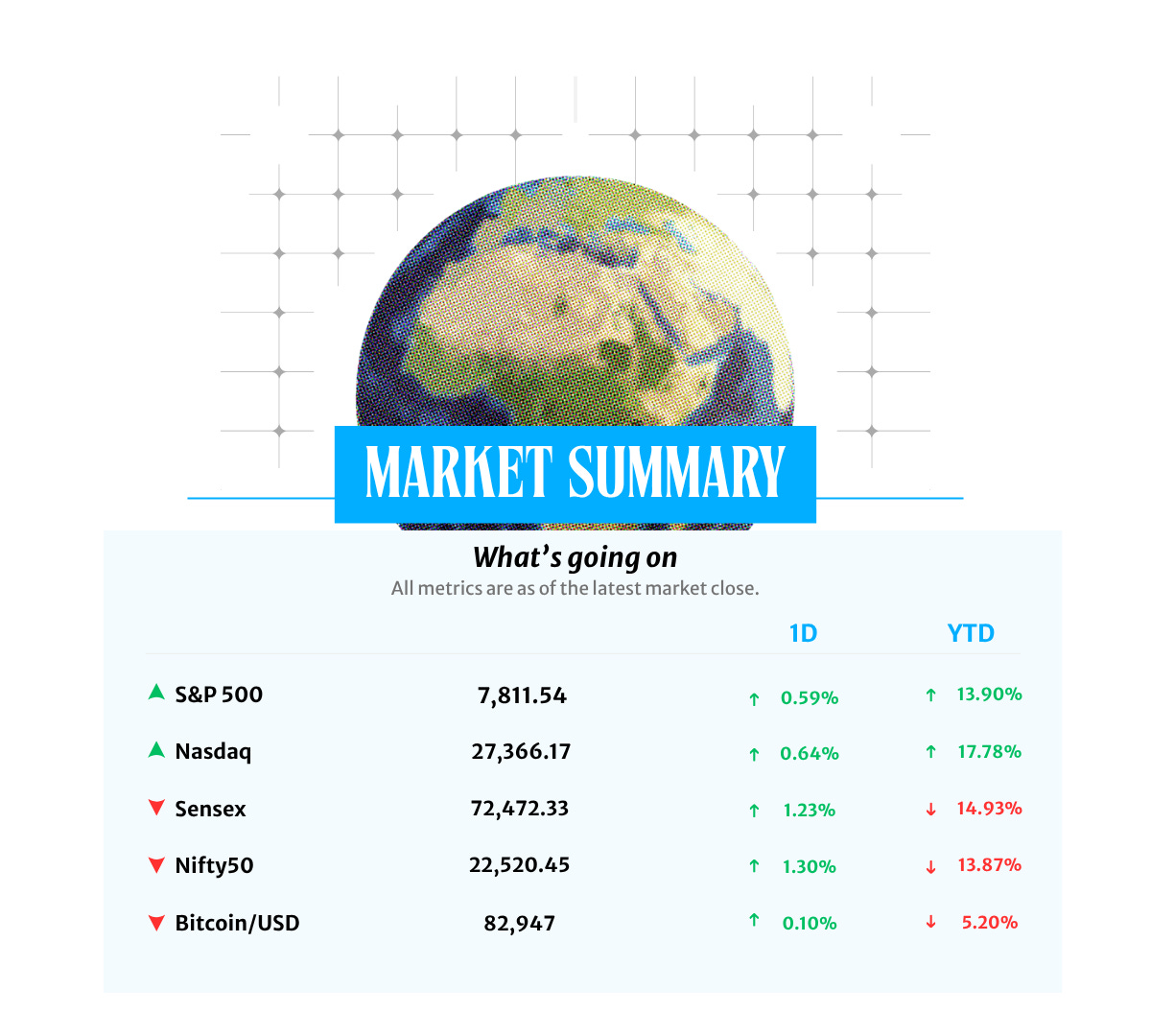
Back to business, after weeks of heavy selling, the markets finally ended higher on Friday.
What to watch this week: investors will watch Wipro and HCLTech’s quarterly results, September’s consumer and wholesale inflation data, global market trends and crude oil prices.
💡 Spotlight: Japan leads foreign investment in India 🇯🇵
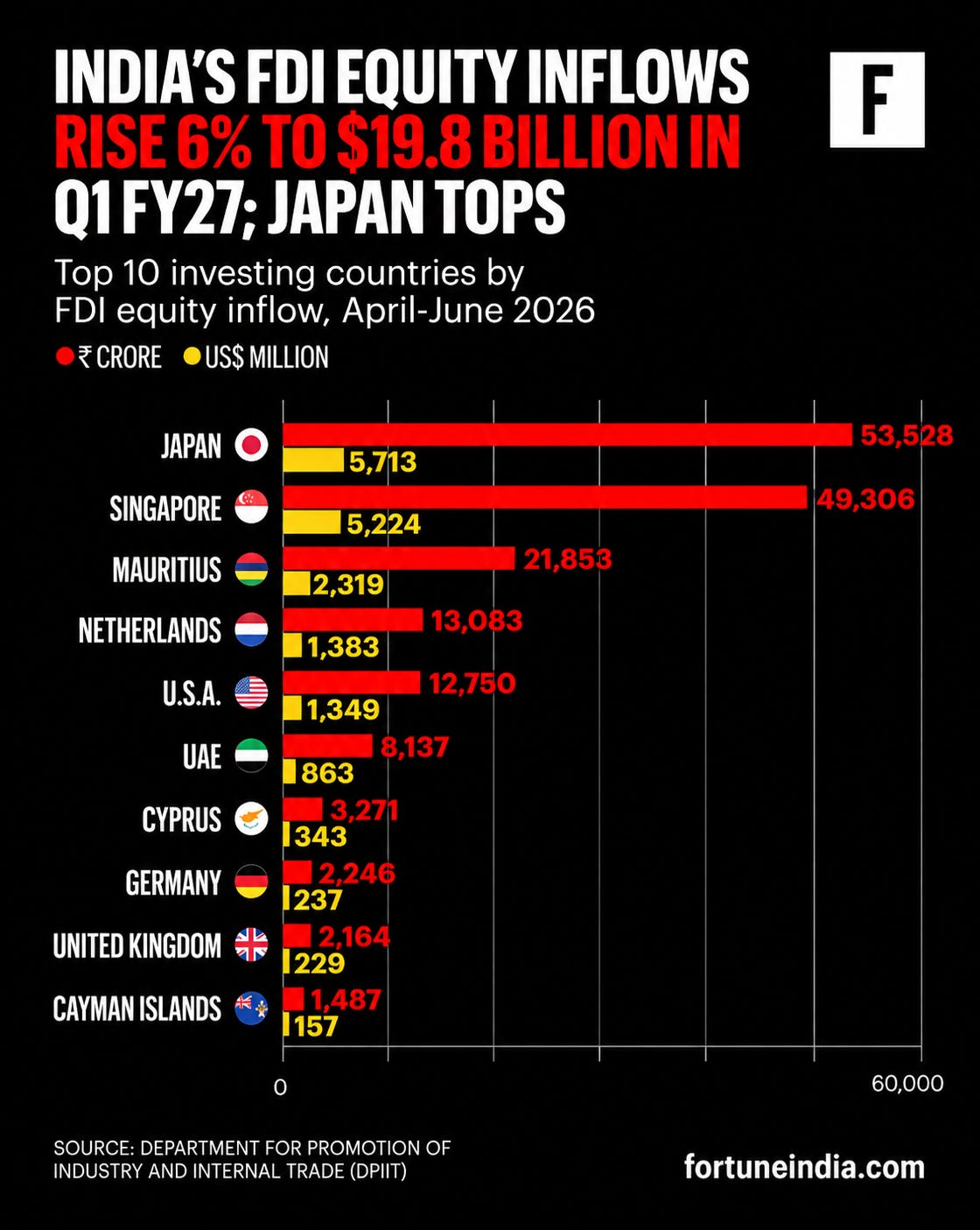
Japan has emerged as India’s largest source of foreign direct investment (FDI) in the April-June quarter of FY27, bringing in $5.71 billion.
Where is this money going: interestingly, the biggest push came from banking and financial services rather than new factories.
One major deal was Japan’s MUFG Bank acquiring a 20% stake in Shriram Finance for around ₹39,618 crore. Japanese investors are also expanding into technology, digital infrastructure and financial services.
Moreover, the country has committed to investing 10 trillion yen, or roughly ₹7 lakh crore, in India over a decade.
Meanwhile, Singapore was India’s second-largest FDI source during the quarter at $5.22 billion, followed by Mauritius at $2.4 billion. The Netherlands and the US contributed $1.38 billion and $1.35 billion, respectively.
Let’s hit it! 💪🏻
1 Big Thing: Indian IT stocks shrug off US Green card shock 💻
Infosys said on Saturday that it does not expect the US government’s suspension of its green card applications to have any major impact on its business.
TCS also said it expects no impact on its workforce plans or customer relationships, as it has filed very few applications under the programme in the past two years.
Meanwhile, India’s Ministry of External Affairs criticised the US move, saying Indian professionals are highly skilled and make important contributions to America’s economy.

Industry body Nasscom also pointed out that Indian IT companies have reduced their dependence on H-1B visas and are increasingly hiring American workers.
What exactly happened: the US government suspended eight major technology companies, TCS, Infosys, Wipro, HCLTech, Cognizant, Capgemini, Microsoft and Adobe from its Permanent Labour Certification (PERM) programme.
Many foreign IT professionals first move to the US on temporary work visas, such as H-1B. The PERM process is an important step that helps eligible workers apply for a green card, allowing them to live and work in the US permanently.
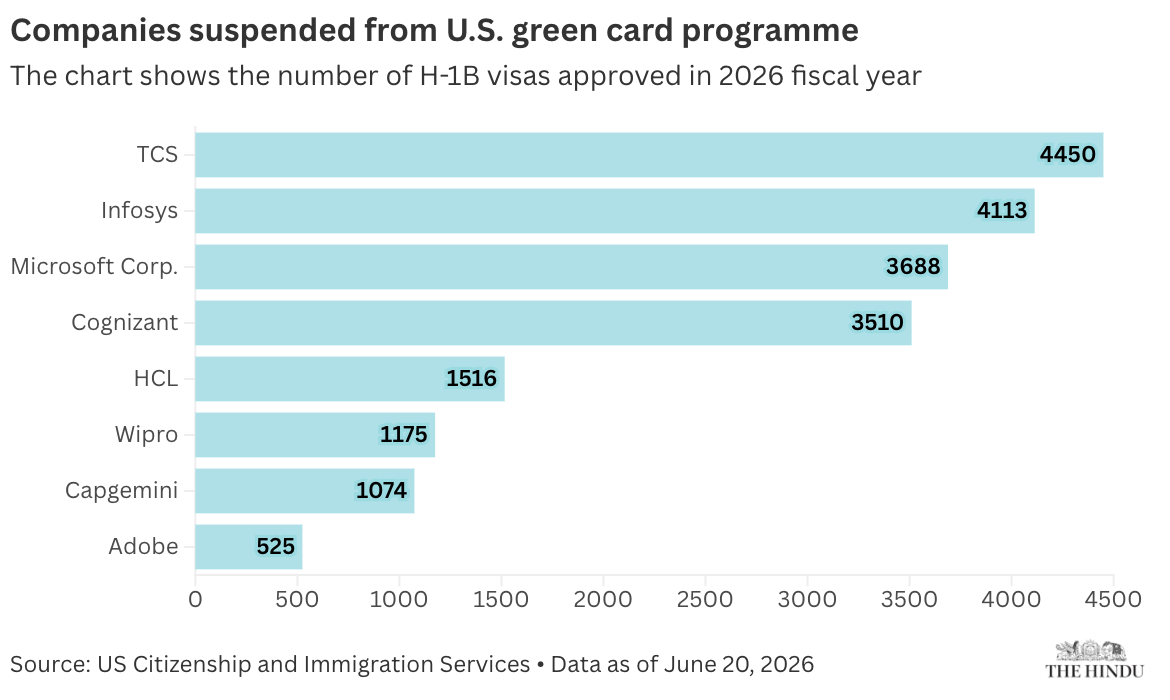
How IT stocks reacted: interestingly, Indian IT stocks rallied on Friday despite the announcement.
The Nifty IT index gained around 3%, led by TCS following its strong September-quarter result.
But analysts aren’t completely relaxed. ICICI Securities warned that the suspension could hurt investor confidence in the near term. If the restrictions continue, companies may also find it harder to retain foreign employees in the US.
2. Satellite internet takes centre stage before Jio IPO 👀
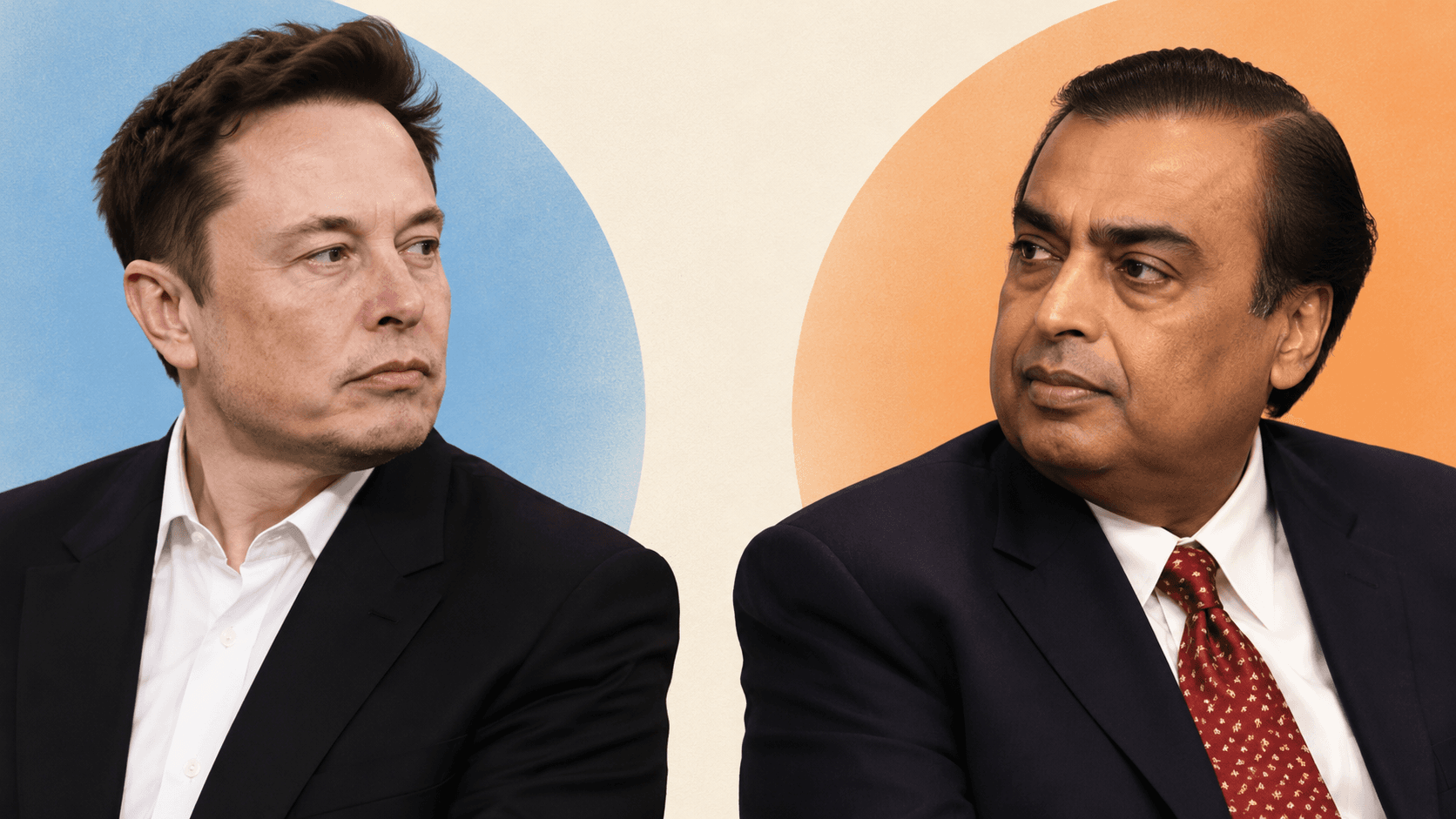
Elon Musk has accused “certain oligarchs” of trying to restrict competition in India’s satellite internet market.
Musk also argued that Starlink would have to keep its prices affordable in India because customers simply wouldn’t subscribe if the service was too expensive. According to him, allowing more companies to compete would ultimately give Indian consumers greater choice.
The timing: Musk’s comments came just as Jio Platforms, the digital services arm of Reliance Industries, prepares for what could become India’s biggest-ever IPO.
Reliance has not publicly responded to Elon’s allegations.
The Indian government, meanwhile, has maintained that its approval process for telecom and satellite services is fair and applies equally to all companies. It has rejected suggestions that the rules are being selectively enforced.
Amazon’s Project Kuiper has also expressed interest in entering the market but will need to go through the same approval process.
The battle: Satellite internet works by delivering connectivity through satellites in space instead of relying entirely on mobile towers or underground cables. It can be particularly useful in remote areas where traditional internet infrastructure is difficult to build.
Both companies are investing in this market, although their satellite networks differ significantly in scale.
Jio is developing a network of more than 1,600 low-Earth orbit satellites, supported by 23 ground stations. Starlink, operated by Musk’s SpaceX, already has more than 11,000 satellites in its constellation.
For now, Musk’s allegations remain disputed, Reliance has not publicly addressed them, and the government maintains that its satellite internet rules apply equally to everyone.
We also covered this on Market Bites.
3. Deal done 🤝
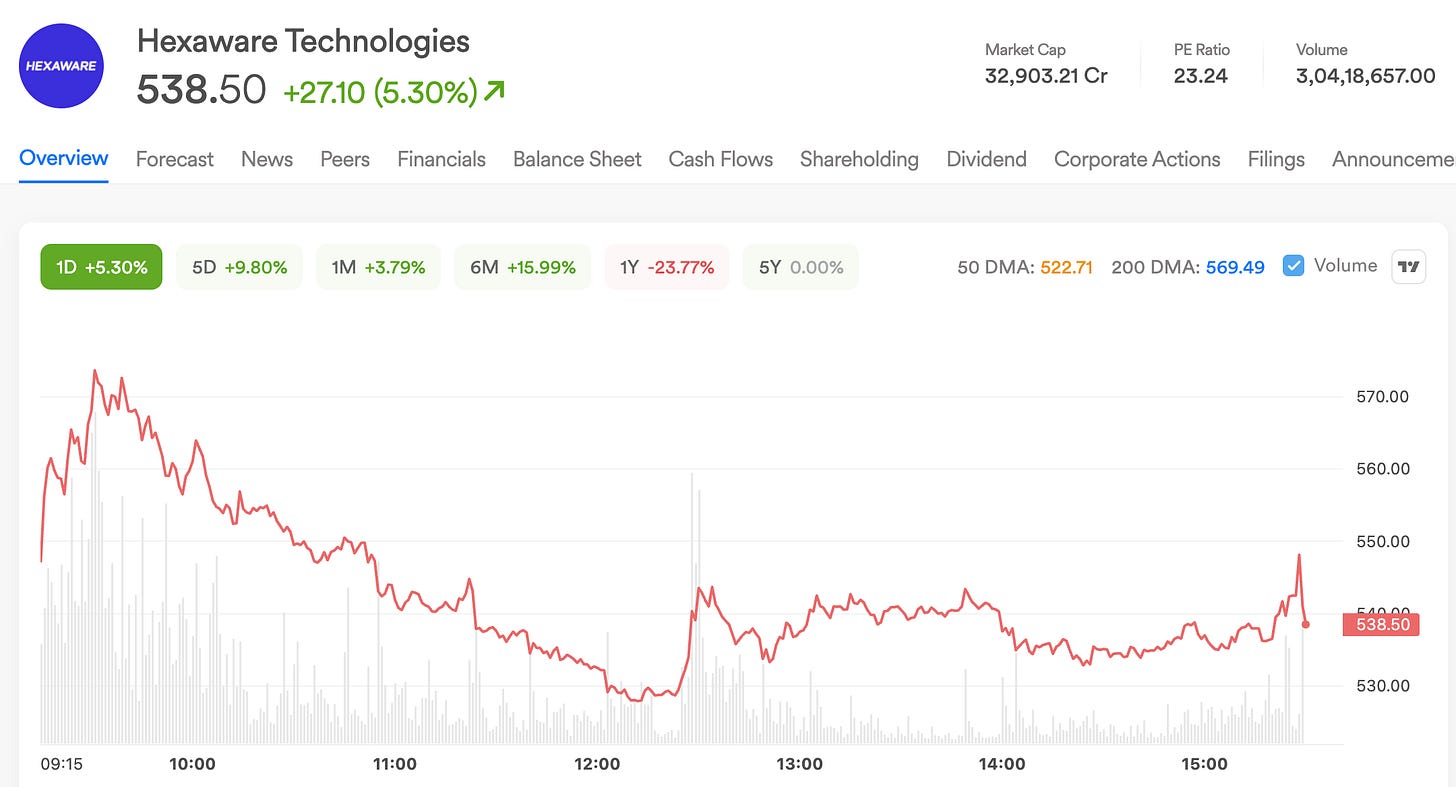
Shares of Hexaware Technologies jumped 5% on Friday after it signed a multi-year partnership with Anthropic. Under the deal, Hexaware will become a Preferred Partner in Anthropic’s Claude Partner Network.
What’s going on: Hexaware will integrate Claude into two of its platforms: Zerovity, which uses AI to help build and update software, and AgentVerse, which helps businesses build and manage AI agents.
Hexaware will use Claude across IT operations and software development, offering services linked to agreed results.
The numbers:
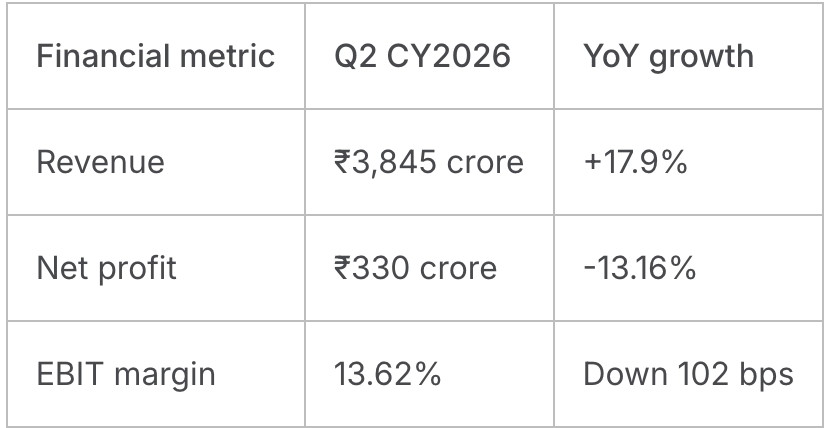
Revenue rose 17.9% in rupee terms, but only 6.1% in US dollar terms. After removing the effect of exchange rate changes, revenue grew 6.3%.
That means the underlying business grew more slowly than the rupee figures suggest.
However, Hexaware earned less operating profit for every ₹100 of revenue, even though its total operating profit rose. Its EBIT margin fell by 1.02 percentage points year-on-year to 13.6%.
The Anthropic partnership could help Hexaware deliver projects more efficiently. The test will be whether those gains improve margins after accounting for the added cost of AI.
4. Who dominates the world’s chipmaking business? 🤑
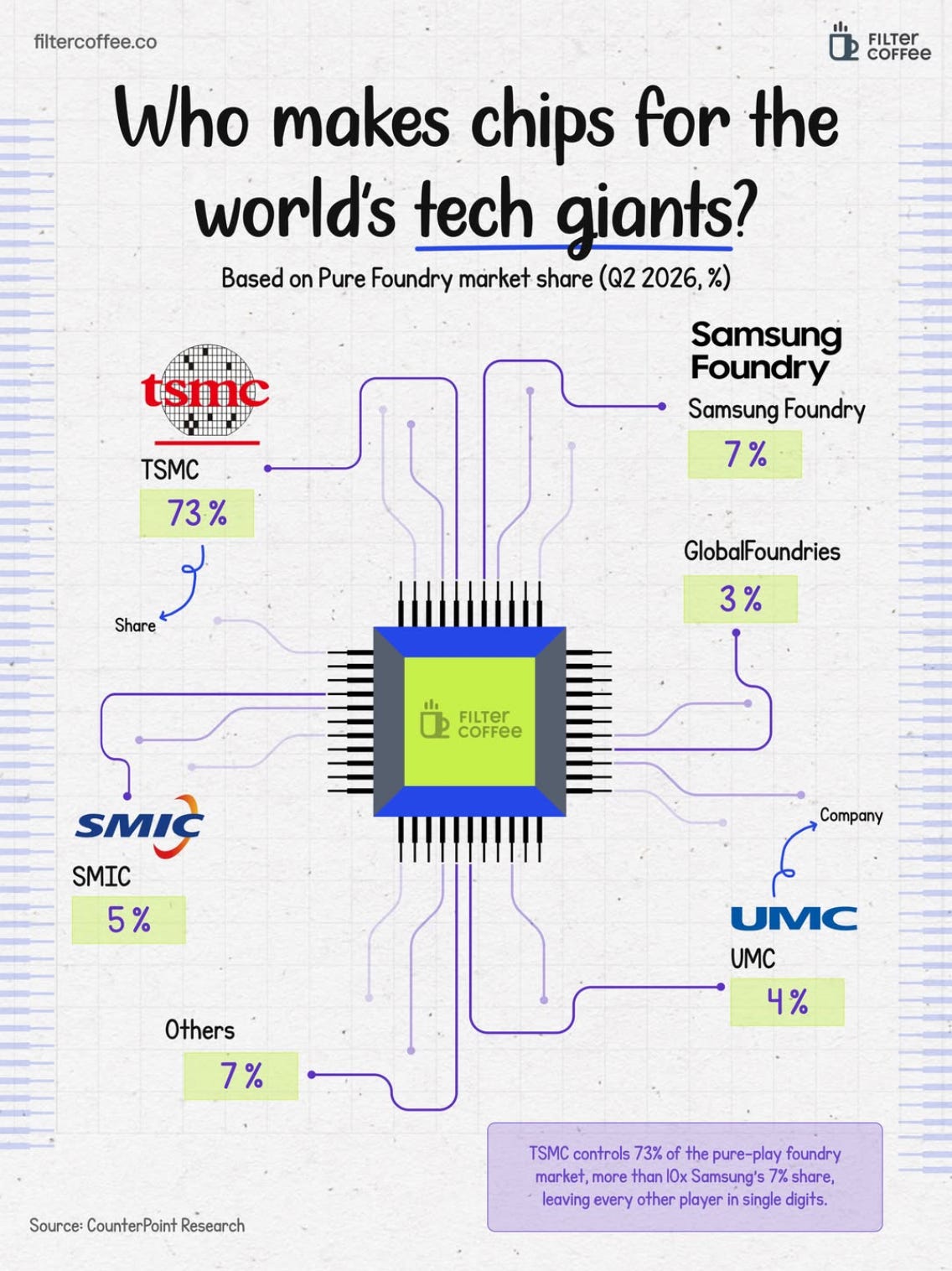
TSMC controls 73% of the pure-play foundry market, more than 10 times Samsung Foundry’s share, with every other player in single digits.
The bigger story? Designing a chip and manufacturing it are two very different businesses. Even tech giants with billions to spend on innovation depend on a handful of manufacturers to turn their designs into reality.
5. Stocks that kept us interested 🚀
What went up ⬆️
🚬 ITC surged 4% after GQG exited the company through block deals.
🪥 Colgate-Palmolive gained nearly 8% after the GST Council proposed allowing businesses to claim tax credits on more expenses, potentially reducing their costs.
💰 Vedanta ended 4% higher after the company announced its first interim dividend for the financial year 2026-27.
📈 Thermax and Info Edge rose up to 4% as Kotak Equities upgraded both stocks to ‘Buy’.
🛡️ Life insurance stocks including HDFC Life Insurance jumped up to 3% as brokerages HSBC and Nomura retained a positive outlook on the sector.
🏥 Hospital stocks, other than Healthcare Global Enterprises traded higher after the government capped trade margins on all non-scheduled anti-cancer drugs at 30%.
What went down ⬇️
👎🏾 BSE shares fell over 1% as investors awaited SEBI’s final paper on the Closing Auction Session (CAS).
What else are we snackin’ 🍿
💰 Funding round: DailyObjects raised ₹332 crore in Series C funding led by Xponentia, Anicut and Axiom Asia.
Pink slips: Amazon reportedly laid off at least 100 employees in India, mainly in retail and customer service, amid global job cuts.
💼 Stake sale: Global investment firm Alpha Wave reportedly plans to sell up to 1.6% of Lenskart in a deal worth ₹1,691 crore.
That’s a wrap! Don’t let the Monday blues get to you.
And if you’d like to place your brand on this newsletter, let us know.
Hit that 💚 if you liked this issue.
Disclaimer: this newsletter is for informational and research purposes only. Nothing here should be considered financial, investment, legal, or professional advice.