
 Newsletter
Its store network is expanding, shoppers are spending more and profits are still rising. But the business is keeping less money from every ₹100 it sells.
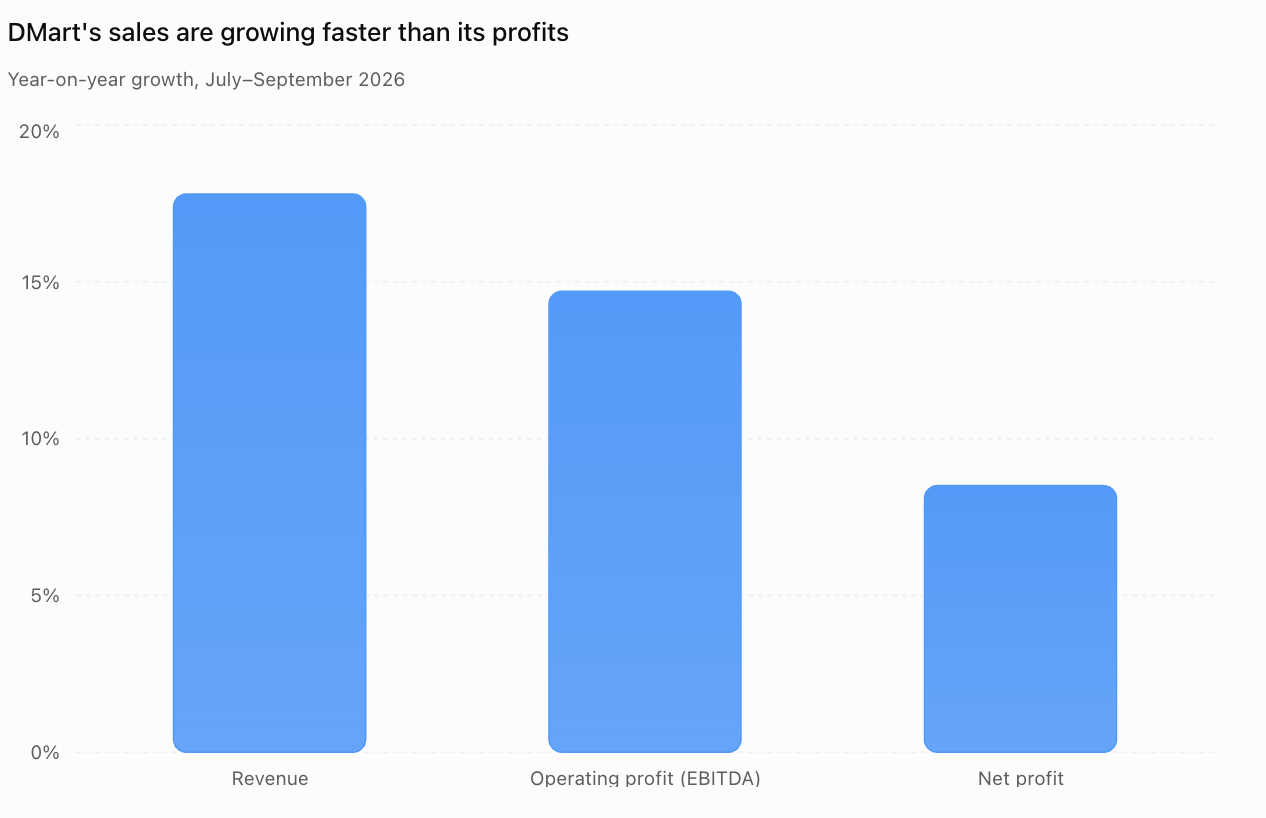
DMart recorded ₹19,644 crore in sales between July and September this year, nearly 18% more than a year ago. Yet when the company announced its results on Saturday, profit had grown by only 8.5%, to ₹743 crore. How can sales rise almost twice as fast as profits?
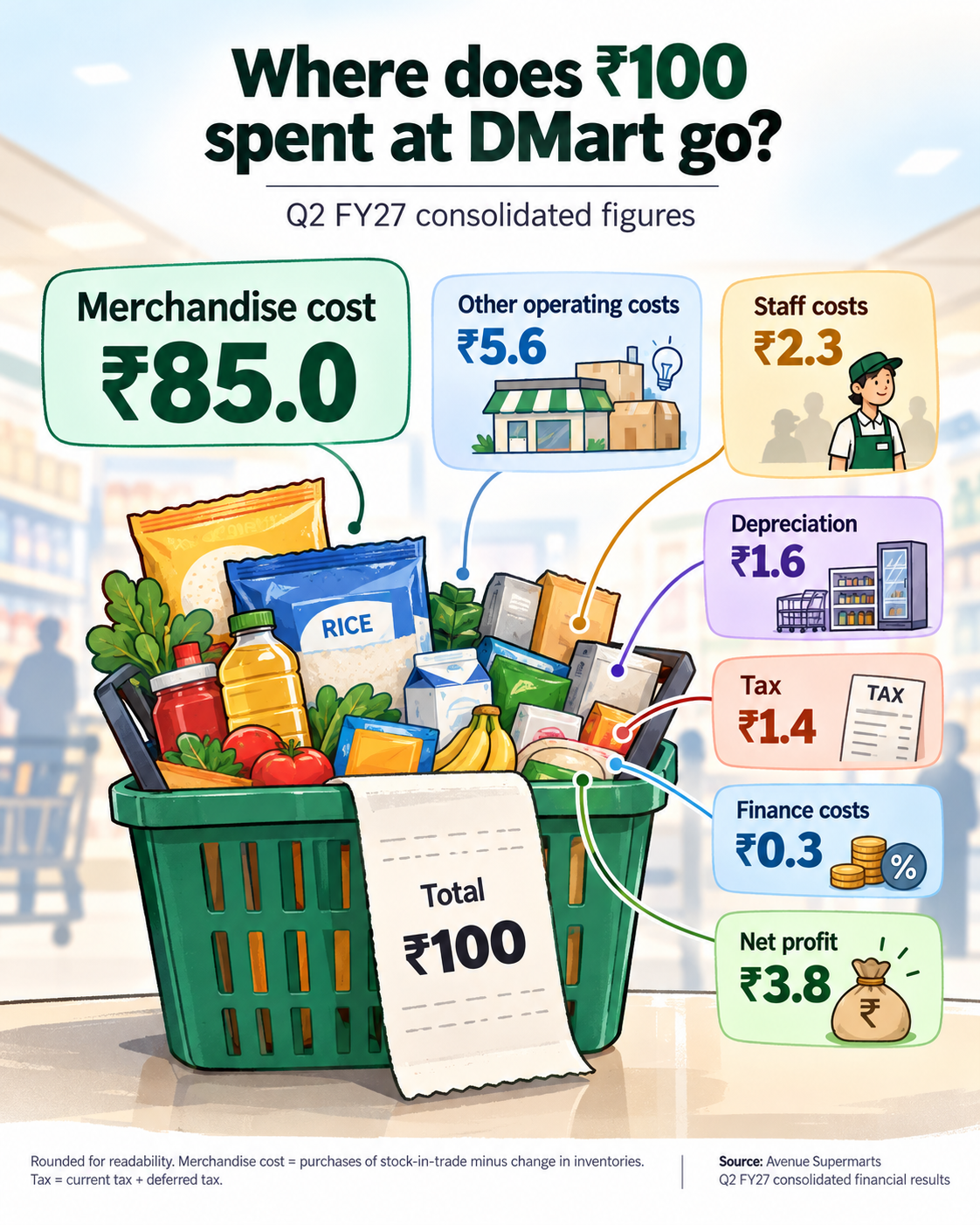
Think about your last supermarket bill. If you spent ₹100 at DMart, how much do you think the company actually kept? ₹20? ₹10? In the latest quarter, the answer was roughly ₹3.80. Last year, it was about ₹4.10. That's the difference between sales, which is the money customers pay, and profit, which is what remains after paying all the bills.
And DMart has plenty of bills to pay. Out of roughly ₹100 in sales, around ₹85 goes towards buying the products it sells. Much of the rest pays employees, transports goods, runs stores and warehouses, and covers other expenses and taxes. This is an approximate way of looking at its company-wide accounts, rather than the actual profit on an individual trolley. Still, it explains why even small cost increases can make a difference.
So how did DMart build a giant supermarket chain on margins this thin?
Radhakishan Damani opened its first store in Powai, Mumbai, in 2002, with a bet on shoppers who were willing to make a trip if it saved them money on their monthly essentials. DMart buys popular products in bulk, keeps stock moving and watches its running costs. It has traditionally preferred owning many of its stores, giving it more control over property costs over time. The money is made by selling a lot, repeatedly, rather than earning a large profit on every packet of biscuits or detergent.
That strategy still seems to be attracting shoppers. DMart stores that have been open for at least two years recorded 9.5% sales growth in the September quarter, compared with 6.8% a year ago. People are spending more at established outlets. So if customers haven't suddenly disappeared, what has changed?
The cost of doing business has risen a little faster than sales. DMart's total expenses increased 18.3% in the quarter, against 17.8% revenue growth. Employee expenses rose nearly 19% to ₹447 crore, with management pointing to higher wages for entry-level workers. The company is also hiring and improving its systems to manage a much bigger store network. Other running expenses increased too. None of these costs is surprising on its own, but thin retail margins leave little room for them to rise together.
There is also a less familiar expense: depreciation.
Imagine DMart opening a new supermarket. It needs shelves, billing counters, equipment and a building to operate in. Rather than counting the full cost of long-lasting assets as an expense on day one, accounting rules spread much of that cost over several years.
That's depreciation, and DMart's depreciation expense grew about 25% this quarter. Its financing costs grew as well, although from a much smaller base. Both reduce the profit left after the business has covered its costs.
But why is DMart taking on so many new expenses?
Because it's growing quickly. It added 85 stores in the financial year ending March 2026, taking its network to 500. Another 18 opened between April and September, including 15 in the latest quarter. That brings the total to 518.
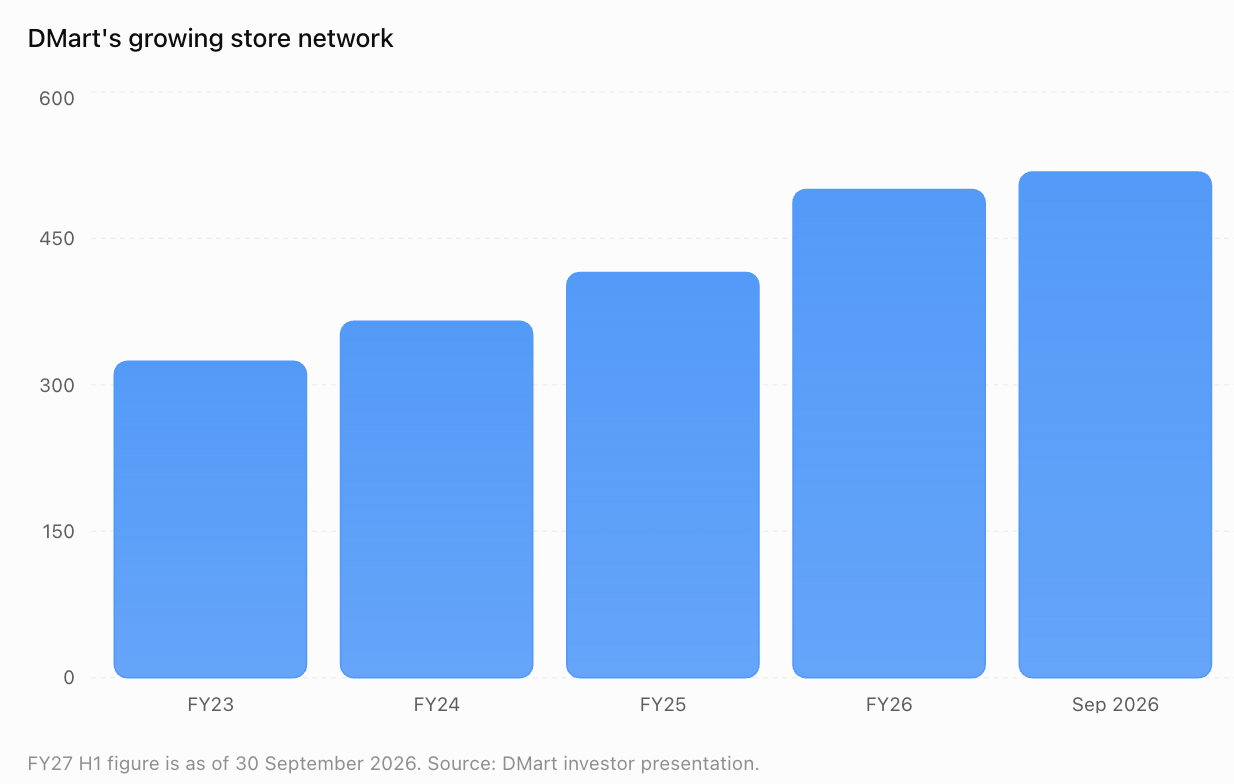
An older store has regular customers who know where to find everything and often fill an entire trolley. A new outlet needs time to build that habit, but the employees, electricity and equipment are needed from the start. Credit-rating agency CRISIL noted that DMart's sales per square foot dipped slightly in FY26, partly because so many stores opened late in the year. Expansion can therefore increase costs well before the new stores reach their full earning potential.
What about Blinkit, Zepto and Instamart? They certainly compete for grocery spending, especially in big cities where ordering milk or snacks takes a few taps. But a ₹200 top-up order is different from a family's monthly grocery run, where saving on the entire basket can justify a DMart trip.
CEO Anshul Asawa acknowledged in July that quick commerce may be capturing some smaller purchases, while saying larger baskets remained resilient. DMart hasn't measured exactly how much spending has shifted, so it would be misleading to blame the latest profit slowdown on delivery apps. Its own online arm, DMart Ready, is also loss-making: it lost ₹307 crore in FY26, adding pressure to the group's overall profitability.
Could DMart simply increase prices to recover those costs? It could, but the promise of low prices is why customers go there. Opening fewer stores would ease some investment pressure, but also slow expansion into new markets. And hiring fewer people when the network is growing risks making the stores harder to run.
DMart isn't in trouble just because one quarter's profits grew more slowly than sales. Its existing stores are doing better, and the company remains profitable. What the results reveal is the balancing act at the heart of discount retail: keep prices low enough to bring people back, while keeping costs low enough to make that worthwhile.
DMart is betting that its newer stores will eventually bring in enough sales to cover today's higher expenses. Whether they do will decide how much of its future growth actually reaches the bottom line.