
 Newsletter
CAS framework revised, Global AI selloff, and Nestlé disappoints investors.
🗓️ Morning, folks and Happyy Fridayyyy!
It’s not summer anymore but if it was, it would definitely be analogue summer, and proof lies with video games.
Video game company Nintendo has confirmed that it has no plans to ditch physical game cartridges anytime soon, even as Sony, the company behind PlayStation, prepares to phase out physical discs for new PlayStation games from 2028.
And there’s a business reason for that. Physical games brought in 38.5% of Nintendo’s software revenue in the quarter ending June 2026, compared to just 15% of PlayStation games sold last year.
Sony’s move has also raised concerns about whether gamers truly own their digital purchases.
So, while digital gaming is taking over, Nintendo knows there’s still plenty of love (and money) in the cartridge.

Moving on, Indian markets ended sharply higher on Thursday, with the Sensex jumping more than 2% and the Nifty crossing 23,000 during the session.
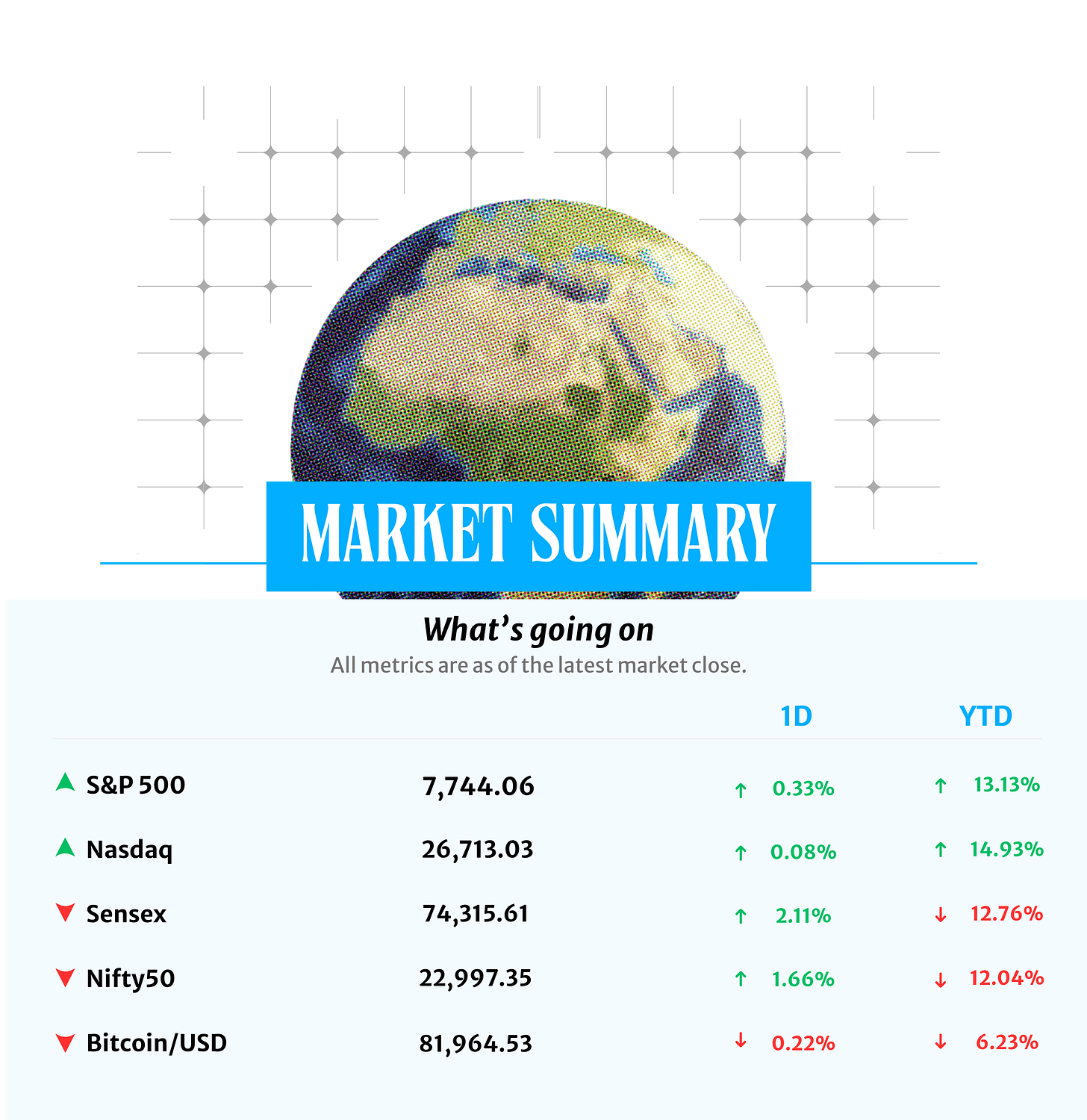
Reliance Industries, ICICI Bank and TCS led the gains, while the Nifty IT index extended its winning streak to three sessions, rising nearly 11% this week.
💡Spotlight: AI stocks feel the global heat 📉
Indian AI-related stocks came under pressure on Thursday, with E2E Networks, ESDS Software and Netweb Technologies falling up to 7%, following a sharp selloff in global chipmakers.

What’s happening: South Korea’s stock market plunged nearly 8%, with chip giants Samsung Electronics and SK Hynix falling over 9% each.
The country’s Kospi index has now dropped around 21% from its September peak, entering a bear market. Trading was even halted for 20 minutes as selling intensified.
Japan wasn’t spared either. The Nikkei fell nearly 5%, with semiconductor companies among the biggest losers.
What’s driving the fall: investors are worried about possible US Federal Reserve interest rate hikes and whether AI companies can continue raising enough money to fund their massive expansion plans.
Let’s hit it! 💪🏻
1 Big Thing: SEBI says, “Okay, we heard you” 🔔
A major breaking update came on Thursday evening, as SEBI finally made revisions to the Closing Auction Session (CAS) framework following requests from market participants.

First, the latest: from December 7, the regular cash market will remain open until 3:30 PM. After that, a separate 10-minute auction will run from 3:30 PM to 3:40 PM to decide the official closing prices of certain stocks.
New system vs old system:
- Regular share trading will continue until 3:30 PM, followed by CAS from 3:30 PM to 3:40 PM. Previously, regular trading ended at 3:15 PM and CAS ran from 3:15 PM to 3:35 PM.
- The market will take only one minute, from 3:30 PM to 3:31 PM to prepare for the auction. Previously, this process took five minutes.
- Investors can place both normal orders and price-specific orders from 3:31 PM to 3:36 PM. From 3:36 PM, only price-specific orders will be accepted.
- The auction will end at any random moment between 3:38 PM and 3:40 PM. This random ending is meant to stop traders from waiting until the final second to influence prices.
- Index futures and options will trade until 3:45 PM on regular days. However, contracts expiring that day will close at 3:30 PM. Stock futures and options will remain open until 3:45 PM even on expiry days.
- Investors can now trade shares at their final closing prices between 3:50 PM and 4 PM through the post-close session.
- From February 8, 2027, most pending price-specific orders will automatically move into CAS. Large “iceberg” orders which reveal only a small part of the full order will also move into the auction as fully visible orders, unless the investor opts out.
The biggest change: on the expiry day of futures and options, their final settlement price will be based on the average traded price of the underlying shares during the last 30 minutes of regular trading - from 3 PM to 3:30 PM.
In simple words, one sudden move during the closing auction will no longer decide how expiring derivatives are settled. SEBI is returning to the method used before CAS was introduced.
2. Nestlé meets estimates, inflation warning spooks street ☹️
Nestlé’s Q2 results were in line with street expectations across all key parameters.
However, the company’s shares tumbled over 7% as management flagged rising inflation, particularly food inflation, and continued pressure from commodity costs.
By the numbers:
- Net profit: up 36.4% at ₹1,027 cr vs ₹753 cr (YoY)
- Revenue: up 20.3% at ₹6,788 cr vs ₹5,644 cr (YoY)
- EBITDA: up 30.6% at ₹1,615 cr vs ₹1,237 cr (YoY)
- EBITDA Margin: at 23.8% vs 21.9% (YoY)
The details: over the past four to five quarters, Nestlé had consistently beaten street expectations by a wide margin. Simply meeting expectations therefore came as a negative surprise for the stock.
Chairman and Managing Director Manish Tiwary said it recorded broad-based growth across product groups, supported by robust double-digit volume growth.
Total sales rose 20.5% to ₹6,782.2 crore, while domestic sales increased 20.4%.
The confectionery business delivered another quarter of double-digit, volume-led growth, supported by market share gains for KitKat and sustained growth across Munch and Milkybar.
In focus: in its commodity outlook, the company said coffee and wheat prices were expected to remain range-bound, while sugar and edible oil prices had stabilised at elevated levels.
3. What is Jio’s ₹30,000 crore bet? 💸
In 2016, Jio made mobile internet ridiculously cheap. Ten years later, it’s asking investors to pay a premium for the business it built.
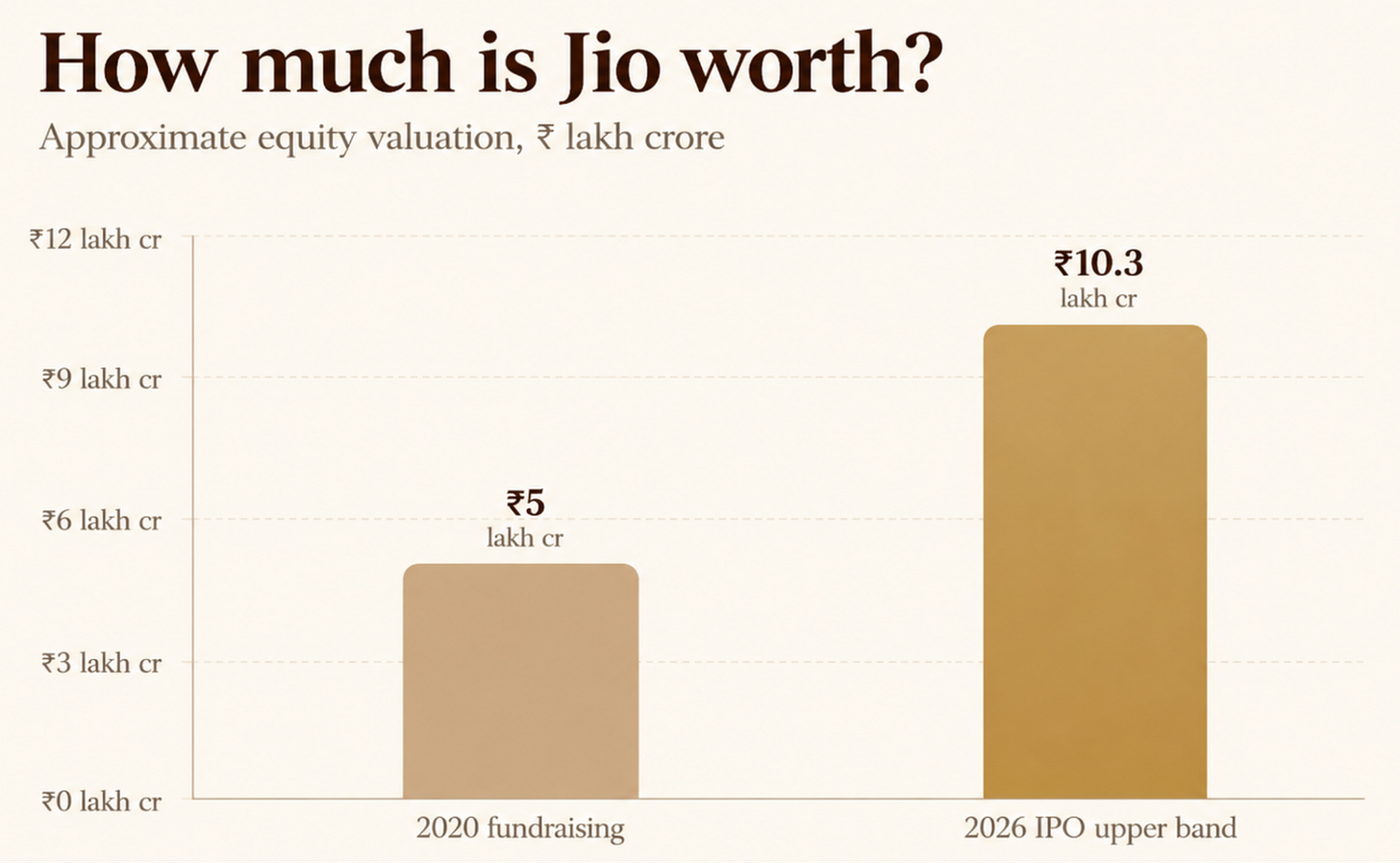
Jio’s ₹30,213 crore IPO opens on 21 October, valuing the company at roughly ₹10.3 lakh crore. That’s almost double its 2020 valuation, when Meta and Google invested billions. Their investments have since grown about 2.4 times in paper value, and neither is selling shares through the IPO.
Jio earned ₹30,049 crore last year. Now, it plans to use up to ₹27,500 crore from the IPO to repay debt.
So why is an already profitable company raising so much money, and what are new investors actually paying for?
4. Why is CEAT losing its grip on profits? ❌

CEAT’s revenue rose 26% to ₹4,762 crore, but its profit fell nearly 40%.
Rising rubber prices, expensive crude-linked raw materials and delayed tyre price hikes are squeezing its margins.
And CEAT isn’t alone. Other Indian tyre makers are facing similar cost pressures despite steady demand.
So, why is selling tyres becoming less profitable?
5. Stocks that kept us interested 🚀
What went up ⬆️
💸 Tata Communications rose 6% as Q2 net profit jumped 86.3% to ₹341 crore on revenue and operating gains.
😮💨 HDFC AMC gained over 5% after Q2FY27 results beat estimates, with revenue rising 6% sequentially to ₹1,170 crore.
🙇🏼♀️ Reliance Industries jumped over 3%, its biggest daily gain in over two months, as Jio’s IPO pricing fuelled value unlocking hopes.
📈 Tech Mahindra zoomed nearly 5% as Q2 revenue beat estimates and the company maintained its 15% FY27 operating margin target.
🤔 Wipro forecast Q3 sequential revenue growth between -1.5% and 0.5%. Q2 net profit fell to ₹3,199.7 crore from ₹3,352 crore. Shares rose nearly 2% ahead of the results.
What went down ⬇️
🫡 Yes Bank tumbled 14% after the Supreme Court ruled against its decision to cancel ₹8,400 crore owed to bondholders.
👀 IDBI Bank fell over 7% after the government approved Fairfax’s stake purchase at ₹81 per share, below market price.
What else are we snackin’ 🍿
💪🏻 Defence deals: Defence Ministry signed deals totalling ₹4,106 crore for Bharat Dynamics’ submarine-hunting torpedoes and a communications satellite through NewSpace India Ltd.
🎬 Netflix layoffs: Netflix is reportedly cutting 6% of its global workforce, affecting around 1,000 employees, in its biggest round of layoffs since 2022.
💎 Jewellery exports: India’s gems and jewellery exports rose 9.43% to $2.95 billion in September, taking total exports in the first half of FY27 to $14.30 billion.
✅Trade boost: India’s September merchandise exports rose 23.04% to $44.40 billion, while the trade deficit narrowed to $30.21 billion despite higher imports.
And that’s a wrap. Pour yourself an extra one this weekend. 🥂

We’ll be back like clockwork on Monday!
Hit that 💚 if you liked this issue.
Disclaimer: this newsletter is for informational and research purposes only. Nothing here should be considered financial, investment, legal, or professional advice