

 Newsletter
In September 2016, Jio arrived with free calls and data offers that made Indians rethink how much a mobile connection should cost. Ten years later, the company that helped make the internet affordable is asking investors to put a price on the business it built.
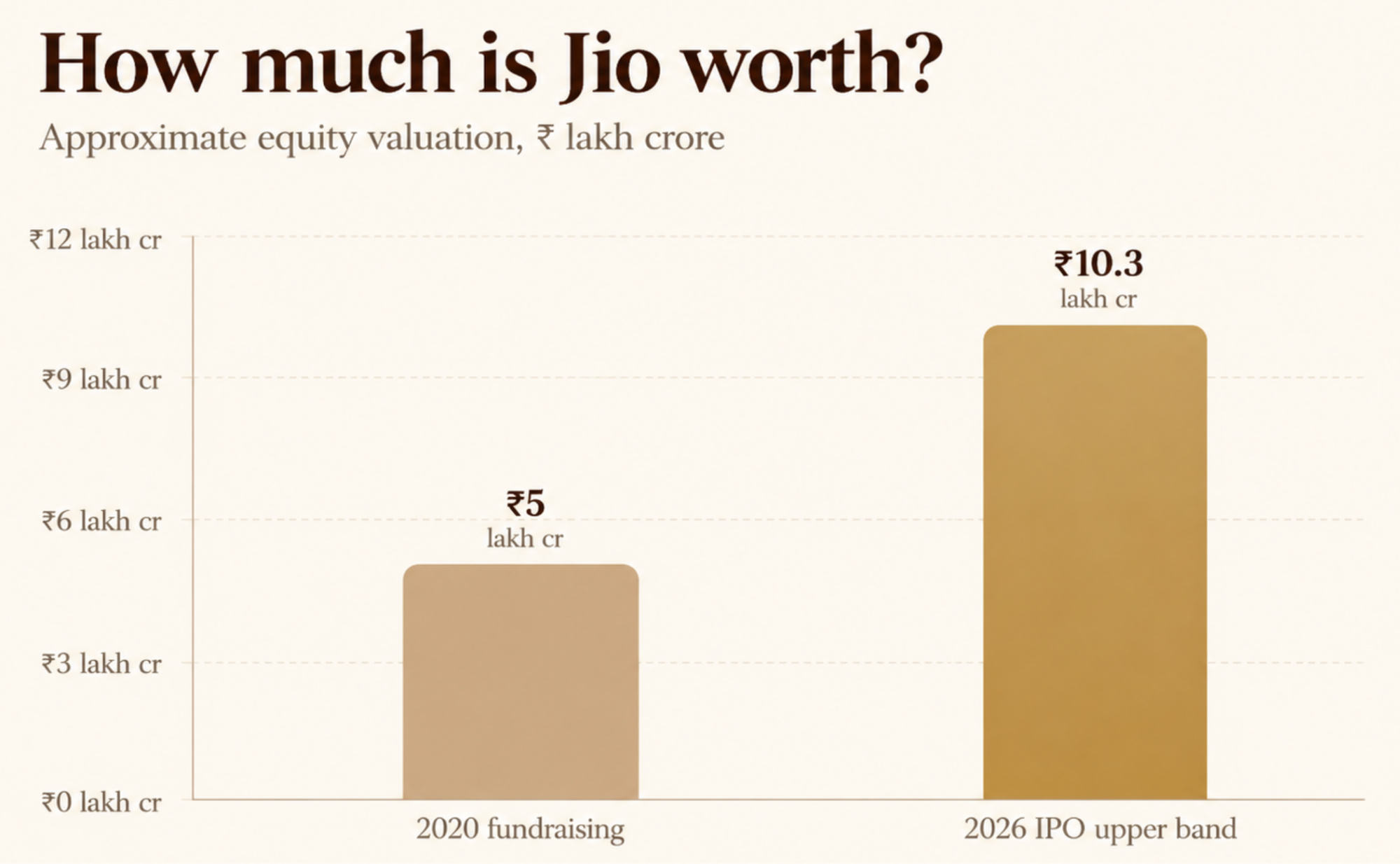
Jio Platforms, Reliance Industries' telecom and digital-services arm, will open its IPO on 21 October. At ₹1,065 to ₹1,119 per share, it plans to raise up to ₹30,213 crore, overtaking Hyundai Motor India's 2024 issue as the country's largest. At the upper end, investors would value Jio at roughly ₹10.3 lakh crore. The shares are expected to list on 28 October.
Mukesh Ambani first put a Jio listing on the calendar in August 2019, telling shareholders that Jio and Reliance Retail would move towards listing within five years. Instead, Jio first turned to some of the world's wealthiest investors.
During the pandemic in 2020, it raised ₹1.52 lakh crore from 13 investors, including Meta, Google, KKR and Saudi Arabia's Public Investment Fund. Those deals valued Jio at roughly ₹5 lakh crore, helped Reliance reduce debt and gave global investors exposure to India's internet market before a stock exchange listing.
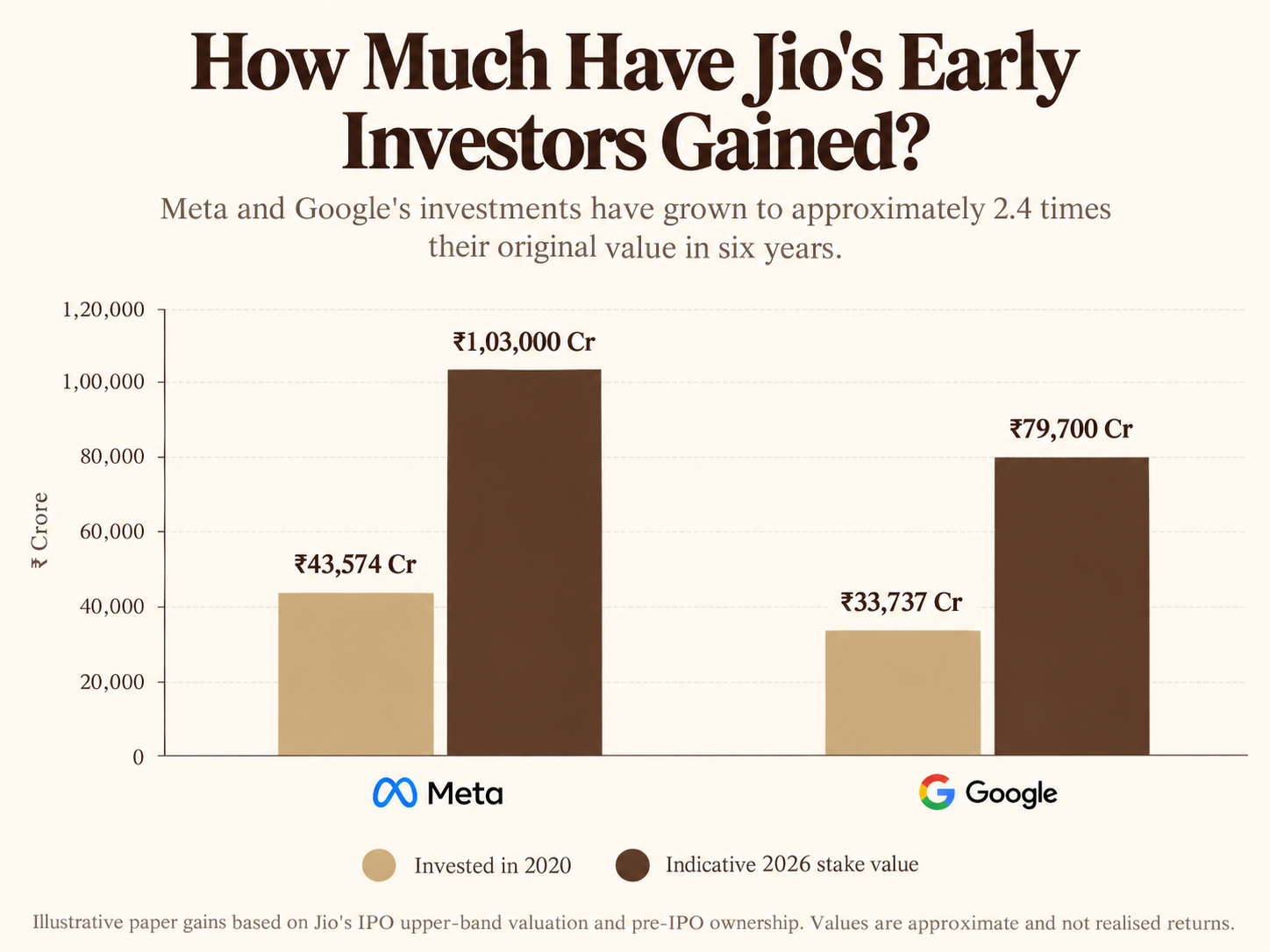
Six years later, none of them are selling in the IPO. Reliance still owns 66.43% of Jio Platforms, Meta holds 9.98% and Google 7.73%. The entire offer consists of 27 crore newly issued shares, so the money goes to Jio rather than into the pockets of existing shareholders. Their percentage ownership will be diluted slightly, but the listing gives them a publicly traded valuation and the possibility of selling later, subject to applicable restrictions. At the upper price band, Meta's existing shares alone would be worth nearly ₹1 lakh crore, against its original ₹43,574 crore investment.
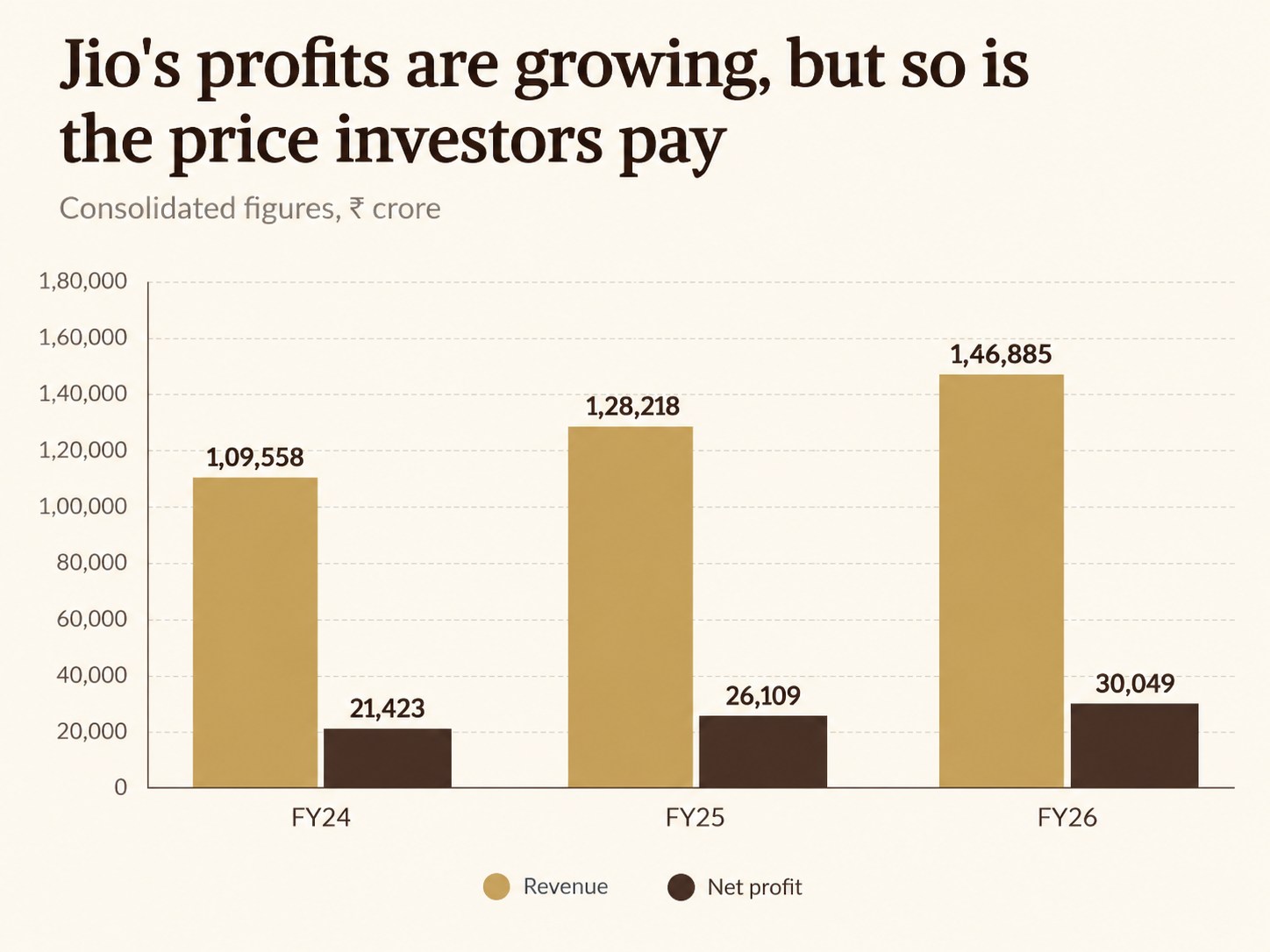
Jio has certainly grown into the expectations surrounding it. By June 2026, it served more than 53 crore subscribers. Its FY26 revenue reached ₹1,46,885 crore, up from ₹1,09,558 crore in FY24, while annual profit rose from ₹21,423 crore to ₹30,049 crore. Its cash capital expenditure also fell from ₹53,510 crore to ₹34,184 crore over those two years, as the heaviest phase of its 5G rollout eased.
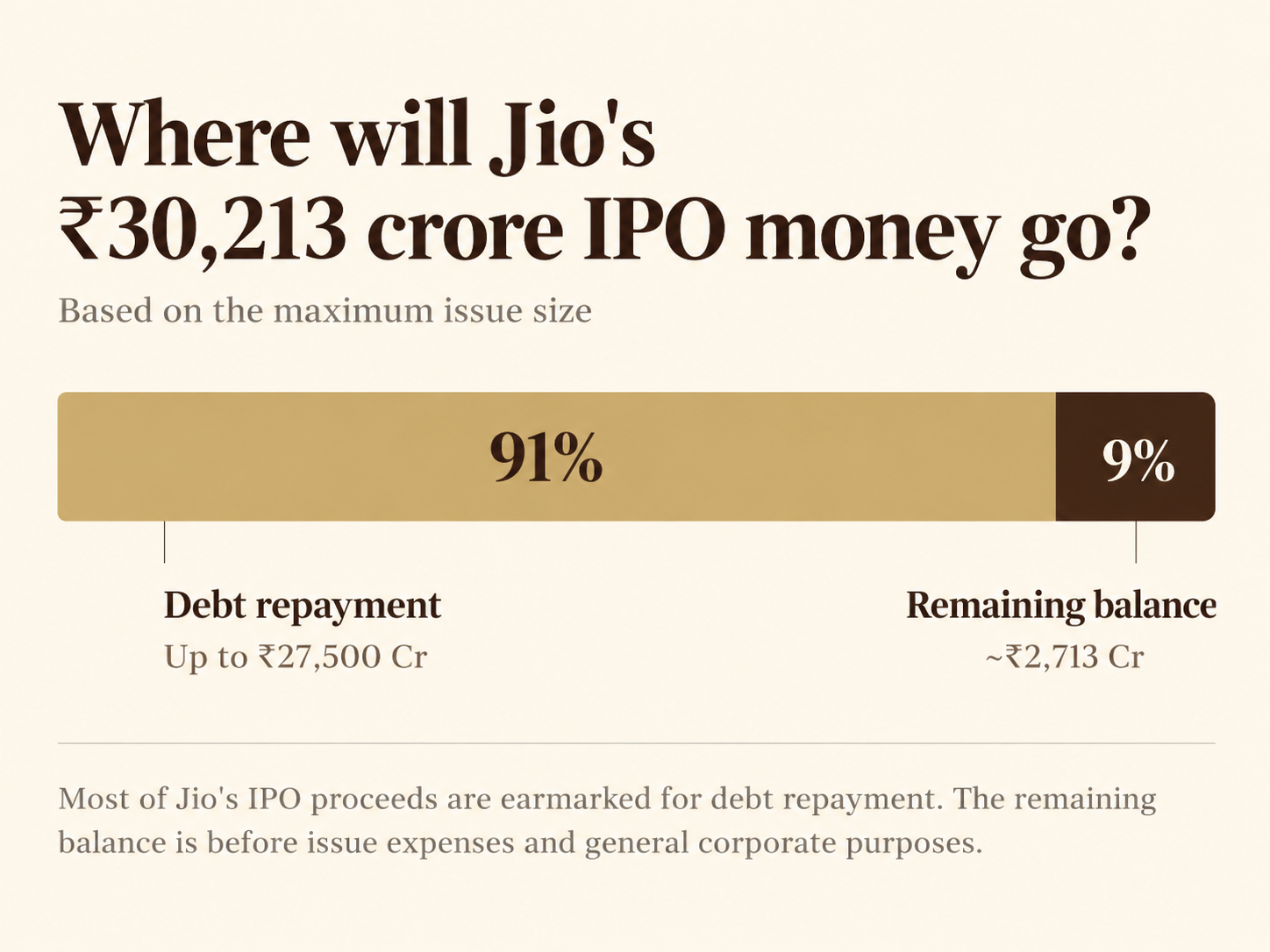
Despite those profits, Jio is raising almost as much money as it earned last year, largely to repay borrowings. It has earmarked up to ₹27,500 crore of the IPO's net proceeds to prepay loans taken by Reliance Jio Infocomm, its operating subsidiary.
Lower debt can reduce interest costs and free up room for new investments. But its obligations extend beyond ordinary bank loans. CRISIL estimates Jio Platforms' adjusted net debt at about ₹1.65 lakh crore in March 2026, including spectrum payments owed to the government. The IPO will reduce some borrowings, not wipe those commitments away.
The next stage of growth also looks different from the first. Jio spent years winning customers through affordable mobile data, then invested heavily in 5G and home broadband. Its average monthly revenue per customer reached ₹215.6 in the June 2026 quarter, compared with roughly ₹264 for Airtel.
Convincing subscribers to move to costlier plans, expanding home broadband and selling more services to businesses could lift earnings. Higher tariffs, however, would have a direct consequence for people who joined Jio for its low prices.
Jio also wants investors to see a technology platform rather than simply a telecom network. It points to cloud, AI, enterprise products and technology it could eventually sell overseas. But during recent international roadshows, Bloomberg reported that fund managers challenged this pitch. They asked how Jio would make money from digital services currently offered without separate charges, and why it deserved a valuation premium over Airtel's India operations.
The pricing gives those doubts some weight. At ₹10.3 lakh crore, Jio would trade at around 34 times its FY26 profit. Nomura estimates its FY28 enterprise-value-to-operating-profit multiple at 10.9 times, versus 9.2 times for Airtel India. Jio has greater subscriber scale, but investors are paying in advance for future growth. A strong company can still disappoint shareholders when the entry price is ambitious.
Even the listing rules form part of the story. In March 2026, India relaxed minimum public-offer requirements for very large companies. Jio's new shares amount to only about 2.93% of its enlarged equity, although it meets the revised framework. The rules apply to other large issuers too; there is no evidence they were written specifically for Jio. Investors must also consider Reliance's continuing control: its retail arm is Jio's sole distributor for prepaid services, which represented around 77% of FY26 revenue.
For Reliance, a listed Jio establishes a visible market price for one of its biggest businesses. For Airtel, it creates a new valuation benchmark. And for individual investors, the test is whether Jio's profits can grow fast enough to justify what they pay today.
Anchor investors bid on 19 October, before public subscription opens on 21 October. Their commitments will offer the first concrete indication of institutional appetite. Jio has already proved it can build an enormous business. Its IPO will test what the market is willing to pay for its next decade.
Sources
- SEBI | Jio Platforms Red Herring Prospectus, October 2026 | Economic Times | RIL Plans to List Jio and Reliance Retail in Five Years | Reliance Industries | Facebook's ₹43,574 Crore Investment in Jio | Financial Express | Jio Platforms IPO Financials and Risks | CRISIL Ratings | Jio Platforms Rating Rationale, August 2026 | Bloomberg via NDTV Profit | Moneycontrol | Jio Platforms IPO vs Bharti Airtel | JSA | Securities Law Updates, March 2026