
 Newsletter

What if getting promoted is no longer the clearest sign that your career is moving forward?
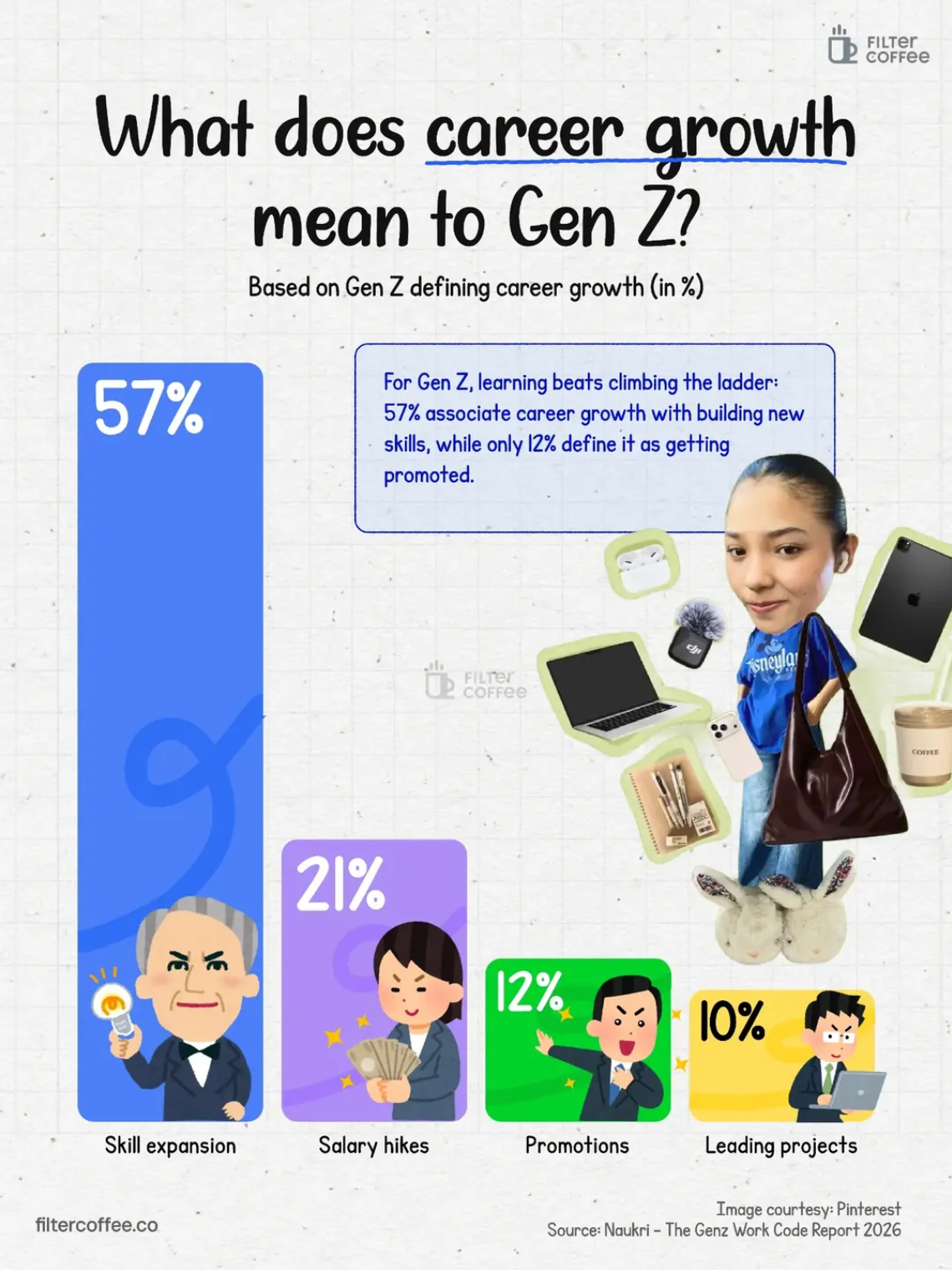
For a generation entering India’s workforce, career growth seems to mean something quite different. Learning a new skill, getting better at the job and becoming more capable can matter more than moving up one rung on the corporate ladder.
There is some data behind this. A 2026 Naukri survey of more than 23,000 Gen Z professionals found that 57% see learning new skills on the job as career growth. Only 12% said the same about getting promoted. Salary hikes were mentioned by 21%.
That tells us something about what young employees are looking for when they join a company. A better designation is obviously welcome, but so is leaving a job with skills you did not have when you joined.
And the workplace is giving them plenty to learn.
AI is probably the biggest example. Deloitte’s 2026 India survey found that 93% of Gen Z respondents use AI in their day-to-day work. More than half, or 54%, also said they want additional AI training.
That puts a different kind of pressure on young workers. The question is no longer just whether you can do your current job. It is whether you are keeping up with how that job is changing.
Money has not suddenly become unimportant either. Naukri found that 50% of Gen Z consider work-life balance the most important factor in a job offer apart from salary.
They also still want to move up. Deloitte found that 96% of Indian Gen Z respondents are interested in senior leadership roles. But only 9% said becoming a senior leader was their main career goal.
That is probably the most interesting part. Gen Z is not turning its back on ambition. It just seems to have a longer list of things it wants from a career.
Learning is high on that list. In Deloitte’s 2025 India survey, 94% of Gen Z respondents said on-the-job learning and practical experience help with career growth, while 91% valued mentorship and professional networks.
For companies, this matters because keeping young employees around may require more than promising the next promotion. Give someone interesting work, let them learn, introduce them to people who know more than they do and give them room to take on something bigger.
The promotion can come later.
For now, a lot of young professionals seem to be asking a simpler question: “Am I actually learning something here?”