
 Newsletter

Imagine you're a global CEO with billions of dollars to invest. You have one question to answer. Where do you build next?
Ten years ago, the answer might have been China without a second thought.
Today, it's not that simple.
Companies are looking for the next manufacturing hub, the next export base and the next big consumer market. And increasingly, one country keeps showing up on that shortlist. India.
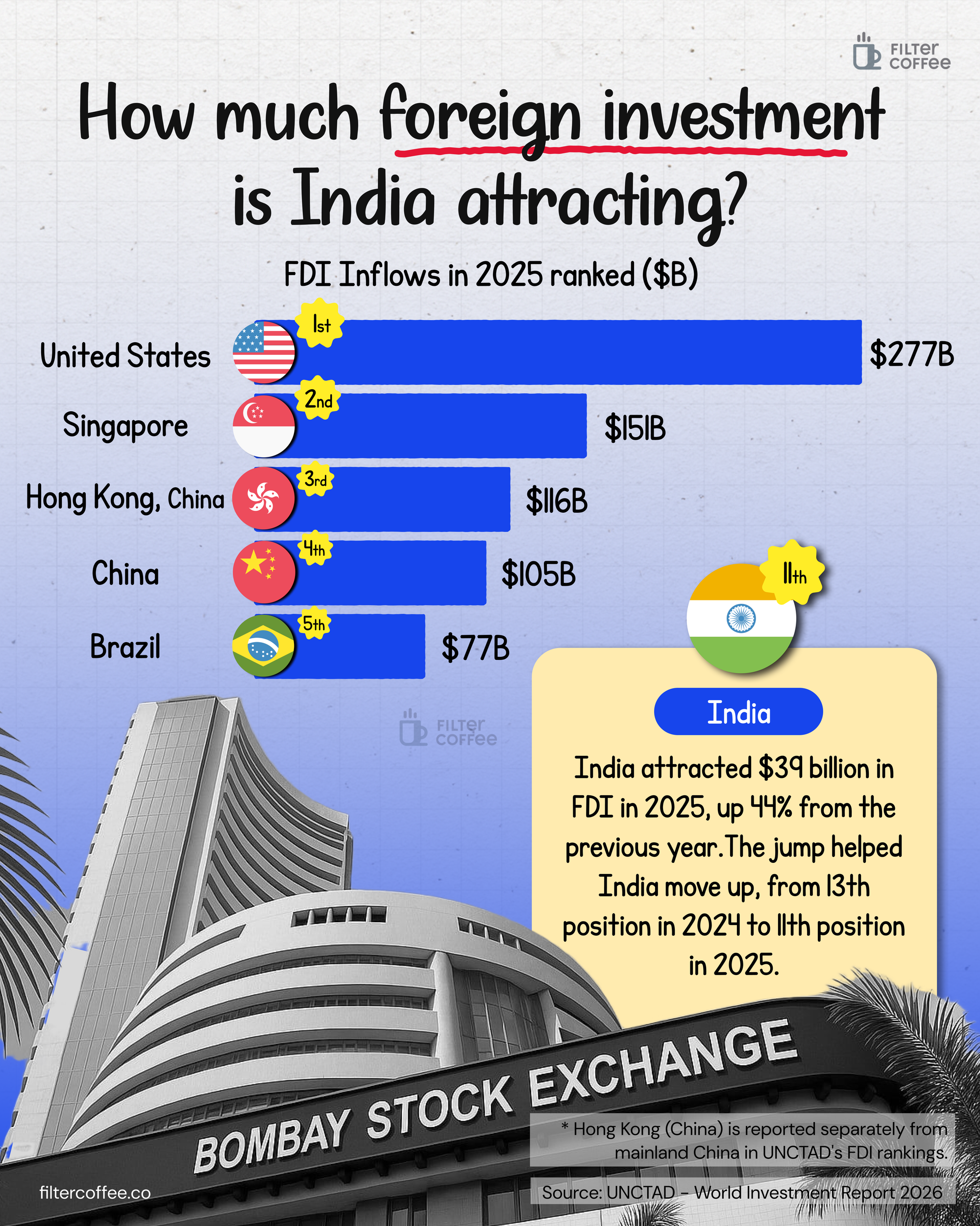
That's exactly what the latest UNCTAD World Investment Report tells us. India attracted $39 billion in foreign direct investment (FDI) in 2025, a 44% jump from the previous year, making it the 11th-largest FDI destination in the world.
This isn't just more money coming into India. It's different money. A decade ago, global investors were chasing India's startup boom. Companies like Flipkart, Paytm and Zomato dominated conversations because India's biggest opportunity was its fast-growing internet economy.
Today, that story has changed.
The biggest investments are increasingly flowing into manufacturing, electronics, renewable energy and AI infrastructure.
Take Alphabet's proposed $14.5 billion investment in Andhra Pradesh. It's one of the largest greenfield investment announcements globally, and it isn't about launching another app or selling more advertisements.
It's about building AI and data centre infrastructure in India. That says a lot about how global companies now see the country. And that's a much bigger shift than it appears.
When a company builds a factory or a large infrastructure project, it doesn't just create one business. It creates jobs for thousands of people, generates demand for suppliers, benefits logistics companies, supports small manufacturers and helps entire industrial clusters grow. One investment often sets off a chain reaction across the economy.
Of course, the timing makes this even more significant.
Global investment has become harder to attract. Trade tensions, geopolitical conflicts and slowing economic growth have made companies far more selective about where they deploy capital. Yet India still managed to climb the global rankings while many countries struggled to attract fresh investment.
That doesn't mean the job is done. Converting investment announcements into operational factories, stronger supply chains and long-term employment remains the real challenge. But the direction is becoming increasingly clear.
The world's biggest companies are no longer looking at India as just a market of 1.4 billion consumers. They're looking at it as a place to build. And that may be the biggest takeaway from this year's FDI numbers.
The ranking is impressive, but what's even more important is what the money is betting on. Because if global companies are choosing to build their future in India, it could reshape the country's economy for years to come.