
 Newsletter

There is a good chance that some of the companies you use every week did not even exist when you started college. That is probably the easiest way to see how much India’s startup ecosystem has changed over the last decade.
Since 2014, Indian startups have raised more than $176 billion across over 12,600 deals. In FY26 alone, the government recognised more than 55,200 new startups, taking the total number of recognised startups past 2.23 lakh. These startups have created more than 23 lakh direct jobs so far.
The number is big, but what has happened around it is probably more interesting. A decade ago, the Indian startup conversation was mostly about a few companies trying to prove that internet businesses could actually work here. Today, startups are spread across almost everything. There are companies working on AI, electric vehicles, spacetech, financial services, manufacturing, healthcare and climate technology. For people entering the workforce today, that has also changed the kind of jobs that are available. Some roles that are fairly normal today would have been difficult to imagine ten years ago.
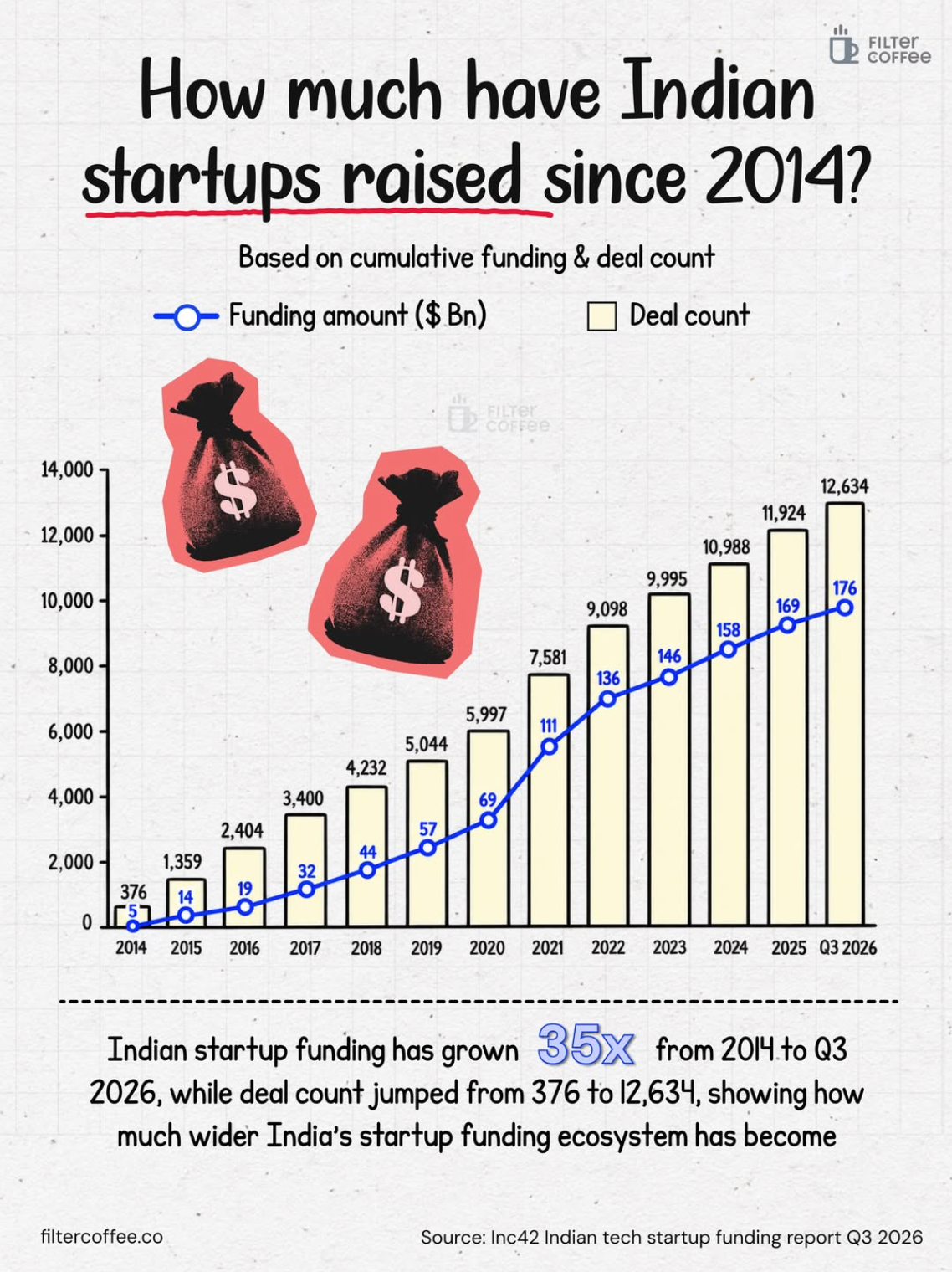
The money going into these companies is changing too. The latest funding numbers are a good example. Indian startups raised $2.2 billion in the third quarter of 2026, slightly more than the same quarter last year. But the number of deals fell from 240 to 210. So there was more money going in, but fewer companies getting it.
This is quite different from the funding boom a few years ago, when fast growth was often enough to get investors interested in the next round. A company could spend heavily on getting customers, expand quickly and worry about profits somewhere down the line. Now the questions are a little harder. How much does that growth actually cost? Does the customer make money for the company? And if the next funding round takes longer than expected, can the business keep going?
That is also showing up in where investors are putting their money. Growth-stage funding jumped 46% in Q3 to $1.1 billion, while late-stage funding was just under $1 billion. AI, deeptech and cleantech also attracted much more attention. AI startups alone raised $438 million in the quarter, while cleantech startups raised $433 million. Meanwhile, funding for ecommerce fell 31% and fintech funding fell 11%.
None of this means investors have suddenly lost interest in startups. They clearly haven't. It just looks like the bar has moved a little. Investors are putting more weight on the actual business, rather than just the size of the market or how quickly the company is growing.
Founders have had to adjust to that as well. Raising another round is still important, but it cannot be the only plan. Building a company that can eventually make money, or at least has a clear path to doing so, matters much more when capital is not as easy to come by.
There is also something else happening that gets less attention. Startups are no longer limited to the usual handful of cities. More than half of India’s startups now come from Tier-II and Tier-III cities, according to the government. That means the startup boom is slowly reaching places where a decade ago, starting a company might not have been the obvious career choice.
For someone in their 20s, that part is worth paying attention to. You do not have to be a founder or a venture capitalist for this to matter. The companies being built today will decide what products we use, what industries grow and, to some extent, what jobs are available a few years from now.
So when you look at the $176 billion, it is worth looking beyond the funding number itself. That money has gone into companies, products, jobs and industries that, in many cases, simply weren't there ten years ago.
And if the next ten years are anything like the last, some of the companies we will be working for, using every day and talking about in 2036 probably haven't even been started yet.