

 Newsletter

The final return doesn't tell you how it was made. A trader can make a lot of money without getting most trades right. An investor can make a fortune from a stock without getting every decision right along the way.
Markets are rarely that neat. Most people who trade do not make money, most trades are not particularly profitable and most stocks never become great investments. Even when you own a stock that turns out to be exceptional, its returns are rarely spread evenly across all the years or days you hold it.
This is where the Pareto effect becomes interesting. The 80/20 rule is not a law of financial markets, and the numbers do not neatly come out to 80 and 20. What does keep showing up is a similar pattern: a relatively small part of the activity produces a very large part of the result.
SEBI's latest study found that 91% of individual traders in equity derivatives lost money in FY25 after transaction costs. The total loss was ₹1.06 lakh crore. So the first concentration is already visible. A small minority of participants made money while the vast majority did not. Academic research suggests that even this small profitable group is not as simple as it looks.
Barber, Lee, Liu and Odean studied day traders on the Taiwan Stock Exchange from 1992 to 2006. They found that fewer than 1% of day traders could predictably and reliably earn positive abnormal returns after fees. In other words, even among people who trade regularly, genuine and repeatable skill appears to be extremely rare.

Then look at where stock market wealth actually comes from. Hendrik Bessembinder studied the lifetime returns of every US common stock listed between 1926 and 2016. He found that the best-performing 4% of companies accounted for the entire net wealth creation of the US stock market over that period. The rest, as a group, did no better than one-month Treasury bills.
Bessembinder's latest update, covering the market through 2025, makes the concentration even harder to ignore. Out of almost 30,000 stocks, just 46 companies were responsible for half of the $91 trillion in net wealth created over the period. Nearly 60% of stocks actually produced a lifetime return below that of one-month Treasury bills.
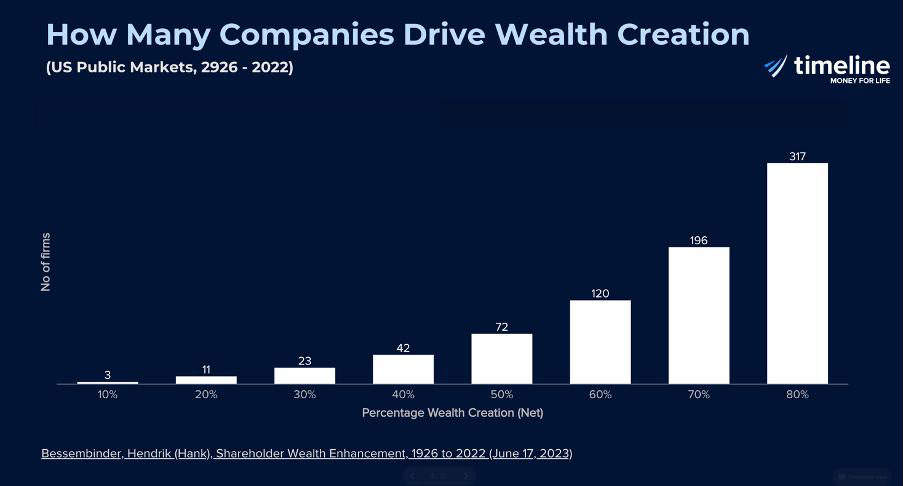
You could give an investor the entire stock market to choose from and most of the eventual wealth would still come from a surprisingly small number of companies. But even finding one of those companies does not guarantee that you capture its return.
Take a stock that eventually compounds at 20% a year. It will not give you 20% every year in a straight line. It might spend two years doing very little, fall 30% during a correction and then rise 70% over a relatively short period. If you sell during the boring period, you never get to participate in the part that makes the investment exceptional.
The same thing happens with the broader market. Some trading days matter far more than others. Research looking at long periods of market data has repeatedly found that missing a relatively small number of the strongest days can take a large chunk out of long-term returns. The market's final result is not built evenly across every day you are invested.
This is also where compounding matters. A large gain is not just a large gain if you leave it invested. It becomes part of the capital that earns the next return. An exceptional period can therefore influence everything that comes after it, which is why missing a few of those periods can matter far more than missing a few ordinary ones.
The same pattern shows up in individual portfolios. You might own ten stocks where most of them do very little, one falls sharply and one or two end up accounting for most of the gains. Looking back, it is easy to think the winning stock was obvious. Before the fact, it rarely is.
That is the uncomfortable part of the whole idea. The few things that matter most are usually obvious only after they have happened. You do not know in advance which trade will become the big winner, which stock will turn into a multibagger or which few market days will have an outsized effect on your returns.
So the answer is not to sit around waiting for a miracle trade. It is almost the opposite. Since we cannot know beforehand which opportunities will matter most, the job is to avoid destroying our ability to participate when they arrive.
That means controlling losses, avoiding unnecessary overtrading and giving genuinely good investments enough time to work. A trader can have a year where most trades are mediocre but a handful make the year.
An investor can own ten stocks where one or two account for most of the portfolio's gains. The important thing is not that everything works. It is that the few things that really matter are still there when they do.
Markets offer thousands of opportunities over a lifetime. Most of them will be ordinary. A very small number will be exceptional, and those few can end up responsible for a disproportionate amount of the final result.
The hard part is that you only find out which ones mattered after the fact. Until then, you have to stay in the game long enough to find them.